Designing a multi-point dust collection system is a precise engineering challenge. The most common failure point isn’t the collector itself, but the miscalculation of its required performance within a complex duct network. Professionals often fixate on a collector’s maximum CFM rating, overlooking the critical interplay between airflow, velocity, and static pressure that dictates real-world operation.
Accurate sizing is now a non-negotiable requirement. Beyond operational efficiency, it directly impacts regulatory compliance for air quality and combustible dust safety, worker health, and long-term energy costs. A system sized by guesswork becomes a permanent liability.
Core Principles: Airflow, Velocity, and Static Pressure
The Fundamental Relationship
Effective dust collection balances three forces: the volume of air moved (CFM), the speed needed to capture and convey particles (Velocity, FPM), and the system’s total resistance (Static Pressure, SP). These are not independent variables. The fan’s performance curve defines the exact CFM it can deliver at a given SP; your ductwork design determines that operating point. Every component adds friction, consuming the fan’s capacity.
The Cost of Poor Duct Design
A common oversight is treating duct design as secondary to collector selection. In reality, a poor layout with excessive elbows, undersized mains, or long flex hose runs can consume the available SP budget before air reaches the tool. This guarantees underperformance, regardless of the collector’s theoretical capacity. The design process must therefore be holistic, mapping the entire network’s resistance to select a fan that can overcome it while delivering the required CFM.
From Specification to Performance
This relationship underscores why “free air” CFM ratings are irrelevant for system design. You must work with “actual CFM” data—the airflow a fan can provide against the specific static pressure of your system. Industry standards like ANSI/AIHA Z9.2-2022 provide the governing principles for this calculation, moving system design from an art to a verifiable engineering practice.
Step 1: Calculate CFM for Each Pickup Hood
Defining Capture Velocity
The process begins at each dust source. The required capture velocity varies significantly by the nature of the contaminant and the process energy. Gentle dust from a mixing operation may require only 100-200 FPM at the hood face, while high-energy grinding or toxic particulate demands 500+ FPM to ensure complete capture. These values are not arbitrary; they are established by authoritative sources like the ACGIH Industrial Ventilation Manual.
Applying the Formula
The CFM for each hood is calculated using the formula: CFM = Capture Velocity (FPM) x Hood Open Area (sq. ft.). A 1.5 sq. ft. hood for wood sanding, requiring 400 FPM, needs a baseline of 600 CFM. An incorrect assumption here—using 200 FPM instead of 400 FPM—would halve the required airflow, dooming the system to failure at that point. I’ve seen this single error render an entire installation ineffective.
Reference for Common Applications
The following table provides a guideline for capture velocities based on application type, which forms the critical first input for your CFM calculations.
| Application / Dust Type | Recommended Capture Velocity (FPM) | Example Hood Area (sq. ft.) |
|---|---|---|
| Gentle dust / vapors | 100 – 200 FPM | 2.0 |
| Grinding, sanding | 200 – 500 FPM | 1.5 |
| Toxic / high-energy | 500+ FPM | 1.0 |
| General woodworking | 400 – 500 FPM | 2.5 |
Source: ACGIH Industrial Ventilation: A Manual of Recommended Practice. This manual provides the foundational methodologies and recommended capture velocities for designing local exhaust ventilation (LEV) hoods, which are critical for calculating the baseline CFM for each dust source in a system.
Step 2: Sum Airflow for Your Worst-Case Scenario
The Myth of Simultaneous Use
In a multi-point system, simply adding the CFM of all connected tools leads to a massively oversized and inefficient collector. The key is to define realistic operational groups. Which machines or stations could plausibly operate at the same time based on workflow? The total system CFM must satisfy the group with the highest cumulative demand.
Enforcing Airflow Discipline
This calculation assumes operational discipline: blast gates on inactive branches must be closed. If the design assumes two tools running but an operator opens three, the system will be starved for airflow at all points. This makes user procedure or, increasingly, automated tool-activated controls integral to the system’s success. The design enforces a physical constraint on operation.
Building in a Safety Margin
Once you’ve identified your worst-case operational group and summed the CFM, industry experts recommend adding a 10-15% safety margin. This accounts for minor leaks, future additions, or slight underestimations in hood capture efficiency. This adjusted figure becomes your Total System CFM requirement for fan selection.
Step 3: Calculate Total System Static Pressure Loss
Mapping the Critical Path
This is the most rigorous engineering step. You must calculate the cumulative static pressure loss along the entire path from the farthest open hood in your worst-case scenario to the collector inlet. This involves mapping every foot of straight duct, every elbow, wye, and section of flex hose in that specific run. The ANSI/AIHA Z9.2-2022 standard outlines the methodology for this detailed accounting.
Quantifying Component Penalties
Each component has a quantifiable loss, often expressed as an equivalent length of straight duct. A 90° smooth elbow might equal 10-15 feet of straight pipe. Flex hose, while convenient, is a major SP consumer, with losses potentially ten times higher than smooth pipe per foot. Component choice is a direct trade-off between installation cost and permanent system performance.
The Full SP Calculation
Sum all duct and fitting losses for the critical path. Then, add the fixed resistance of the cyclone separator itself (typically ~2″ WC) and the filter (0.5-1.5″ WC when clean, more when loaded). The sum is your Total System Static Pressure (SP). This number, paired with your Total System CFM, defines your exact operating point on a fan curve.
The table below summarizes typical static pressure losses for common system components, which are essential for this detailed calculation.
| System Component | Typical Static Pressure Loss | Equivalent Duct Length |
|---|---|---|
| Cyclone separator | ~2.0″ WC | Fixed component loss |
| 90° smooth elbow | 0.25 – 0.35″ WC | ~10-15 ft of duct |
| Flex hose (per ft) | ~0.18″ WC | High friction material |
| Straight duct (per ft) | Varies by diameter/velocity | See duct design charts |
| Final filter | 0.5 – 1.5″ WC (clean) | Increases when loaded |
Source: ANSI/AIHA Z9.2-2022 Fundamentals Governing the Design and Operation of Local Exhaust Ventilation Systems. This standard establishes minimum requirements for LEV system design, including methodologies for calculating pressure losses through ductwork and components to ensure adequate fan performance.
Step 4: Match Requirements to a Fan Performance Curve
Plotting Your Operating Point
With your definitive Total System CFM and Total System SP, you can now select a collector. Obtain the fan performance curve from the manufacturer. Plot your (CFM, SP) point on this graph. The selected fan’s curve must pass at or above this point. If your point falls below the curve, the fan will deliver more airflow than needed (often acceptable); if it falls above, the fan cannot overcome the system resistance and will fail.
The Critical Demand for Actual Data
This step renders “free air” or maximum CFM claims meaningless. You must demand performance curves showing “actual CFM” at various static pressures. Reputable manufacturers provide this data. Selecting a collector based on this engineering match is the only way to guarantee performance, transforming the purchase from a commodity buy into a calculated investment.
The Role of the Collector
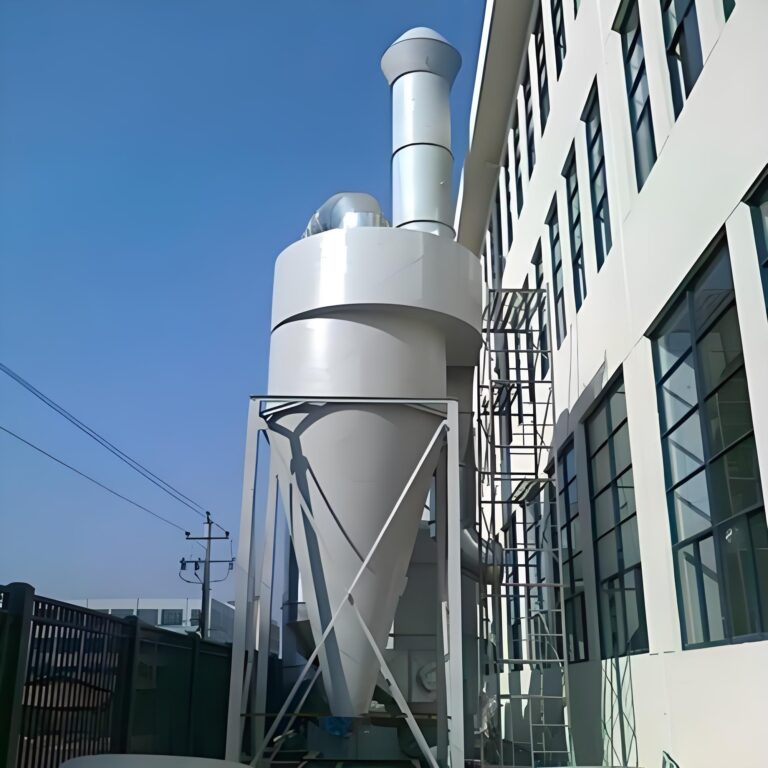
The cyclone’s function within this system is to provide primary separation and house the fan and filter. Its efficiency in removing bulk particulate before the filter is crucial for maintenance intervals, but its internal resistance is a fixed part of your SP calculation. Evaluating a high-efficiency industrial cyclone dust collector requires reviewing both its separation efficiency curve and its contribution to system static pressure.
Key Design Considerations: Air-to-Cloth Ratio and Altitude
Sizing the Filter Bank
The air-to-cloth ratio (total CFM / total filter media area) is the primary metric for filter sizing. For cyclone systems with pulse-jet cleaning, a ratio between 4:1 and 6:1 is standard. A higher ratio, such as 8:1, will cause rapid filter loading, leading to a swift rise in filter SP, which subsequently robs the system of airflow. This metric is as critical as fan selection for long-term stable performance.
Compensating for Altitude
Altitude is a frequently ignored geographic factor that directly impacts fan law calculations. Thinner air at elevation reduces fan mass flow and efficiency. A system designed for 5000 CFM at sea level may only move ~4250 CFM at 5,000 feet with the same motor horsepower. To compensate, you must select a larger fan or increase motor HP—a system at 9,000 feet may require a 50% HP increase.
Ensuring Conveying Velocity
Finally, duct velocity must be maintained above the settling velocity of your dust, typically a minimum of 4000 FPM in main trunks. ASHRAE Handbook Chapter 33 provides detailed guidance on this and other application-specific factors. Failure here leads to duct clogging and system failure.
The following table outlines these critical secondary factors that must be validated after initial CFM and SP calculations.
| Design Factor | Typical Range / Value | Performance Impact |
|---|---|---|
| Air-to-Cloth Ratio | 4:1 to 6:1 | Higher ratio clogs filters |
| Altitude (5,000 ft) | ~15% CFM reduction | Requires larger fan/motor |
| Altitude (9,000 ft) | ~50% HP increase | Necessary for sea-level CFM |
| Duct velocity (main) | Minimum 4000 FPM | Prevents particle settling |
Source: ASHRAE Handbook – HVAC Applications Chapter 33. Chapter 33 on Industrial Local Exhaust Systems provides engineering guidance on critical sizing factors like filter loading (air-to-cloth) and the effects of altitude on fan performance and system design.
Implementation Checklist for Multi-Point Systems
Design for Low Resistance
Operational success hinges on installation choices that minimize the SP you calculated. Use the largest practical diameter for main trunks to reduce friction. Minimize flex hose; when necessary, keep it short and straight. Replace sharp 90° elbows with long-radius elbows or two 45° bends. These choices directly preserve your fan’s capacity for actual dust capture.
Control and Margin
Ensure every branch has a sealing blast gate. The system’s performance depends on these gates being closed on unused branches. Furthermore, incorporate the recommended 10-15% safety margin into your final CFM and SP figures before fan selection. This buffer accounts for real-world variables and installation imperfections.
Pre-Engineered Solutions
The complexity of manual calculation and balancing is driving demand for pre-engineered systems. In these, the collector, ductwork layout, and controls are designed as a single optimized unit, guaranteeing performance and shifting the engineering burden from the installer to the manufacturer.
The checklist below operationalizes the key design principles that ensure your calculated system performs as intended.
| Design Principle | Action / Specification | Benefit |
|---|---|---|
| Duct sizing | Largest practical main diameter | Minimizes friction loss |
| Component choice | Minimize flex hose use | Reduces SP loss per foot |
| Component choice | Use long-radius elbows | Lower loss vs. sharp 90° |
| System margin | Add 10-15% to CFM/SP | Safety factor for reality |
| Operational control | Ensure sealed blast gates | Concentrates airflow on active tools |
Source: Technical documentation and industry specifications.
Next Steps: Validating Your Design and Sizing
Final System Review
Before procurement, conduct a final review. Double-check that duct velocities exceed 4000 FPM in all mains to prevent settling. Verify that your selected fan’s performance curve comfortably exceeds your calculated operating point with margin. Consider the long-term cost of components; cheaper, higher-resistance fittings trade capital savings for permanent energy consumption penalties.
The Role of Smart Controls
Recognize that manual blast gate management is a common failure point in multi-point systems. Investing in tool-activated or automated controls is increasingly viewed not as a luxury but as a necessity to ensure the designed operational discipline is maintained, protecting your performance investment.
Future-Proofing for Compliance
Adopting this rigorous, standards-based methodology does more than ensure performance. It future-proofs your operation against tightening regulations for airborne particulate (PM2.5/PM10) and combustible dust (NFPA 652). Your dust collection system transitions from a shop utility to a compliance-critical asset, with documented design basis.
The core decision points are clear: define accurate hood-level requirements, calculate total system resistance meticulously, and select equipment based on certified performance data, not marketing specifications. This disciplined approach mitigates the risk of costly underperformance or redesign.
Need professional validation of your multi-point cyclone system design or a pre-engineered solution built to your specific CFM and static pressure requirements? The engineering team at PORVOO specializes in translating these calculations into reliable, compliant dust collection systems.
For a detailed review of your system layout or to discuss your application, Contact Us.
Frequently Asked Questions
Q: How do you determine the required CFM for each dust collection hood in a multi-point system?
A: Calculate the CFM for each hood by multiplying the necessary capture velocity in feet per minute (FPM) by the hood’s open area in square feet. Capture velocity varies by application, from 100-200 FPM for light dust to over 500 FPM for toxic or high-energy particles. For a 2 sq. ft. hood needing 200 FPM, the requirement is 400 CFM. This means you must consult authoritative guidelines like ACGIH Industrial Ventilation: A Manual of Recommended Practice for accurate velocities, as an error here will cascade into a fundamentally undersized system.
Q: Why isn’t the total system CFM simply the sum of all hoods in a multi-point design?
A: Total CFM is based on the worst-case operational scenario, not the sum of all tools. You must define realistic machine usage groups and calculate the highest cumulative CFM demand from any branch or combination of branches that would be open simultaneously. This design principle makes operational discipline integral; the system relies on closed blast gates on inactive branches to concentrate airflow. For projects where multiple tools may run concurrently, you should carefully analyze workflow patterns to define this critical design load.
Q: What is the most critical step for ensuring a cyclone dust collector performs as designed?
A: Accurately calculating the total system static pressure (SP) loss is paramount. You must map the entire duct network for the longest run, summing losses from every component: straight duct, elbows, wyes, flex hose, the cyclone (~2″ WC), and the filter. Component choice creates quantifiable penalties; flex hose can add ~0.18″ WC per foot. This detailed accounting reveals why opting for cheaper, higher-resistance components trades lower upfront cost for permanently reduced performance and higher energy bills over the system’s life.
Q: How do you use a fan performance curve to select the right dust collector?
A: Plot your calculated Total System CFM and Total System SP as an operating point on the manufacturer’s fan curve. The selected collector’s performance curve must pass at or above this point. This step highlights the critical need for “Actual CFM” data from manufacturers, as inflated “Free Air” ratings are meaningless for system design. If your operation requires guaranteed performance, you should only evaluate vendors who provide this essential engineering data to mitigate the risk of systemic underperformance.
Q: What secondary checks are non-negotiable for long-term system stability?
A: You must verify the air-to-cloth ratio and account for altitude. The air-to-cloth ratio (CFM / filter area) should typically be 4:1 to 6:1 for pulse-jet cyclones; a higher ratio causes rapid filter clogging and crippling SP rise. Altitude directly dictates required motor horsepower, as thinner air reduces fan efficiency. This means facilities at high elevations, like 9,000 feet, should plan for a motor with up to 50% more horsepower to move the same CFM as a sea-level installation.
Q: What design principles minimize static pressure loss in multi-point ductwork?
A: Key principles include using the largest practical diameter for main trunks, minimizing the use of flex hose, employing long-radius elbows, and centrally locating the collector to shorten duct runs. You must also ensure all unused branches are sealed with blast gates. This checklist operationalizes the insight that integrated system design supersedes component assembly. For projects where performance is critical, expect to prioritize these design choices or consider pre-engineered, balanced systems where ducting and collector are optimized as a single unit.
Q: How do industry standards apply to the design of a multi-point dust collection system?
A: System design should follow established engineering principles for local exhaust ventilation (LEV). Authoritative resources like ANSI/AIHA Z9.2-2022 provide minimum requirements for calculating exhaust volumes and designing ductwork, while ASHRAE Handbook – HVAC Applications Chapter 33 covers hood design and air cleaner selection. This means proactively adopting this rigorous methodology future-proofs your investment against evolving regulations for air quality and combustible dust safety, transforming the collector into a compliance-critical asset.