Most collector sizing errors aren’t discovered during commissioning — they surface three months later when differential pressure climbs faster than expected between cleaning cycles and every hood in the facility starts losing capture velocity. By that point, the ductwork is installed, the collector is bolted down, and a redesign means downtime, cost, and potentially a repeat procurement process. The error that causes this isn’t a calculation mistake; it’s a sequencing mistake — the collector got sized before anyone produced a detailed map of what each station actually emits, how many run at once, and what the duct path between source and filter actually demands. A source map doesn’t just feed the sizing formula; it changes what the formula needs to include. By the end of this article, you’ll be able to identify the conditions that shift a collector requirement, the duct and filter decisions that affect long-term system stability, and the data your source map needs to produce before a credible RFQ can be written.
List every dust-producing operation and active station
The starting point for any grinding dust collection system design is a complete inventory of dust-producing activity — not just the primary grinders, but every operation in the facility that generates airborne particulate. That includes bench grinders, angle grinders, surface grinders, cut-off wheels, buffing stations, and any secondary operations like metal filing or abrasive blasting that share airspace with grinding stations. Omissions here carry forward directly into undersized infrastructure.
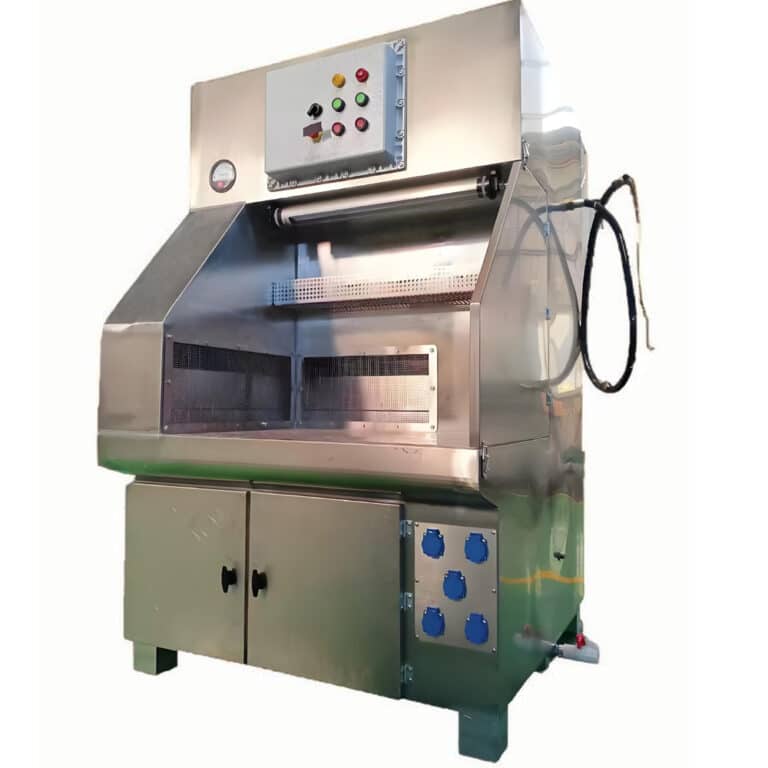
For each station, the next step is assigning a capture configuration category. Three configurations are commonly used in industrial grinding design: a local exhaust hood positioned close to the source, a downdraft table that draws air downward through the work surface, and an enclosed grinding booth that captures dust from all directions around a larger workpiece. These aren’t a regulated taxonomy — they’re planning categories that carry different airflow geometries, space requirements, and proximity constraints. Assigning the wrong category to a station early means the duct sizing, hood geometry, and collector capacity calculations that follow are built on a flawed assumption.
Grinding generates dust and sparks continuously during operation, not in bursts. That sustained emission rate is what justifies source-point capture as the design baseline. A station left unclassified or loosely classified is effectively treated as if ambient room ventilation will cover the gap — and the downstream consequences of that assumption are covered in a later section.
Mark source direction workpiece size and operator movement
Once every station is listed, each one needs three pieces of spatial data: where the dust plume exits the wheel, what the workpiece dimensions are, and how far the operator moves during the task. These three variables interact in ways that shift the airflow requirement substantially, and a source map that omits any one of them produces a sizing input that may look precise but carries embedded error.
Dust plume direction is determined by wheel rotation. A grinding wheel throws dust and sparks in the direction of the trailing edge, which means a hood positioned on the wrong side of the wheel intercepts significantly less of the plume than its rated capture velocity suggests. This isn’t a marginal correction — it can mean the difference between a hood that works and one the operator instinctively steps around because dust is escaping into their breathing zone.
Workpiece surface area is a direct input to downdraft table sizing. A table sized for a small part but used for a larger workpiece will produce insufficient face velocity across the extended surface, allowing dust to lift off the uncovered perimeter rather than being drawn down through the grate. The relationship between surface area and required airflow is a sizing dependency, not a fixed ratio — it scales with the geometry and must be recalculated for each part family the station handles. For operations where workpiece sizes vary, the largest anticipated workpiece should govern the design condition. Detailed guidance on matching airflow to workpiece dimensions is covered in the Downdraft Grinding Table CFM Sizing Calculator.
Operator movement defines the usable capture zone. A hood designed for a fixed-position task fails if the operator routinely shifts laterally to access different faces of the workpiece — the hood becomes a background fixture instead of an active capture point. Mapping operator reach and movement range during the source inventory prevents hood placement decisions that look correct on a drawing but fail under actual task conditions.
Separate local capture points from room-level ventilation
A common planning assumption — sometimes left implicit rather than stated — is that room-level ventilation provides a meaningful backup for stations where local capture is imperfect or undersized. In light grinding applications with low dust loads, ambient filtration may contribute enough to keep ambient concentrations acceptable. In heavy grinding operations, that assumption often leads to local capture being under-specified and ambient filtration being asked to carry a load it wasn’t designed for.
The core reason local capture must be treated as the primary control is distance. Capture efficiency drops sharply as the gap between the dust source and the hood face increases. Each additional foot of separation requires a disproportionate increase in airflow volume to maintain the same capture velocity at the emission point. Room-level ventilation operates at that distance by definition — it’s diluting already-dispersed dust, not intercepting it at the source. Leaning on it in lieu of adequately positioned local capture increases the total required airflow across the system and accepts a higher escape fraction as a design condition.
| Ventilation Approach | Role in Dust Control | Key Limitation | Risk if Over-Relyed On |
|---|---|---|---|
| Local capture (hoods, downdraft tables, booths) | Primary control; captures dust at the source | Efficiency drops rapidly with distance; requires close proximity to emission point | Dust escape if placed too far or undersized |
| Room-level ventilation | Supplemental only; not a substitute for source capture | Cannot handle heavy grinding dust loads alone | Under-sized local capture and increased ambient dust levels |
The consequence of misapplying room-level ventilation as a primary control isn’t always visible at startup. Ambient dust levels build gradually, filter loading on the ambient system increases, and the facility may operate for months before monitoring confirms that local source capture was insufficient. Treating these two layers as equivalent in the source map — rather than as primary and supplemental — produces an inventory that underrepresents what local capture actually needs to deliver.
Estimate simultaneous station use before collector sizing
The collector size cannot be determined from a single station’s CFM requirement multiplied by the total station count. That calculation produces a theoretical maximum that rarely reflects how the facility actually operates, but the opposite error — sizing to a low estimate of concurrent activity — creates a system that performs well during commissioning and degrades steadily under normal production load.
The correct sizing input is the realistic peak concurrent station count: the number of stations that run simultaneously during normal operations, not worst-case theoretical maximum, not best-case minimum. For facilities with shift-based production or sequential workstations, this number may be significantly lower than the total station count. For facilities where all stations run in parallel, it approaches the total. Getting this number right requires observing actual production patterns, not inferring them from a station list.
To that concurrent CFM sum, a margin must be added for filter loading between pulse-jet cleaning cycles. During operation, filter media accumulates dust and differential pressure rises. A collector sized to the exact concurrent CFM with no loading margin will reach maximum allowable pressure drop before the cleaning cycle completes its effect, reducing airflow to every connected hood and table in the system. This isn’t a dramatic failure — it’s a gradual loss of capture velocity that erodes system performance under sustained load. The loading margin is a sizing discipline that prevents this pattern; how much margin is appropriate depends on dust concentration, filter area, and cleaning cycle frequency, and should be specified as a design condition rather than left to a default assumption.
An undersized collector also creates a compounding problem: as differential pressure increases, the fan works harder against higher resistance, energy consumption rises, and airflow at the capture points drops — meaning the stations that need the most reliable capture during heavy production are the ones most likely to be starved of it.
Trace duct hoses bends and filter locations
Duct layout decisions are often treated as a coordination task — routing pipes around structure and equipment to reach the collector inlet. In grinding applications, duct geometry also carries a fire protection function, and the two objectives don’t always point in the same direction.
Hot sparks ejected from a grinding wheel can travel through ductwork and reach filter media if the path from source to collector is short and straight. The practical response is to introduce bends in the duct run that extend the travel path, reducing spark velocity and allowing cooling before the airstream reaches the filter. This is a fire protection rationale, not just a layout preference — the ASHRAE Handbook Chapter 33 treatment of industrial local exhaust systems supports this approach as part of the broader logic for spark control in grinding duct design. The trade-off is pressure loss: every bend adds resistance to the system, and that resistance must be accounted for in the original fan and collector sizing. Treating bends as free additions after the collector is sized is a sequencing error with measurable consequences for system airflow.
Spark arrestors — drop-out boxes, perforated screens, or centrifugal devices — are installed at the collector inlet to intercept particles that survive the duct run before they reach filter media. Filter media selection then needs to account for the residual spark exposure that arrestors don’t fully eliminate, which is why nanofiber and PTFE membrane filters are commonly recommended for high-volume fine dust in grinding applications: they balance capture efficiency with durability under spark-prone conditions. Specifying a filter based on efficiency rating alone, without considering spark resistance, is a failure pattern that surfaces as premature filter damage rather than immediate system failure — often after the installation warranty has expired.
| Design Element | Requirement | Reason |
|---|---|---|
| Duct routing (bends) | Avoid straight runs; include bends to lengthen travel path | Slows spark velocity and allows cooling before reaching filters |
| Spark arrestor | Install drop-out box, perforated screen, or centrifugal device at collector inlet | Intercepts hot particles before they reach filter media |
| Filter media selection | Use nanofiber or PTFE membrane filters for high‑volume fine dust; balance efficiency, durability, and spark resistance | Prevents ignition and premature filter failure in spark‑prone environments |
Hose connections between flexible pickup points and rigid ductwork deserve specific attention in the source map. Hose diameter, length, and bend radius each affect local pressure loss, and in multi-station systems where several flexible hoses connect to a common duct trunk, unbalanced resistance can cause some stations to receive adequate airflow while others are starved — even when the collector is correctly sized for the total load.
Identify where dust discharge and maintenance happen
A source map that stops at the collector inlet is incomplete for system design purposes. Two downstream conditions — where collected dust exits the system and where filter maintenance occurs — directly affect whether the system maintains its designed performance over time, and both need physical space and operational access that must be confirmed before installation.
Drop-out boxes at the collector inlet serve a dual purpose: they reduce the velocity of the incoming airstream so that heavier spark particles fall out by gravity before the air reaches the filter media, and they accumulate the separated material in a removable hopper. This reduces filter burden and extends cleaning intervals, but it also creates a maintenance point that requires regular emptying. If the drop-out box location is inaccessible — positioned above production equipment, in a confined space, or without clearance for a collection drum — maintenance intervals get extended beyond design intent and the accumulated material eventually restricts airflow through the separator itself.
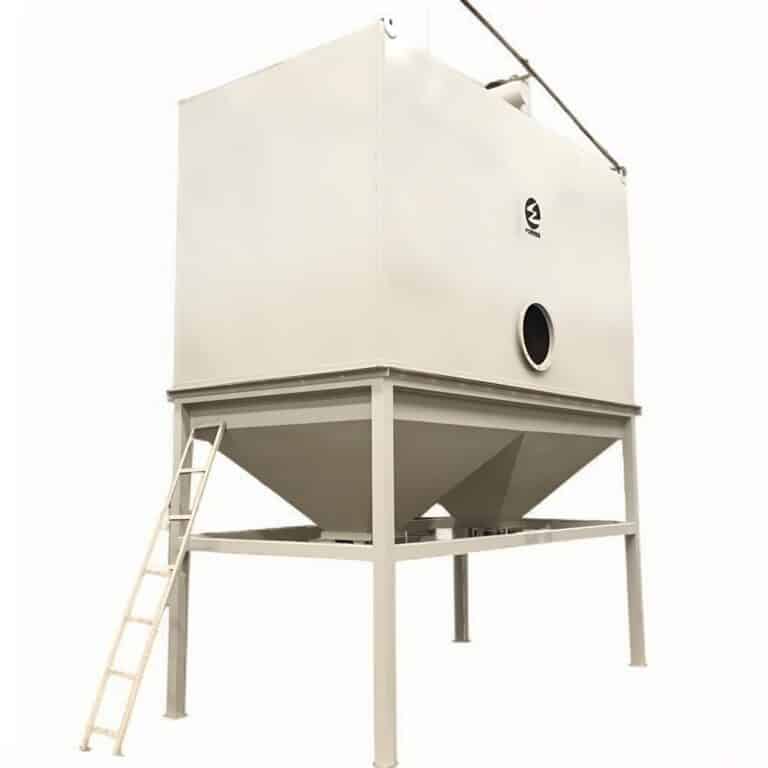
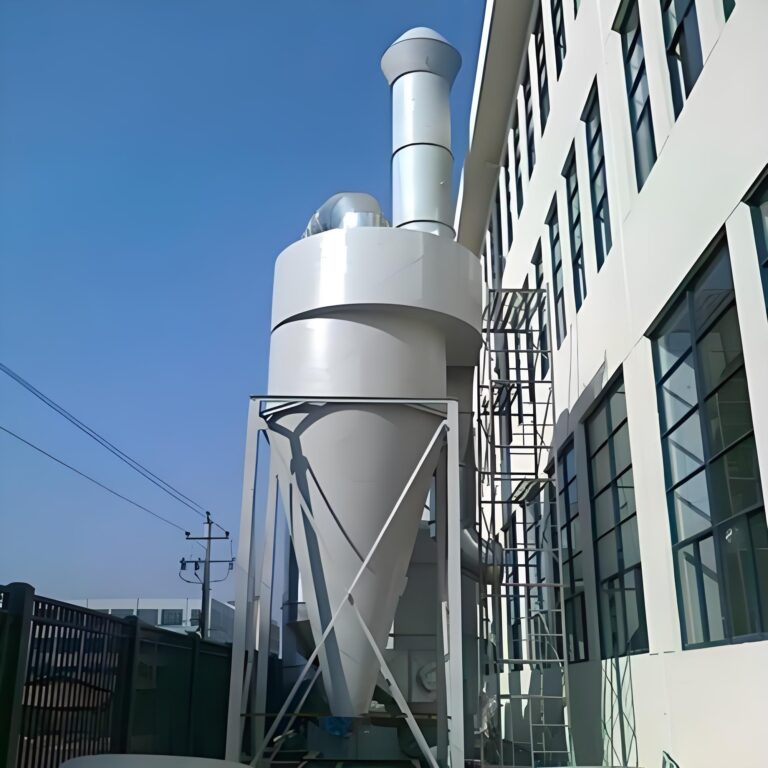
Filter maintenance access is the other planning constraint that frequently gets resolved late. Pulse-jet cleaned cartridge collectors require enough clearance above or beside the collector housing to remove and replace filter cartridges without disturbing adjacent equipment or ductwork. In facilities where the collector is mounted on a mezzanine or against a wall to save floor space, this clearance is often the first thing that gets compressed during layout. The consequence is that filter replacement — which should be a routine maintenance task — becomes a disruptive half-day procedure, and intervals stretch to avoid it, which degrades system performance in the same way an undersized loading margin does.
Filter loading margin, mentioned in the simultaneous station sizing section, is directly connected to maintenance frequency. If the collector is sized without factoring in how quickly filters load between cleaning cycles under production conditions, the system will require more frequent manual intervention than the maintenance plan anticipates. This should be treated as a sizing input — one that requires knowing dust concentration, particle size, and filter area — rather than a value to be confirmed after installation.
Convert the source map into RFQ data
A complete source map produces specific, defensible inputs for the collector RFQ — not ranges or approximations, but station-level airflow requirements, duct velocity targets, filter specifications, and simultaneous use conditions that a supplier can evaluate against their equipment offering. Without these inputs, an RFQ invites the supplier to make assumptions, and those assumptions are typically conservative in ways that increase cost or optimistic in ways that create performance risk.
For steel grinding dust, a common design starting point is a duct velocity of 3500 fpm with approximately 500 cfm per grinder through a 5-inch minimum duct diameter. These figures are typical for steel applications and serve as a useful cross-check on source map outputs — if the CFM requirements derived from your station inventory differ substantially from these values, the discrepancy should be examined before the RFQ is issued. These are design figures for steel grinding, not universal values; different materials, wheel diameters, and enclosure types will produce different requirements, and the source map should reflect those differences rather than default to a single figure.
| Parameter | Recommended Value |
|---|---|
| Duct design velocity (steel grinding dust) | 3500 fpm |
| Airflow per typical grinder | 500 cfm |
| Minimum duct diameter per grinder | 5 inches |
The undersized and oversized duct risks captured in that table belong in the RFQ as performance criteria, not as background assumptions. Specifying a minimum duct velocity — and naming the consequences of falling below it — gives the supplier a clear constraint to design against and gives you a measurable parameter to verify during commissioning. Velocity and volume flow measurement methodology, as covered in ISO 10780, provides the testing framework for confirming these values in the field.
| Sizing Condition | Consequence | Impact on System |
|---|---|---|
| Undersized duct | Higher pressure loss, increased energy consumption | Reduced air volume at hood, loss of capture efficiency |
| Oversized duct | Dust settling in duct, excessive weight | Structural safety risk, potential plugging and airflow degradation |
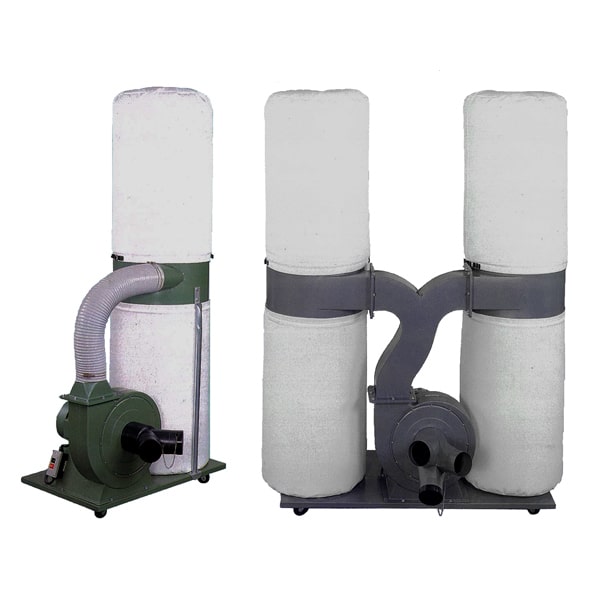
The source map should also identify which stations are candidates for a shared downdraft grinding table versus which require a dedicated portable dust collector due to workpiece size or station mobility. That distinction belongs in the RFQ scope, not in a note left for the supplier to resolve. Where stations share a collector, the simultaneous use estimate must be explicit; where stations have dedicated units, the RFQ can specify airflow, filter type, and discharge configuration individually. Either way, the map drives the specification — not the other way around.
The sequence matters more than any individual calculation in this process. A collector sized without a source map may appear to meet the facility’s requirements at first glance, but the inputs that determine whether it actually performs — simultaneous station count, duct geometry, workpiece variation, maintenance access — weren’t confirmed before the specification was written. That gap produces systems that commission adequately and degrade under load, often in ways that take months to diagnose.
Before issuing an RFQ, confirm three things from the source map: the realistic peak concurrent CFM across all active stations including a loading margin, the duct velocity and routing constraints that apply to the specific materials being ground, and the physical locations for dust discharge and filter maintenance that need to be verified against the facility layout. These are the inputs that make a collector specification defensible — and that prevent a redesign after the system is already in the wall.
Frequently Asked Questions
Q: Our facility runs a mix of steel and non-ferrous grinding at the same stations — does the 3500 fpm / 500 cfm design starting point still apply?
A: No, those figures apply specifically to steel grinding dust and should not be carried over to non-ferrous materials without recalculation. Aluminum, copper, and other non-ferrous dusts have different particle density, transport characteristics, and — critically — combustion risk profiles that alter both the minimum duct velocity required to keep dust in suspension and the filter media that can be safely specified. Use the steel figures only as a cross-check against steel stations in a mixed facility; each material type needs its own transport velocity and CFM derived from the source map for that station.
Q: Once the source map is complete and the RFQ is issued, what should be verified during commissioning before the system is accepted?
A: Measure actual duct velocity and volume flow at each branch connection and confirm they match the design conditions specified in the RFQ. ISO 10780 provides the testing methodology for stationary source velocity and volumetric flow measurement. If any branch falls below the minimum duct velocity for the material being ground, dust will begin settling in that section under load — a condition that won’t be visible during a short commissioning run but will accumulate into a blockage or structural overload over time. Pressure drop across the filter should also be recorded at startup as a baseline for tracking filter loading rate against the design margin.
Q: Is a portable dust collector a legitimate long-term solution for a permanent grinding station, or is it only appropriate as a temporary measure?
A: A portable collector is a legitimate permanent solution for stations where workpiece size, mobility requirements, or physical separation from other stations makes a shared centralized system impractical. The trade-off is filter maintenance frequency: portable units typically have smaller filter area than centralized cartridge collectors, so they load faster under sustained high-dust grinding and require shorter service intervals to maintain capture velocity. If a station runs continuously at high intensity, the maintenance burden of a portable unit may exceed what the facility can reliably sustain — which is a planning criterion, not a product limitation, and should be resolved in the source map before the RFQ is written.
Q: At what point does adding more stations to a shared collector become a worse option than installing a second dedicated unit?
A: The threshold is when the realistic peak concurrent CFM — including the loading margin — exceeds what a single collector can deliver while keeping differential pressure within its operating range during a full production shift. A secondary signal is duct length: as more stations are added to a shared trunk, the branch runs to distant stations grow longer, pressure loss increases, and balancing airflow across all capture points becomes increasingly difficult without damping dampers that reduce total system efficiency. A second dedicated unit typically becomes the better option when either of these conditions is reached, or when stations are physically separated in ways that would require duct routing longer than the system fan curve can support without significantly oversizing the collector.
Q: The article focuses on the design phase — what is the most common way a correctly designed system is degraded during routine operation?
A: Extending filter maintenance intervals beyond the design intent is the most common cause of performance degradation in otherwise correctly designed systems. When filter replacement or pulse-jet cleaning is deferred — usually because access is difficult or the task is disruptive — differential pressure climbs above the design operating range, airflow at every connected hood and table drops, and capture velocity falls below what the source map assumed. The system doesn’t fail visibly; it loses effectiveness gradually while continuing to run. This is why maintenance access for filter cartridges and dust discharge points needs to be confirmed as a physical constraint during the source mapping phase, not resolved after the collector location is fixed.