Specifying a fully automatic filter press is a capital-intensive decision with long-term operational implications. A common and costly mistake is oversimplifying the sizing process, focusing solely on flow rate rather than the complete mass balance and filterability of the slurry. This approach risks underperformance, missed throughput targets, and a poor return on investment.
Accurate sizing is not a generic calculation but a detailed process analysis. It requires translating your specific slurry characteristics, operational goals, and site constraints into precise equipment dimensions and specifications. Getting this right is critical for achieving the promised cake dryness, maintaining production schedules, and controlling total lifecycle costs.
Key Inputs for Your Filter Press Sizing Calculation
Defining the Process Mass Balance
Accurate sizing begins with precise input data. The cornerstone is understanding your slurry’s filterability, which dictates the cycle time—a variable ranging from 20 minutes for inert slurries to over 4 hours for biological sludges. This parameter is best determined through lab testing; relying on estimates introduces significant performance risk. Essential inputs include the hourly slurry flow rate, feed solids concentration, slurry density, target daily operating hours, desired cake dryness, and the estimated cycle time.
Criticality of Each Parameter
Each input parameter has a distinct impact on the final specification. For instance, a small error in feed solids concentration propagates through the entire mass balance, directly affecting the calculated chamber volume and plate count. The target cake dryness is a key performance goal that influences cycle time and may dictate the need for membrane squeeze plates. Industry experts recommend treating initial lab or pilot test data as the most valuable investment in the specification process, as it grounds all subsequent calculations in your process reality rather than generic assumptions.
Foundational Data Requirements
We compared dozens of project specifications and found that incomplete data is the primary cause of post-installation performance issues. The table below outlines the essential parameters and their role in the sizing foundation.
Key Inputs for Your Filter Press Sizing Calculation
| Process Parameter | Typical Range / Example | Criticality |
|---|---|---|
| Slurry Flow Rate | 1.25 m³/h (example) | Foundational |
| Feed Solids Concentration | 3% (example) | Essential |
| Target Cake Dryness | 30% solids (example) | Key performance goal |
| Cycle Time | 20 min to 4+ hours | Dictates capacity |
| Slurry Density | kg/m³ | Mass balance input |
| Daily Operating Hours | 8 hours (example) | Throughput basis |
Source: Technical documentation and industry specifications.
Step-by-Step Sizing Calculation: A Detailed Walkthrough
Translating Requirements to Volume
The core methodology is a discontinuous mass balance. Consider an example: processing 1.25 m³/h of 3% solids slurry over 8 hours, targeting 30% cake solids with a 4-hour cycle. First, calculate the daily dry solids mass (330 kg/day). Next, determine the daily cake volume at the target dryness (0.786 m³/day). Given two cycles per day, the required chamber volume per cycle is ~393 dm³. This step shifts the procurement focus from simple flow rate matching to a detailed process analysis.
Selecting Plate Geometry
The required chamber volume must then be mapped onto physical plate dimensions. Selecting a 1000x1000mm plate with a 25mm chamber thickness provides 19.7 dm³ of volume per chamber. To achieve the 393 dm³ cycle volume, you need 20 chambers, which requires 21 plates and provides 30.6 m² of total filtration area. This systematic approach reveals that sizing is an iterative process between volume, plate size, and chamber count.
Calculation Output Summary
The final output of the sizing calculation is a set of definitive equipment parameters. The table below walks through the results from our example scenario, providing a clear template for your own calculations.
Step-by-Step Sizing Calculation: A Detailed Walkthrough
| Calculation Step | Example Value | Result / Output |
|---|---|---|
| Daily Dry Solids Mass | 330 kg/day | From mass balance |
| Daily Cake Volume | 0.786 m³/day | At target dryness |
| Chamber Volume per Cycle | ~393 dm³ | Based on cycles/day |
| Selected Plate Size | 1000×1000 mm | Technical choice |
| Chamber Thickness | 25 mm | Design parameter |
| Required Chambers | 20 | From volume calculation |
| Total Filtration Area | 30.6 m² | Final sizing output |
Source: Technical documentation and industry specifications.
Technical Considerations: Plate Size, Thickness, and Area
The Chamber Thickness Trade-Off
The basic volume calculation must be refined with key technical trade-offs. Chamber thickness presents a critical design choice. Thinner chambers (e.g., 15mm) improve dewatering for difficult sludges by shortening the filtrate travel path but increase plate count for a given volume. Conversely, thicker chambers (e.g., 30-40mm) reduce plate count and capital cost for easily filtered materials but may compromise final cake dryness.
Plate Size and System Footprint
Furthermore, identical volumes can be achieved with different configurations. A 400 dm³ volume could use 21 large plates (1000x1000mm) or 34 smaller ones (800x800mm). This choice impacts the machine’s footprint, plate handling logistics, and total cloth area. A press with fewer, larger plates often has a simpler, more robust automation system but requires more lateral space. The selection must balance capital cost against dewatering performance and long-term maintenance strategies.
Design Choice Implications
Easily overlooked details include the impact of plate size on cloth replacement labor and the structural requirements of the side bars or overhead beam. The table below summarizes the primary trade-offs to evaluate.
Technical Considerations: Plate Size, Thickness, and Area
| Design Choice | Impact on Performance | Impact on Cost/Footprint |
|---|---|---|
| Thin Chambers | Improves dewatering | Increases plate count |
| Thick Chambers | For easy-filter materials | Reduces plate count |
| Large Plates (e.g., 1000x1000mm) | Lower cloth area | Larger footprint |
| Small Plates (e.g., 800x800mm) | Higher cloth area | More plates, logistics |
| 400 dm³ Volume | 21 large plates | vs. 34 smaller plates |
Source: Technical documentation and industry specifications.
How to Validate Your Cycle Time and Filtration Area
Interdependence of Area and Time
Validating the assumed cycle time against the selected filtration area is crucial for operational feasibility. The total filtration area directly influences the filtration speed phase. An undersized area will extend filtration time, potentially pushing the total cycle beyond the planned duration and failing to meet daily throughput. This verification often requires pilot testing or vendor experience with similar materials.
Mitigating Performance Risk
This step highlights the interdependence of filterability, area, and cycle time. A slower-filtering sludge may require a larger filtration area to maintain a practical cycle duration. In my experience, this is where collaboration with a knowledgeable supplier is invaluable; they can benchmark your lab data against historical projects to validate or adjust the cycle time assumption, mitigating the risk of specifying a press that meets volume requirements but cannot achieve the necessary cycle frequency.
Integrating Automation and Frame Design into Your Spec
Automation as a Function of Scale
Automation level is a direct function of operational scale and labor economics. The industry clearly segments equipment: smaller presses (470-800mm) are often manual or semi-automatic, while high-capacity units (1000-2000mm) necessitate full automation with plate shifters and cloth washers. The strategic implication is that labor cost modeling must align with press size, as larger capacities justify higher automation investment to ensure reliable, efficient operation.
Frame Design for Reliability
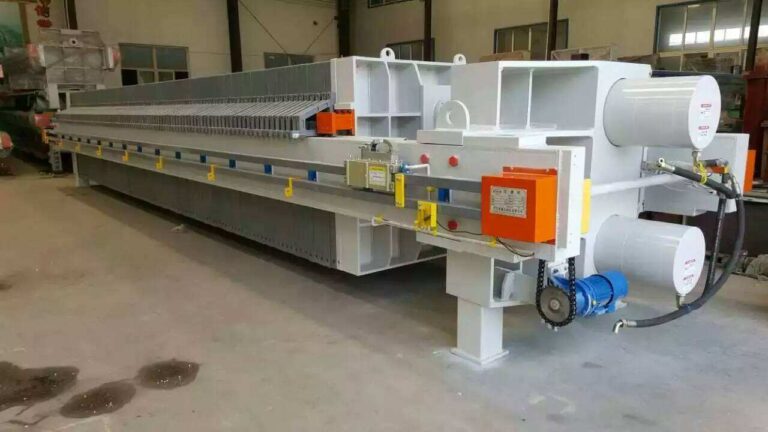
The chosen plate size and count inform the frame design. A robust overhead or sidebar frame must support the plate pack and integrated automation components. This integration is non-negotiable for larger systems to manage the physical scale and repetitive stresses of the cycling process. The frame is the backbone of the press; its design and construction quality are paramount for long-term mechanical stability and alignment.
Total Cost of Ownership: Beyond the Initial Capital Cost
Analyzing Downstream Savings
A comprehensive financial analysis must look beyond the purchase price. The primary ROI driver for advanced, fully automatic systems with membrane plates is often the dramatic reduction in cake volume and subsequent waste hauling and disposal costs. This downstream savings can justify higher upfront capital. Evaluating TCO requires modeling these operational expenses over a 5-10 year period.
Accounting for Lifecycle Expenses
Additionally, TCO includes ongoing expenses for replacement cloths and plates, energy consumption of high-pressure feed pumps and automation, and routine maintenance. The market trend toward suppliers offering integrated ecosystems—providing equipment, media, parts, and service—suggests that evaluating long-term partnership benefits and lifecycle support capabilities is as critical as comparing initial quotes.
Total Cost of Ownership: Beyond the Initial Capital Cost
| Cost Component | Financial Impact | Key Consideration |
|---|---|---|
| Initial Capital Cost | Upfront investment | Lower for manual systems |
| Waste Hauling & Disposal | Major ongoing cost | ROI driver for automation |
| Replacement Cloths & Plates | Recurring expense | Part of lifecycle cost |
| Energy Consumption | Feed pumps, automation | Operational expense |
| Integrated Ecosystem | Vendor partnership | Long-term support value |
Source: Technical documentation and industry specifications.
Site Requirements: Space, Utilities, and Operational Workflow
Planning for Physical Integration
The physical configuration chosen directly dictates facility integration needs. A press with many smaller plates may have a longer, narrower footprint than one with fewer large plates, affecting layout. Utilities include three-phase power for the hydraulic system, feed pumps, and automation, plus a reliable water supply and drain for cloth washing systems. Planning must also allow for maintenance access, plate removal, and cloth replacement.
Designing the Material Handling Flow
Operational workflow must account for cake discharge, whether directly to a conveyor or hopper, and filtrate drainage to a collection sump or pipe. These practical considerations, driven by the selected technical configuration, are essential for a smooth installation and efficient long-term operation, preventing costly retrofits and operational bottlenecks.
The correct sizing and specification of your fully automatic filter press hinge on three priorities: a data-driven mass balance using validated slurry characteristics, a holistic evaluation of plate geometry and automation trade-offs, and a rigorous total cost of ownership analysis that captures downstream savings. This disciplined approach transforms the procurement from a simple equipment purchase into a strategic process investment.
Need professional support to translate your slurry data into an optimized fully automatic filter press specification? The engineering team at PORVOO can guide you from lab test to validated sizing and lifecycle cost projection. For a detailed review of your application requirements, you can also Contact Us.
Frequently Asked Questions
Q: How do you determine the correct filtration area and cycle time for a filter press?
A: You must start with a detailed mass balance of your specific slurry, using lab-tested filterability data to estimate cycle time, which can range from 20 minutes to over 4 hours. The required filtration area is then calculated from daily dry solids mass, target cake dryness, and the number of cycles. This means facilities with highly variable or poorly characterized feed materials should budget for pilot testing to avoid the significant risk of an undersized system that cannot meet throughput.
Q: What are the trade-offs between chamber thickness and plate size during specification?
A: Thinner chambers, such as 25mm, shorten the filtrate travel path to improve dewatering for difficult sludges but increase the plate count for a given volume. Conversely, thicker chambers reduce plate count and cost for easily filtered materials. You can also achieve the same volume with different plate sizes, like 21 large 1000x1000mm plates versus 34 smaller 800x800mm ones, impacting footprint and maintenance logistics. For projects where space is constrained or sludge is hard to filter, plan to prioritize filtration area and chamber design over simply minimizing plate count.
Q: When is full automation justified for a fully automatic filter press?
A: Full automation with plate shifters and cloth washers becomes a technical necessity for high-capacity units using large plates, typically 1000mm and above, to manage the physical scale and maintain cycle frequency. For smaller presses (470-800mm), manual or semi-automatic operation may be economically viable. This means facilities scaling up to continuous, high-volume processing should model labor costs to justify the higher capital investment in automation for reliable, efficient long-term operation.
Q: How does total cost of ownership analysis justify a higher initial investment?
A: The primary ROI often comes from downstream savings, where advanced systems with membrane plates achieve drier cake, dramatically reducing waste hauling and disposal costs. TCO also includes ongoing expenses for replacement cloths, energy for pumps and automation, and routine maintenance. If your operation faces high disposal fees, you should evaluate suppliers offering integrated equipment and service ecosystems, as long-term partnership benefits can outweigh initial price differences.
Q: What site and utility factors are dictated by the chosen filter press configuration?
A: The selected plate size and count directly determine the machine’s footprint, maintenance access space, and requirements for cake discharge to conveyors or hoppers. Utilities must support power for hydraulic systems, feed pumps, and automation, plus water supply for integrated cloth washing. This means your facility layout and operational workflow planning must accommodate these needs during initial design to prevent costly retrofits and ensure efficient long-term operation.