In grinding operations, the primary engineering challenge is not simply moving air but capturing hazardous particulates at their source before they enter the breathing zone. The critical metric for this is capture velocity, a specification often misunderstood or inadequately applied. Misconceptions that any downdraft table will suffice or that face velocity is a static, one-size-fits-all figure lead directly to failed compliance and increased liability.
Attention to this specification is non-negotiable now. Regulatory scrutiny on air quality and combustible dust hazards intensifies annually. Selecting and maintaining a downdraft table based on authoritative capture velocity standards is a direct investment in operational continuity, worker health, and legal defensibility. The cost of error extends far beyond a fine.
What Is Capture Velocity and Why Is It Critical for Grinding?
Defining the Core Metric
Capture velocity is the minimum air speed required at the point of contaminant release to overcome its initial momentum and capture it. For a downdraft table, this is engineered and measured as face velocity—the average air speed across the perforated work surface. This is not a general ventilation parameter but a targeted, localized control. Without sufficient velocity, high-speed grinding ejecta simply bypass the capture zone.
The Direct Consequences of Inadequate Specification
Inadequate face velocity creates a predictable failure chain. Contaminants escape the immediate capture envelope, polluting the general shop air and HVAC systems. This exposes operators to respirable crystalline silica, metal fumes, and other toxic particulates. The resulting liability shifts from a regulatory citation to demonstrable negligence in providing a safe workplace. From our analysis of facility audits, the root cause is frequently an undersized system selected on price rather than engineered performance.
The Source Capture Advantage
A properly specified downdraft table represents the most efficient form of local exhaust ventilation (LEV). By enclosing the source, it requires significantly less airflow than a distant hood to achieve the same capture. This principle of source control directly translates to lower long-term energy costs and more effective protection. It transforms the table from a compliance checkbox into a productivity asset by maintaining a cleaner work environment.
ACGIH Face Velocity Standards for Grinding and Deburring
The Authoritative Benchmark
The ACGIH Industrial Ventilation: A Manual of Recommended Practice provides the foundational engineering guidance. It stipulates a capture velocity range of 200 to 500 feet per minute (fpm) for operations like grinding, deburring, and sanding. This range accounts for variables including particle size, initial ejection speed, and ambient air currents. It is the starting point for all professional system design.
Translating Capture to Face Velocity
A downdraft table must achieve a face velocity that meets or exceeds the required capture velocity for the specific task. Because grinding generates high-momentum particles, targeting the higher end of the ACGIH range (300-500 fpm) is standard practice for robust protection. The table below clarifies this relationship between operation type and target velocity.
ACGIH Standards and Downdraft Table Targets
The following table translates the ACGIH capture velocity recommendations into practical targets for downdraft table specification.
| Operation Type | ACGIH Capture Velocity Range | Typical Downdraft Table Target |
|---|---|---|
| Grinding | 200 – 500 fpm | 300 – 500 fpm |
| Deburring | 200 – 500 fpm | 300 – 500 fpm |
| Sanding | 200 – 500 fpm | 300 – 500 fpm |
Source: ACGIH Industrial Ventilation: A Manual of Recommended Practice. This manual provides the foundational benchmark for capture velocity, directly informing the required face velocity specifications for downdraft tables used in these operations.
The Specification Imperative
The wide range underscores that facility managers cannot assume a default value. A detailed process audit is mandatory. Factors like material toxicity, wheel grit, and part size dictate where within the range to specify. Under-specification risks health; over-specification wastes capital and energy. The correct figure is determined by a hazard assessment, not a catalog.
Key Design Factors for Effective Downdraft Table Performance
Uniform Airflow Distribution
The advertised face velocity is an average. Effective capture requires uniform distribution across the entire work surface. Dead spots from poor internal plenum design allow contaminants to escape, rendering the average velocity meaningless. Superior designs employ baffles or engineered airflow patterns to ensure consistency from edge to edge. This is a critical differentiator often hidden in marketing specifications.
The Inverse Square Law and Enclosure
Airflow requirements increase with the square of the distance from the source. A downdraft table’s integrated, enclosing design places the capture point millimeters from the work, making it exponentially more efficient than an extractor arm placed even a few inches away. This fundamental hood design philosophy dictates total system cost—smaller, enclosed hoods require smaller fans and filters, reducing initial and operating expense.
Total Cost of Ownership Engineering
Investing in a properly engineered table with uniform airflow and high-efficiency filtration yields a faster return than opting for a low-cost, low-performance unit. The ROI is realized through lower energy consumption, reduced filter change frequency, less facility-wide dust accumulation, and avoided downtime. I consistently observe that the operational cost savings over three years eclipse the initial price differential between basic and performance-oriented models.
How Cross-Drafts and Work Practices Impact Capture Efficiency
The Disruptive Force of Cross-Drafts
Even a table specified for 400 fpm can be defeated by a cross-draft of 50 fpm from an open door, pedestrian traffic, or general ventilation. These competing air currents redirect the contaminant plume away from the capture zone. Strategic placement in low-traffic areas or the use of three-sided side shields is not optional for reliable performance. It is an integral part of the system design.
Operator-Dependent Performance
Capture effectiveness decays rapidly with distance. If an operator holds work several inches above the table surface, the required capture velocity increases exponentially, likely exceeding the system’s capacity. Effective use requires training and procedural integration—the work must be performed on the surface. The downdraft table is a tool within a system, and operator practice is part of that system’s specification.
Integrating Equipment and Environment
This interplay highlights that a downdraft table is not a plug-and-play solution. Its success depends on integrating it into the broader facility layout and workflow. A site assessment should map air currents and work patterns before final equipment selection and placement. This holistic view prevents the common failure of blaming the equipment for an environmental or procedural shortfall.
Maintaining Consistent Face Velocity: Filter and System Upkeep
The Performance Decay Curve
The specified face velocity is a clean-filter benchmark. As filters load with dust, system resistance increases, causing both CFM and face velocity to drop. This decay is often gradual and unnoticed until protection is critically compromised. Relying on manual inspection schedules is unreliable under production pressure; performance must be engineered for consistency.
Automated Maintenance as a Core Feature
Features like automatic reverse-pulse cleaning are not luxury add-ons but essential for sustained performance. They maintain low filter resistance, preserving face velocity between scheduled maintenance intervals. Easy-access dust drawers that facilitate quick emptying without tool disassembly prevent the accumulation that leads to airflow blockage. The table below outlines key maintenance factors.
Factors Affecting Sustained Face Velocity
This table details common maintenance challenges and the engineered features required to mitigate them, ensuring long-term performance.
| Maintenance Factor | Impact on Face Velocity | Key Feature for Mitigation |
|---|---|---|
| Filter loading | Decreases CFM & velocity | Automatic reverse-pulse cleaning |
| Dust accumulation | Causes performance decay | Easy-access dust drawers |
| Manual cleaning delays | Increases liability risk | Automated maintenance systems |
Source: Technical documentation and industry specifications.
Validating Ongoing Performance
Long-term compliance requires periodic verification. This means using an anemometer to measure actual face velocity at multiple points on the grid and comparing it to the original specification. This documented check is the only way to ensure the engineered control continues to meet the theoretical requirement. It transforms maintenance from a cleaning task into a performance audit.
Special Considerations for Combustible Metal Grinding (NFPA 484)
A Non-Negotiable Regulatory Mandate
For grinding combustible metals like aluminum, magnesium, or titanium, the selection criterion is binary. NFPA 484 Standard for Combustible Metals explicitly prohibits dry collection systems for the fine particulates generated. This mandate overrides all considerations of cost or convenience to address severe fire and explosion hazards.
The Wet Collection Imperative
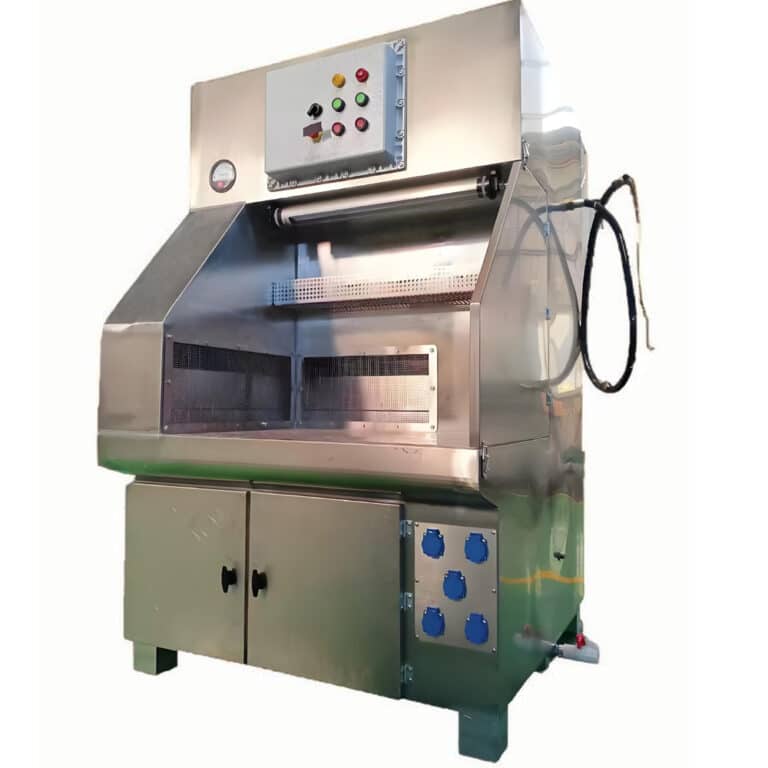
Compliance necessitates a wet downdraft table, where water captures and neutralizes the dust, preventing a combustible cloud from forming. These systems must be designed to achieve the necessary hydraulic flow and capture velocity simultaneously. They represent a specialized product category with distinct engineering requirements, as shown in the following table.
NFPA 484 Requirements for Combustible Metals
This table outlines the regulatory-driven specification for dust collection when processing hazardous combustible metals.
| Material Hazard | NFPA 484 Collection Method | Required Downdraft Table Type |
|---|---|---|
| Combustible metal dust | Prohibits dry collection | Wet downdraft table |
| Aluminum, magnesium, titanium | Mandates hazard neutralization | Water-based system |
Source: NFPA 484 Standard for Combustible Metals. This standard creates a non-negotiable, regulation-driven requirement for wet collection systems when grinding specified combustible metals, overriding all other selection criteria.
Partner Selection is Critical
This standard creates irreversible market segmentation. Buyers must select partners with demonstrable expertise in wet system design and a deep understanding of NFPA 484, not general-purpose ventilation vendors. The wrong choice carries catastrophic risk. The correct industrial wet downdraft grinding table is a engineered safety control, not just a dust collector.
Selecting a Downdraft Table: A Criteria-Based Decision Framework
Priority 1: Verify Performance Data
Move beyond marketing claims to verified test data. Require documentation showing measured face velocity across the work surface under standard test conditions (e.g., ASHRAE or manufacturer-defined test protocols). The market shows a clear performance spread, with advertised velocities for similar applications ranging from 200 fpm to over 325 fpm. This spread indicates a transition from selling basic compliance tools to offering high-performance assets.
Priority 2: Match Technology to Hazard
The second filter is regulatory. Determine if the process involves materials regulated under NFPA 484 or other standards requiring wet collection. This decision branch is absolute and precedes all other comparisons. A dry table is never an option for combustible metals, regardless of its capture velocity specifications.
Priority 3: Evaluate for Operational Efficiency
Finally, assess design features that impact long-term efficiency and uptime. The following framework prioritizes these operational criteria.
A Strategic Selection Framework
This decision matrix prioritizes the key criteria for selecting a downdraft table that delivers both compliance and operational value.
| Selection Priority | Key Criterion | Example Specification/Consideration |
|---|---|---|
| 1. Performance Verification | Face velocity under test | 200 – 325+ fpm advertised range |
| 2. Regulatory Compliance | Wet vs. dry technology | NFPA 484 for combustible metals |
| 3. Operational Efficiency | Airflow uniformity & maintenance | Design for low upkeep |
Source: Technical documentation and industry specifications.
This framework shifts procurement from a price-based transaction to a value-based decision focused on total cost of ownership and risk mitigation.
Ensuring Long-Term Compliance and Worker Safety
A Strategic Shift to Source Capture
Implementing a correctly specified downdraft table represents a strategic commitment to source capture ventilation. This approach is fundamentally superior to general dilution ventilation. It protects the operator’s breathing zone directly and prevents corrosive or abrasive contaminants from degrading the entire facility’s HVAC system and other equipment, lowering long-term capital costs.
The Documentation Trail
Ongoing compliance requires documented due diligence. This includes the initial hazard assessment and specification report, records of installation commissioning showing achieved face velocity, and a log of periodic performance verification checks against the original target. This paper trail is essential for regulatory audits and demonstrates a proactive safety culture.
Integrating into a Connected Ecosystem
Modern industrial hygiene views ventilation as a connected ecosystem. The downdraft table is a critical node. Its performance should be monitored, and its maintenance integrated into digital facility management systems. This transforms it from an isolated piece of equipment into a managed component of your plant’s health and safety infrastructure.
The core decision points are clear: specify face velocity based on a formal process audit, mandate wet collection for combustible metals per NFPA 484, and select for design features that ensure sustained performance through automated upkeep. This moves the investment from a reactive compliance cost to a proactive productivity and safety asset.
Need professional guidance to specify a downdraft table that meets ACGIH velocity standards and integrates into your safety ecosystem? The engineering team at PORVOO can provide a criteria-based assessment of your grinding operations.
For a detailed consultation on your specific application, you can also Contact Us directly.
Frequently Asked Questions
Q: What is the ACGIH recommended capture velocity for grinding dust, and why is the range so broad?
A: The ACGIH Industrial Ventilation Manual recommends a capture velocity of 200 to 500 feet per minute (fpm) for grinding and deburring. This wide range accounts for variables like particle ejection speed, material toxicity, and the presence of ambient air currents in your facility. This means you must conduct a detailed process audit to specify the correct velocity, as choosing a value too low creates a health risk while an excessively high one wastes energy and capital.
Q: How do cross-drafts from general ventilation affect a downdraft table’s performance?
A: Cross-drafts are a primary disruptor, as even a mild 50 fpm air current can defeat a system engineered for 200 fpm capture. This environmental interference means strategic placement away from doors, aisles, or HVAC vents is critical, and you should consider models with three-sided side shields. For projects where you cannot control the ambient airflow, plan for a higher design face velocity to compensate and ensure reliable contaminant capture.
Q: Why is filter maintenance a critical factor for long-term downdraft table compliance?
A: A system’s advertised face velocity is a clean-filter specification; as filters load with dust, airflow decays and capture efficiency silently fails. This performance drop makes features like automatic reverse-pulse cleaning essential for sustaining the required capture velocity. If your operation runs under continuous production pressure, you should prioritize low-maintenance, automated systems to prevent liability from inadequate protection and unplanned downtime.
Q: What is the non-negotiable requirement for downdraft tables used on combustible metals like aluminum or magnesium?
A: For combustible metals, NFPA 484 explicitly prohibits dry collection, mandating the use of a wet downdraft table that neutralizes explosive dust with water. This regulation-driven requirement overrides all cost or convenience considerations and creates a strict market segmentation. This means you must select a wet table system and a vendor with deep expertise in this standard, not a general-purpose ventilation supplier.
Q: How should we evaluate face velocity claims from different downdraft table manufacturers?
A: You must verify that the advertised face velocity data is based on standard test conditions, as this is the primary engineered guarantee of performance. Be aware that marketed velocities for similar applications can range from 200 to over 325 fpm, indicating a market shift from selling basic compliance tools to productivity assets. This means your procurement framework should treat face velocity as a key performance indicator tied to operational efficiency, not just a check-box specification.
Q: What are the key design factors that ensure uniform airflow across a downdraft work surface?
A: Effective performance hinges on plenum design that delivers uniform air distribution, eliminating dead spots where contaminants can escape. The integrated, enclosing design of a downdraft table is inherently more efficient than a separate extractor arm because airflow demand increases exponentially with distance from the source. This principle dictates that investing in proper source enclosure design reduces long-term energy costs, offering a faster ROI despite a potentially higher initial equipment price.
Q: How does operator work practice impact the effectiveness of a downdraft table?
A: Operator practice is critical because capture effectiveness diminishes sharply with distance; work must be performed on or very near the perforated surface. This interplay highlights that the table is a node within a broader managed system, not a standalone solution. If your facility cannot enforce strict work positioning protocols, you should plan for supplemental training and consider designs with physical guides or barriers to keep the work within the optimal capture zone.