Selecting the correct downdraft grinding table is a critical engineering decision, not a simple equipment purchase. The central challenge professionals face is accurately sizing the system’s airflow capacity. An undersized unit fails to contain hazardous dust, creating health and compliance liabilities, while an oversized one wastes capital and energy. This miscalculation often stems from focusing solely on table dimensions while neglecting the decisive influence of material type and system integration.
The need for precision has never been greater. With stricter enforcement of workplace safety standards and a growing focus on operational efficiency, a properly engineered downdraft system is a strategic investment. It directly impacts productivity, tool longevity, and long-term liability. This guide provides the framework to match CFM to your specific operational reality.
Key Variables in Downdraft Table CFM Sizing
Understanding CFM and Capture Velocity
The primary metric for sizing is Cubic Feet per Minute (CFM), a measure of volumetric airflow. However, effective dust capture depends on the air velocity across the table’s perforated surface, measured in Feet Per Minute (FPM). The goal is to generate sufficient velocity—typically 100-150 FPM for wood dust—to capture particles at the source before they become airborne. This velocity must be maintained across the entire work grid, which requires an engineered plenum beneath the surface for even air distribution. A common oversight is specifying CFM based on a table’s physical footprint alone, without accounting for how workpieces obstruct airflow.
The Dynamic Work Envelope
Your required CFM is not static; it’s a function of the dynamic work envelope. A large, single panel covering most of the table surface reduces the effective open area, potentially lowering the needed pull. Conversely, processing multiple small parts that leave much of the grid exposed demands higher CFM to maintain capture velocity across all openings. This principle underscores that system sizing must be based on your most challenging typical operation, not a best-case scenario. In our shop, we’ve observed that operations with intermittent, high-dust generation like grinding require a significant CFM buffer compared to consistent, lower-volume sanding.
System Interdependence
The table itself is just the intake point. Its performance is intrinsically linked to the ductwork and dust collector. An undersized duct creates excessive static pressure, starving the table of airflow regardless of the collector’s rated CFM. The collector must be selected based on its performance curve, ensuring it can deliver the required CFM at the total system static pressure. Failing to design the table, duct, and collector as a cohesive system is the most frequent cause of performance failure.
Material Type: The Critical Factor for CFM & Safety
Hazard Classification Dictates Design
The first and most critical step is a risk assessment of the workpiece material. This classification dictates everything from required CFM to mandatory safety features. For benign materials like wood and plastics, the goal is capturing fine, airborne dust for health and housekeeping. Metalworking introduces heavier, often spark-producing particles (swarf) that require higher capture velocities due to their greater mass and ejection force.
The Combustible Dust Imperative
The operational paradigm shifts entirely when processing combustible metal dusts like aluminum or magnesium. Here, the primary objective is explosion prevention, governed by stringent standards such as NFPA 484. This mandates the use of wet downdraft tables where dust is immediately inerted in a liquid bath. CFM requirements escalate dramatically—often ranging from 2,000 to 4,800 CFM—to ensure total capture of highly explosive particulates. Investing in a certified wet system for these materials is not optional; it’s a fundamental legal and insurance requirement to mitigate catastrophic risk.
Matching System Specifications to Material
The table below outlines how material type dictates the core system architecture, moving from general safety to specific, regulated hazard control.
Material Hazard and System Requirements
| Material Category | Key Hazard | Typical CFM Range | System Type Mandate |
|---|---|---|---|
| Wood & Plastics | Fine airborne dust | 100-150 FPM velocity | Dry table with filtration |
| Non-combustible Metals | Heavy sparks, swarf | Higher than wood | Dry, spark-resistant components |
| Combustible Metals (Al, Mg) | Explosion risk | 2,000 – 4,800 CFM | Wet table (NFPA 484/660) |
Source: Technical documentation and industry specifications.
Calculating Your Required CFM: A Step-by-Step Guide
The Air Velocity Method
A systematic calculation prevents costly guesswork. Start by defining your maximum work envelope: calculate the open table area in square feet (Length x Width). Next, apply a target capture velocity (FPM) based on your material. For a standard 3’ x 4’ (12 sq ft) table targeting 125 FPM for wood, the base CFM requirement is 1,500 (12 x 125). This base figure must then be adjusted upward for factors like material density, particle ejection force (e.g., grinding vs. sanding), and the typical percentage of open grid.
Applying Adjustment Factors
The base calculation is a starting point. Operations generating high-velocity particles, such as grinding metal, require a higher capture velocity, thus increasing CFM. Furthermore, if your workflow typically leaves over 50% of the grid open, you may need to calculate CFM based on the open area, not the total table area. This often reveals a smaller metalworking table requires more CFM than a larger woodworking table. Chronic under-sizing imposes a hidden tax through increased cleanup time, filter changes, and exposure risks.
A Practical Calculation Framework
Follow this step-by-step approach to translate your operational parameters into a technical specification. It moves from physical dimensions to the final adjusted airflow requirement.
CFM Calculation Steps and Parameters
| Calculation Step | Key Parameter | Example Value / Target |
|---|---|---|
| 1. Define Work Envelope | Table Open Area | 3′ x 4′ (12 sq ft) |
| 2. Set Capture Velocity | Target Air Speed | 125 Feet Per Minute (FPM) |
| 3. Calculate Base CFM | Area x Velocity | 12 sq ft x 125 FPM = 1,500 CFM |
| 4. Apply Material Factor | Hazard Adjustment | +CFM for metal grinding |
Source: Technical documentation and industry specifications.
System Integration: Matching Ductwork & Dust Collectors
Ducting as a Critical Component
The duct connecting your table to the collector is a performance bottleneck if undersized. Its diameter must be sufficient to convey the required CFM with minimal static pressure loss. While a 4-inch duct is common for smaller setups, higher-CFM applications demand 5-inch, 6-inch, or larger diameters. The total cross-sectional area of the duct should meet or exceed the combined area of the table’s exhaust ports. Use smooth-walled metal ducting and limit elbows to maintain airflow efficiency; every sharp bend increases resistance.
Selecting the Right Collector
Dust collector ratings are often given at free air flow (zero static pressure). Real-world performance is defined by the fan curve, which shows how CFM drops as static pressure increases. You must select a collector that can deliver your required CFM at your calculated system static pressure. This pressure is the sum of resistance from the table baffles, ductwork, elbows, and the filter itself. Procuring a high-CFM table paired with an undersized collector is a guaranteed path to subpar performance.
Validating the Complete Assembly
The integration point is where theoretical CFM becomes practical reality. Ensure all connections are airtight; even small leaks compromise suction at the table. The electrical supply must support the collector’s amperage draw, especially for high-CFM units. I’ve seen systems fail at startup simply because the circuit breaker couldn’t handle the in-rush current of the collector motor, a detail often overlooked in planning.
Wet vs. Dry Downdraft Tables: Which Is Right for You?
Operational Mechanism and Use Case
The choice between wet and dry collection is dictated by material hazard, not preference. Dry tables pull contaminated air through a perforated surface into a collection plenum, where it is filtered before being exhausted or recirculated. They are optimal for wood, plastics, and non-combustible metals. Wet tables, required for combustible metals, draw dust-laden air through a curtain of water or oil, immediately submerging and inerting the particles to prevent explosion.
Cost and Complexity Trade-offs
Dry systems offer simpler operation and maintenance, primarily involving filter changes. Wet systems introduce significant ancillary complexities: fluid treatment to prevent biological growth, sludge removal, pump maintenance, and corrosion-resistant construction. Their CFM requirements and associated energy costs are also substantially higher. However, for combustible dust, this operational overhead is the non-negotiable cost of compliance and safety.
Decision Matrix for System Selection
This comparison clarifies the fundamental differences in application, design, and operational responsibility between the two technologies. The decision is rarely a matter of choice but of regulatory and safety mandate.
Wet vs. Dry Table Comparison
| Feature | Dry Downdraft Table | Wet Downdraft Table |
|---|---|---|
| Primary Use Case | Wood, plastics, safe metals | Combustible metals (Al, Mg) |
| Key Mechanism | Air filtration | Liquid immersion (inerting) |
| CFM Range | Standard (e.g., ~1,500 CFM) | High (2,000 – 4,800 CFM) |
| Operational Overhead | Filter replacement | Fluid treatment, sludge management |
| Regulatory Driver | General safety | NFPA 484/660 compliance |
Source: Technical documentation and industry specifications.
Cost Considerations: Initial Investment vs. Operational Efficiency
Total Cost of Ownership Analysis
The purchase price of the table is a fraction of the total investment. Significant ancillary costs include the compatible dust collector, ducting kit, electrical upgrades, and ongoing consumables like cartridge filters, which can cost hundreds of dollars each. For wet systems, factor in fluid additives, pump maintenance, and waste disposal. A holistic budget that accounts for these items prevents mid-project financial shortfalls.
The Hidden Cost of an Inadequate System
Justifying capital expenditure requires calculating the cost of not having an effective system. This includes the productivity loss from manual cleanup, increased wear on tools and machinery from abrasive dust, higher HVAC filter replacement costs, and potential health-related liabilities. An undersized system that fails to capture dust simply redistributes the cost from the capital budget to the operational and risk management budgets, often at a higher long-term expense.
Efficiency and Return on Investment
A correctly sized downdraft table dedicated to a finishing station eliminates the downtime of swapping extraction hoses between tools, a significant efficiency gain in high-volume sanding workflows. This streamlined process improves finish quality and reduces labor hours. The ROI calculation should factor in these productivity gains alongside the hard costs of filtration and maintenance.
Comprehensive Cost Breakdown
Understanding where costs accrue—both visible and hidden—is essential for accurate budgeting and justifying the investment to stakeholders. It frames the purchase as a productivity and safety system, not just a piece of shop furniture.
Downdraft System Cost Analysis
| Cost Category | Typical Components | Impact of Inadequate System |
|---|---|---|
| Initial Capital | Table, collector, ducting | Wasted if system undersized |
| Recurring Operational | Filter replacements ($100s) | Increased cleanup labor |
| Wet System Specific | Fluid, pump maintenance | N/A |
| Hidden “Tax” | N/A | Productivity loss, health liability |
| Efficiency ROI | Dedicated station workflow | Hose-swapping downtime |
Source: Technical documentation and industry specifications.
Implementing Your System: Installation & Performance Validation
Installation Best Practices
Proper installation is critical for performance. The table must be level to ensure even liquid distribution in wet systems or uniform airflow in dry ones. Ductwork should be supported securely to prevent sagging and use sealed, gradual bends. All connections, from the table outlet to the collector inlet, must be airtight; use silicone sealant or approved duct tape on seams. Position the collector to allow for safe filter access and maintenance, considering noise implications for the workspace.
Performance Testing and Validation
After installation, validate that the system meets design specifications. Simple qualitative tests, like observing the capture of smoke or fine talcum powder across the entire grid, can indicate if target capture velocities are achieved. For dry systems, monitor the manometer (if equipped) to track filter loading and schedule maintenance. For wet systems, verify pump flow and splash curtain integrity. Documenting these initial performance checks is especially important for systems handling hazardous materials, as it forms the baseline for a compliant safety program as outlined in standards like ANSI/ASSP Z9.5-2022.
Ongoing Monitoring and Maintenance
Performance degrades over time. Establish a routine maintenance schedule: checking filter condition, emptying collection bins before they overflow, inspecting ductwork for leaks, and for wet tables, testing fluid concentration and cleaning the tank. Training operators to recognize changes in suction sound or visible dust escape ensures early detection of issues before they become hazards or cause downtime.
Final Selection Criteria: Choosing Your Downdraft Table
Synthesis of Technical Requirements
Final selection requires reconciling all previous factors. First, confirm the table’s rated CFM and construction (wet/dry, spark-resistant) match your calculated need and material hazard. Second, audit your shop’s infrastructure: do you have the electrical capacity, floor space, and ducting path for a centralized system, or would a self-contained unit with an integrated fan and filter offer more flexibility? Third, verify compatibility with your existing dust collection infrastructure or plan for the necessary upgrades.
Strategic Integration into Workflow
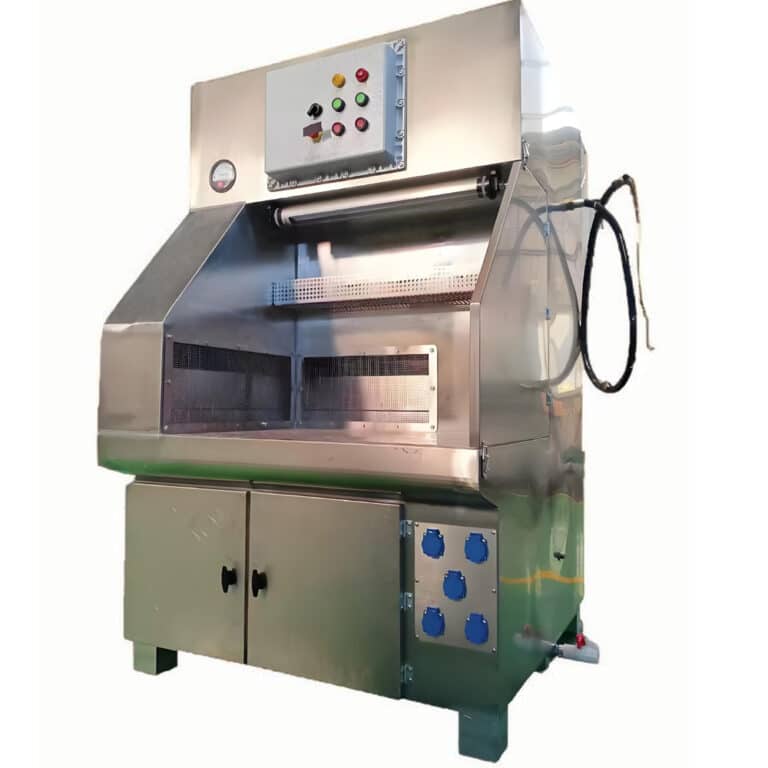
View the downdraft table not as an isolated tool but as a component within a holistic dust management strategy. The professional standard involves mapping specific technologies to workflow zones: a downdraft table for dedicated sanding and finishing, source extraction at machining centers, and ambient air cleaners for residual particulates. This layered approach, often incorporating a high-capacity industrial downdraft grinding station, ensures comprehensive protection and optimizes overall shop efficiency.
Vendor and Support Evaluation
Assess the manufacturer’s expertise in your specific material category. Request documentation of compliance with relevant standards (NFPA, ANSI). Evaluate the availability of replacement parts, filters, and technical support. A system with robust engineering support and clear documentation ultimately provides lower lifecycle risk and cost than an unsubstantiated bargain option.
The decision hinges on a disciplined process: start with a material hazard assessment, calculate CFM based on dynamic work area and required capture velocity, and design the entire airflow path as an integrated system. Prioritize compliance and validated performance over initial price for operations involving regulated hazards. The correct system is an engineered control that pays dividends in safety, productivity, and operational certainty.
Need a professional solution tailored to your specific material and workflow? The engineers at PORVOO can help you specify and integrate a downdraft system that meets both performance demands and regulatory requirements. For a detailed consultation on your application, you can also Contact Us.
Frequently Asked Questions
Q: How do you calculate the required CFM for a downdraft table based on workpiece size?
A: Base CFM is calculated by multiplying the table’s open surface area in square feet by a target capture velocity, typically 100-150 FPM for wood dust. For a 3′ x 4′ table (12 sq ft) targeting 125 FPM, the base requirement is 1,500 CFM. This must be adjusted upward for high-velocity particles or when the grid is largely uncovered. This means your CFM need is driven by the dynamic work envelope and material, not just the table’s physical footprint, to ensure effective contaminant capture.
Q: Why is material type the most critical factor in selecting a downdraft table?
A: The particulate generated dictates the entire system’s safety and performance architecture. Combustible metal dusts like aluminum mandate wet tables with immediate liquid immersion and CFM ranges from 2000-4800, governed by standards like NFPA 484. For wood or non-combustible metals, dry tables with fine filtration suffice. This bifurcation means selecting a wet system for combustible materials is a legal and safety imperative, not an option, to pre-empt compliance costs and liability.
Q: What are the key differences between wet and dry downdraft tables for operational planning?
A: Wet tables, required for combustible metals, inert dust in a liquid bath and feature non-sparking construction, specialized pumps, and higher CFM. Dry tables are standard for wood and non-combustible metals, using filtration. The operational implications are substantial: wet systems involve fluid treatment and sludge management, while dry systems focus on filter changes. For operations involving aluminum or magnesium, plan for the higher complexity and maintenance of a wet system as a fundamental compliance investment.
Q: How does system integration impact the performance of a downdraft table?
A: A table’s performance depends on the entire airflow path. The connecting duct must be sized to deliver the required CFM without excessive static pressure loss, often requiring a minimum of 4″ diameter. The dust collector must overcome the total system resistance to deliver the target CFM at the calculated static pressure. This means procuring a table without planning for compatible ducting and collector capacity creates a systemic bottleneck, guaranteeing subpar performance and wasted capital.
Q: What should we validate after installing a downdraft grinding system?
A: After installation, validate performance by observing smoke or fine dust capture across the entire grid to confirm target capture velocities. Listen for fan tone changes indicating filter clogs or blockages. For hazardous materials, document installation and regular checks per relevant standards like ANSI/ASSP Z9.5. This step transforms the equipment into a validated operational safeguard, meaning you should build performance testing and documentation into your commissioning plan from the start.
Q: How do you justify the total cost of ownership for a properly sized downdraft system?
A: Justify capital by calculating the cost of an inadequate system: productivity loss from cleanup, compromised tool performance, and health liabilities from exposure. While ancillary costs for collectors, ducting, and filters are significant, they often pale against the silent tax of an undersized system. This means your financial analysis should contrast the purchase price against the operational efficiency gains and risk mitigation a correctly sized system provides.