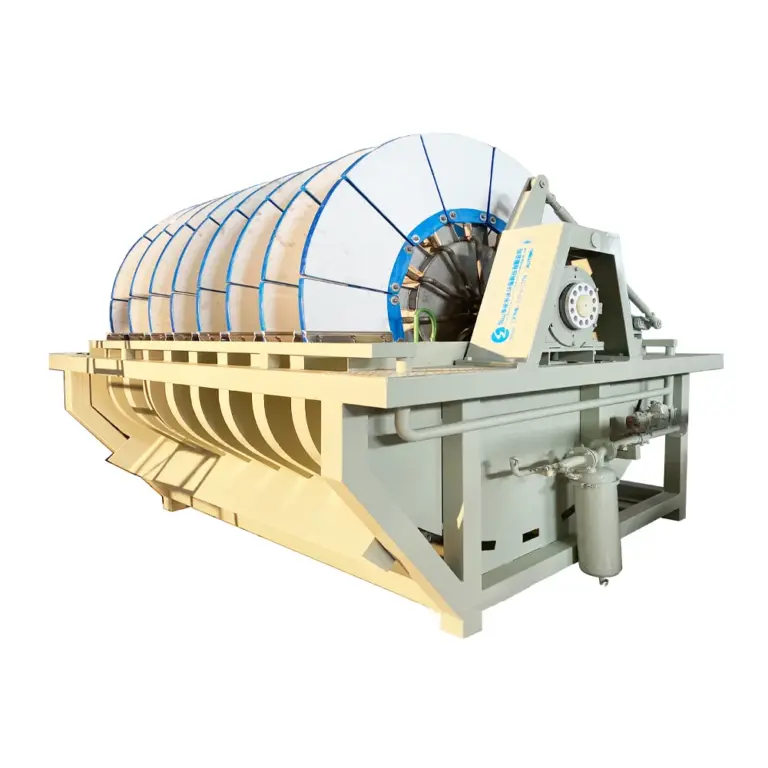
On PORVOO, the terms vacuum disk filter, vacuum disc filter, ceramic vacuum filter, и vacuum ceramic disc or disk filter refer to the same ceramic-media equipment family. This terminology note is important when comparing older PORVOO articles or preparing a filtration inquiry.
The advantages of a ceramic disc filter are conditional, not universal. The equipment can offer useful process characteristics when the slurry forms a suitable cake, the ceramic medium matches the solids and chemistry, the vacuum and rotation are stable, and cleaning restores the filtering surface. A selection decision should therefore examine both potential value and the conditions required to realize it.
1. Continuous filtration in a compact rotating arrangement
Multiple ceramic sectors rotate through cake formation, dewatering, discharge, and regeneration zones. Different sectors can be at different stages of the cycle at the same time, supporting continuous filtration without turning the entire process into a batch sequence.
This arrangement can provide substantial filtration area around a common shaft, but useful capacity still depends on the feed and the selected configuration. A compact layout is not evidence that a smaller unit will meet a particular duty; filtration area and operating margin must be established from representative process data.
2. Vacuum and capillary-assisted dewatering
Vacuum moves liquid through the porous ceramic medium while solids form a cake on the surface. Once a sector leaves the slurry, continued vacuum supports further dewatering before discharge. The ceramic pore structure also contributes capillary behavior within the medium.
For a compatible feed, this can support a cake condition that is easier to handle or requires less downstream drying. The actual cake result is controlled by particle distribution, solids concentration, cake permeability, vacuum stability, rotation time, and discharge behavior. It must be demonstrated rather than inferred from a generic comparison.
3. Filtrate separation that can be monitored
The ceramic surface retains cake-forming solids while filtrate passes into the internal collection system. Consistent filtrate appearance can be useful as an operating signal: a change may indicate a damaged sector, a seal problem, unstable cake formation, an abnormal feed, or another loss of process control.
Whether the filtrate is suitable for reuse or another process step depends on an application-specific quality requirement and actual read-back data. “Clearer filtrate” should not be treated as a guaranteed specification without sampling and an agreed acceptance method.
4. Regenerable ceramic filtering surfaces
Ceramic sectors are intended to remain in service through repeated filtration and cleaning cycles. Backwash and, where included in the selected system, other regeneration methods can address deposits that reduce permeability. This can reduce reliance on routine disposable cloth changes in suitable duties.
That does not establish a universal service life or maintenance interval. Abrasion, chemistry, thermal conditions, scraper alignment, cleaning practice, and handling all affect the condition of the sectors. Selection should include an inspection and cleaning plan as well as a method for recognizing irreversible damage or blinding.
5. Process value beyond the filter itself
The most relevant benefit is often the effect on the wider process. A stable cake may improve conveying or the next processing step. A filtrate that meets the site’s criteria may support water management or recovery. Continuous operation may reduce interruptions in an upstream or downstream process.
These benefits are possibilities to test, not promises of energy savings, return on investment, waste reduction, or environmental performance. A valid business case requires measured baseline data, an agreed trial or reference basis, and a comparison that includes the complete installation and downstream effects.
Limitations and non-fit conditions
A ceramic disc filter may not be the right choice when the feed cannot form a stable, permeable cake; the solids blind the selected ceramic medium faster than it can be regenerated; the cake does not release reliably; the slurry or cleaning method is incompatible with wetted materials; or the required result lies outside what representative testing can demonstrate.
Feed variability also matters. A configuration selected for one particle distribution or solids concentration may not remain stable when the process changes. The evaluation should identify the expected operating envelope and what the operator should do when the feed moves outside it.
What to verify before purchase
- Feed evidence: representative solids concentration, particle distribution, chemistry, temperature, and variation.
- Cake criteria: required handling condition, discharge behavior, and the method used to assess the result.
- Filtrate criteria: the quality needed for discharge, reuse, or downstream processing, plus a sampling plan.
- Capacity basis: the filtration area and operating margin required for the duty, supported by representative evidence.
- Cleaning and maintenance: regeneration method, inspection access, wear points, and response to declining permeability.
- System integration: slurry delivery, agitation, vacuum, filtrate handling, cake conveying, controls, utilities, and safe access.
Choose the right next page
Read what a vacuum ceramic disk filter is and how its cycle works for the technical foundation. If you already operate a unit, use the guide to monitor and improve ceramic disc filter efficiency. For process-fit and configuration work, continue to the vacuum ceramic disk filter equipment page.