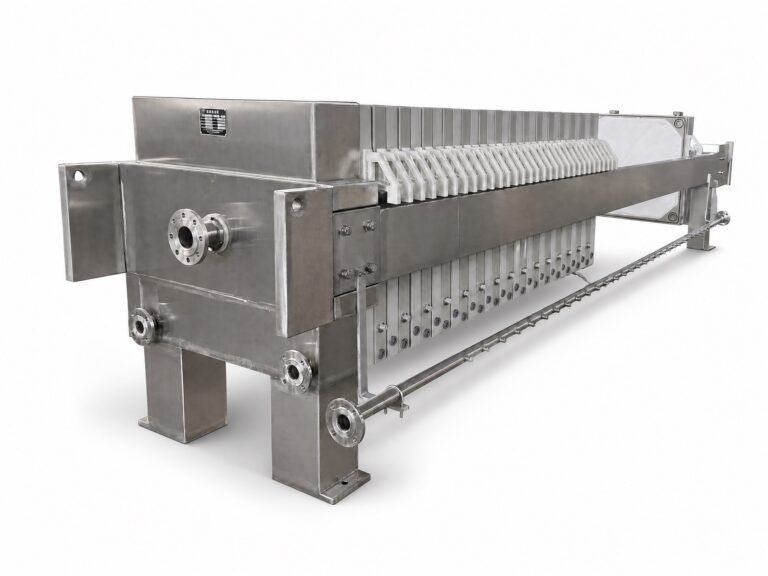
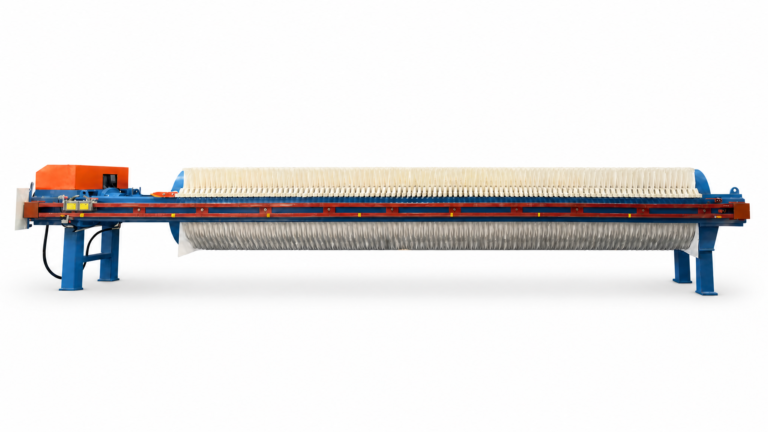
Raising press pressure is the default response when filter cake comes off wet, and it is often the wrong one. In stone plant operations, the pressure has frequently already been increased by the time a maintenance call is made—yet cake moisture stays high, cloth wash cycles multiply, and replacement intervals shorten without any lasting improvement. The real cost is rarely the pressure setting; it is the accumulated effect of a feed problem, a chemistry gap, or an upstream sludge handling failure that has been misread as a mechanical one. Working through the checks below gives operations and maintenance teams a structured way to identify where the process is actually failing before that misreading becomes an expensive equipment decision.
Check whether the feed is too dilute or too variable
Filter presses are designed to work within a functional range of feed solids concentration. When the feed falls significantly below that range, the press is asked to extract moisture from a slurry that has not yet been conditioned to release it efficiently—longer filtration times result, and cake moisture rises regardless of operating pressure. In one documented case involving coal froth flotation concentrate at approximately 10% solids, unheated cake moisture reached 31.0% at standard belt rotation speed. That figure is specific to its feed material and should not be read as a design threshold for stone plant sludge, but it illustrates the direction of the relationship: highly dilute feeds consistently challenge dewatering efficiency.
Feed variability creates a subtler problem than sustained dilution. If solids concentration swings between batches or across shifts, the press cycle cannot be tuned to handle all conditions reliably. A cycle optimised for a 25% solids feed will either under-dewater a 15% feed or run unnecessary time on a 30% feed. Where suspended solids measurement is being used to characterise feed consistency, ISO 11923:1997 provides a testing framework for determining suspended solids in water, though the standard itself does not prescribe acceptable concentration ranges for press operation.
The practical check here is not to identify a single target concentration but to establish whether feed solids are being monitored at all before the feed enters the press, and whether there is any mechanism—thickening, sedimentation, sump residence time—to buffer variability before it reaches the filtration stage.
Test floc quality before increasing press pressure
Poor floc quality is one of the conditions most commonly overlooked before a plant escalates to mechanical adjustments. Inadequate pre-treatment and improper chemical dosing are established contributors to high cake moisture; the issue is that their effects look similar to those of a mechanical fault—wet, poorly releasing cake—so the diagnosis gets deflected toward the press itself.
Floc structure determines how effectively moisture can drain through the cake during the filtration cycle. Weak, poorly formed floc breaks under pressure rather than consolidating, allowing fine particles to migrate into the cloth and block drainage channels. Increasing press pressure on top of weak floc compounds the problem rather than resolving it.
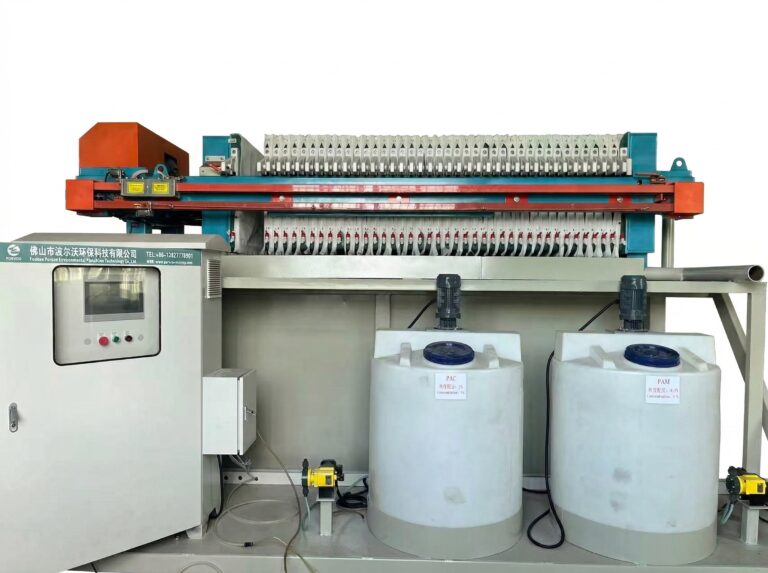
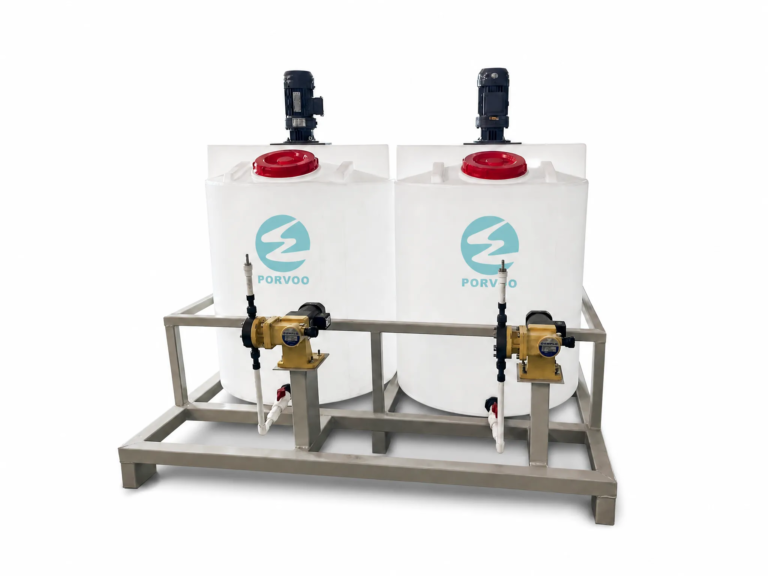
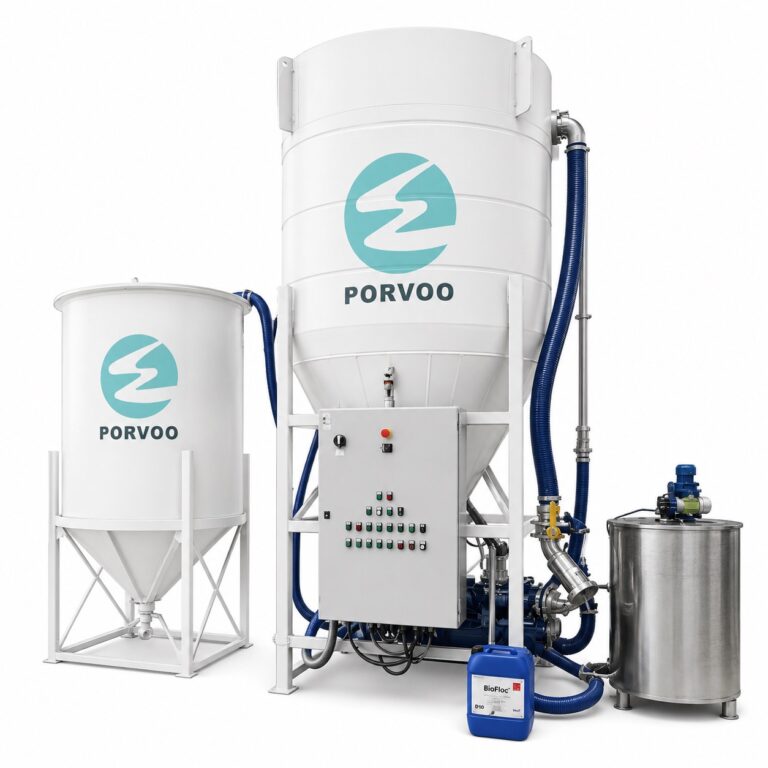
The appropriate check before adjusting press settings is a jar test on the actual plant sludge at current operating conditions, using the polymers and coagulants being dosed in production. This gives a direct visual indication of floc size, strength, and settling behaviour before committing to a dose change or a pressure adjustment. Chemical dosing that responds automatically to feed variability—rather than running at a fixed rate—is worth evaluating where feed composition fluctuates across shifts. A Интеллектуальная система дозирования химических веществ PAM/PAC can modulate dose rates to match changing feed conditions, though the underlying floc quality still needs to be confirmed through testing rather than assumed from dosing rate alone.
Inspect cloth blinding cake release and wash effectiveness
Cloth condition is the most physically accessible variable in the troubleshooting sequence, and it is frequently the one that reveals upstream problems. Blinded cloths are partly a symptom: fine particles and chemical residues accumulate in cloth fibres when pre-treatment is insufficient or when the feed contains a high proportion of colloidal material. The blinding itself then becomes an independent cause of wet cake by restricting the drainage pathways that filtration pressure depends on.
The practical implication is that cleaning schedules driven only by visible contamination or a fixed calendar interval may not be adequate. If filtration cycle times are lengthening progressively between scheduled washes, that trend is a more reliable indicator that cloth condition is degrading than any single inspection. Where filter performance assessment is relevant, GB/T 30176-2013 provides a testing framework for measuring filter performance, though it does not prescribe cloth cleaning intervals or service life criteria.
Cloth selection adds a second failure mode that operates independently of blinding. A cloth with pore size or material specification mismatched to the actual particle size distribution of the sludge will allow fine particles to pass, increase filtrate turbidity, and allow retained fines to compact against the cloth surface rather than building a stable cake. This is not a maintenance issue—it is a specification issue that requires evaluation of whether the installed cloth is appropriate for the feed being processed.
| Observation | Likely Cloth Issue | Влияние на обезвоживание |
|---|---|---|
| Filtration cycles become longer, filter cake remains wet | Blinded or worn cloths | Reduced liquid flow through the cake |
| High cake moisture despite normal operation | Improper cloth material or pore size (poor water permeability) | Inefficient moisture drainage |
| Wet, slimy filter cake | Cloths require cleaning | Persistent moisture and poor cake release |
When slimy, poorly releasing cake persists after a cloth wash, that is a signal that cleaning effectiveness needs to be assessed rather than simply repeated. A cloth that returns to reduced permeability within a short period after cleaning is either beyond service life or being asked to handle a feed it was not specified for.
Review cycle time chamber depth and pressure ramping
Cycle time and chamber geometry interact in ways that are not obvious until one of them becomes the binding constraint. Short cycle times are a recognised cause of wet cake: if the filtration stage ends before the cake has consolidated sufficiently, residual moisture in the cake structure has not had time to drain. The temptation is to compensate by increasing pressure, but pressure accelerates the rate of filtration—it does not substitute for adequate time at pressure if the cake permeability is already low.
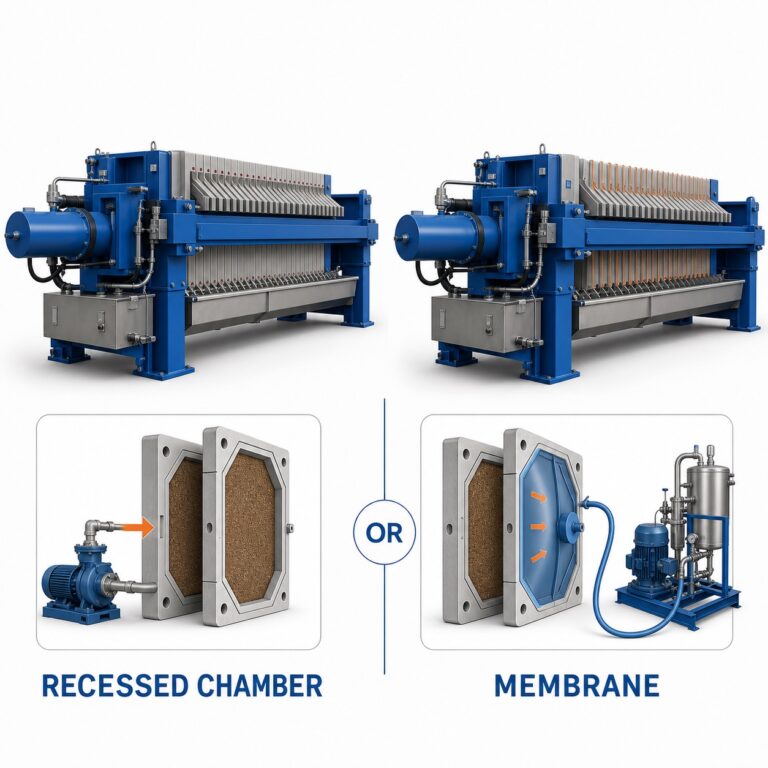
Chamber depth introduces a trade-off that moves in the opposite direction. Thicker cakes can increase throughput per cycle, but they can also retain more moisture because the drainage path length through the cake increases. Deeper chambers do not reliably produce drier cakes on their own; they are a design parameter that needs to be matched to the specific compressibility and particle size distribution of the sludge being processed. Optimising chamber depth without first stabilising feed consistency and pre-treatment is a common mistake—the depth is adjusted, cake moisture remains variable, and the chamber geometry gets blamed for a problem that is actually upstream. For a more detailed discussion of how chamber depth decisions interact with target moisture content, the article on recessed filter press cake thickness optimisation examines this relationship by industry context.
Pressure ramping deserves attention as a separate parameter. Applying full pressure immediately at the start of the cycle can cause the filter cloth to blind rapidly if the sludge has not yet formed a stable pre-coat. A staged ramp that allows an initial filter cake layer to build before full pressure is applied is often more effective at maintaining cloth permeability across the cycle—but the optimal ramp profile is specific to the sludge and cannot be determined without operational trials on the actual feed.
Look upstream at grit removal and sludge withdrawal
Fine particle content in the feed has a measurable effect on cake moisture that cannot be corrected at the press. Fine particles—particularly those passing a 200-mesh sieve—form dense, low-permeability cake layers that resist drainage regardless of pressure or cycle time. When a high proportion of the feed consists of these fine fractions, the cake structure itself becomes the drainage barrier.
Desliming upstream, using classification equipment such as hydrocyclones to remove the finest fraction before the feed reaches the press, reduces this effect. In a documented comparison involving coal slurry, the relationship between feed particle size and cake moisture was clear:
| Feed Condition | Minus 200 mesh content | Влажность пирога |
|---|---|---|
| Original feed (coal slurry) | 79.9% | 23.6% |
| Deslimed feed (cyclone underflow) | 39.5% | 19.3% |
These figures are specific to coal slurry and should be treated as illustrative of the particle-size effect, not as moisture outcomes that translate directly to stone plant sludge. The underlying principle—that reducing the fine fraction in the feed improves cake drainage—is well supported, but the degree of improvement will depend on the specific mineralogy and particle size distribution present in any given plant.
Sludge withdrawal consistency from the clarifier is a related upstream variable that is frequently overlooked in troubleshooting. Intermittent or poorly timed withdrawal produces feed surges with elevated fines content and variable solids concentration. Where sludge withdrawal is being assessed for consistency, ISO 5667-13:2011 provides a sampling framework for characterising sludge, though the standard addresses sampling methodology rather than withdrawal scheduling. The practical check is whether the clarifier underflow is being withdrawn at a rate and frequency that maintains stable sludge blanket depth, rather than allowing accumulated sludge to compact and then be discharged in concentrated slugs.
Separate equipment faults from process-control faults
Conflating equipment faults with process-control faults leads to misallocated maintenance effort and deferred resolution of the actual root cause. The two categories require different responses: equipment faults are corrected through inspection, repair, or component replacement; process-control faults are corrected through operational discipline, training, or control system adjustment.
Poor maintenance produces inefficiencies that increase cake moisture through mechanisms that are distinct from process-control failures—worn seals, degraded diaphragms, hydraulic pressure loss, or misaligned plates each affect dewatering performance in ways that no amount of dosing optimisation or cycle-time adjustment will fix. Equally, a well-maintained press operated with inconsistent dosing practices or poorly timed cycles will deliver variable results that do not point to any mechanical fault.
| Fault Category | Пример | Результат |
|---|---|---|
| Equipment fault | Poor maintenance | Inefficiencies leading to wetter filter press cake |
| Process-control fault | Lack of operator training | Mismanagement of dewatering, complicating moisture control |
The diagnostic value of this distinction is that it prevents the investigation from stalling at symptoms. If cake moisture improves after a cloth wash but deteriorates again within a short period, the fault category is process-related—the feed or chemistry is driving accelerated blinding. If cake moisture is consistently poor across all feed conditions and does not respond to pre-treatment adjustment, an equipment fault is more likely. Mapping symptoms to categories before committing to corrective action reduces the risk of spending maintenance time on the wrong system.
Fix the bottleneck before resizing the press
Resizing a press is a capital decision that resolves a capacity constraint, not a process failure. When wet cake is the presenting problem, increasing press size increases the volume of wet cake being produced—it does not address the cause of excess moisture. The same principle applies to adding chambers, increasing operating pressure beyond the current design rating, or shortening cycle frequency: each of these adjustments works against the process rather than with it if the underlying feed, chemistry, or cloth conditions are not first stabilised.
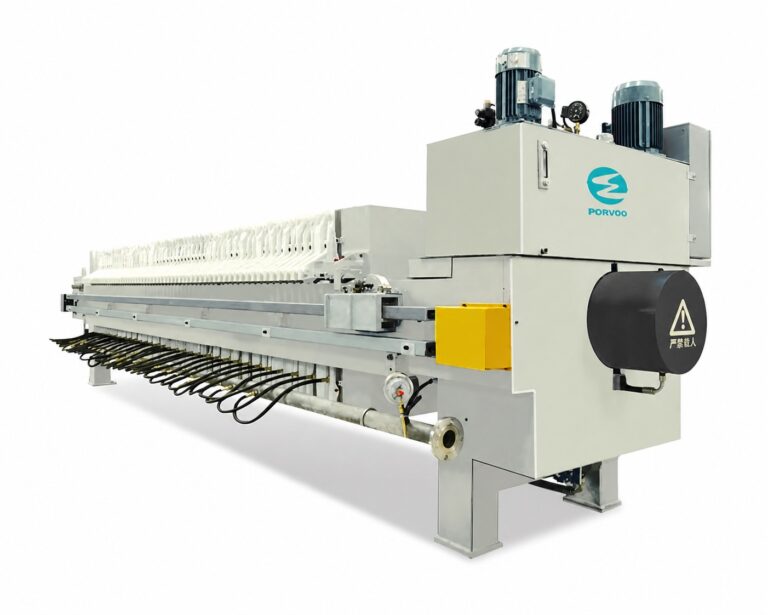
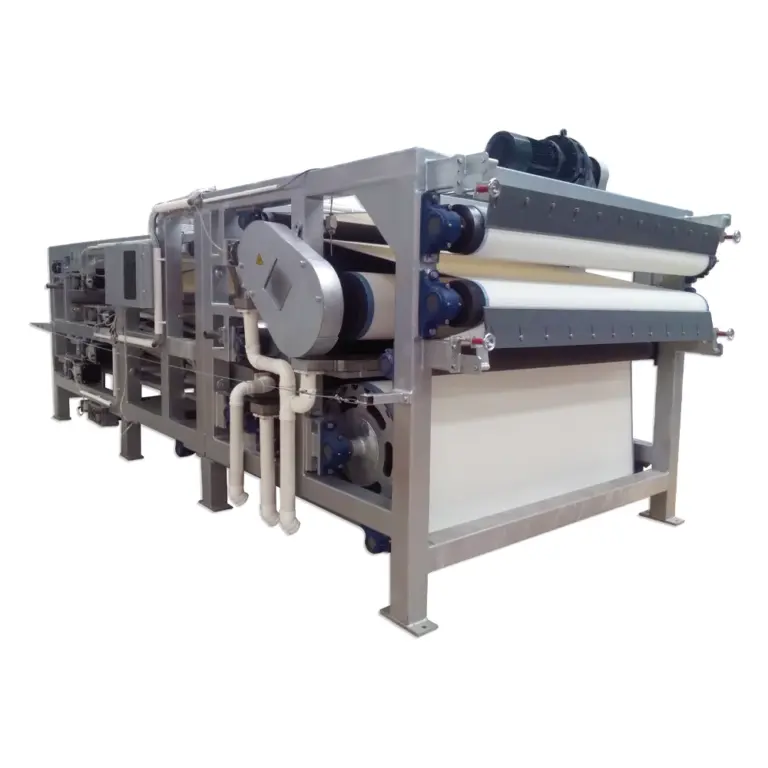
The practical planning risk is that a process-control failure—variable feed solids, inadequate flocculation, accumulated fines—gets reframed as a capacity problem once it persists long enough. At that point, the procurement case for a larger press has already been built around the wrong diagnosis. A пластинчато-рамный фильтр-пресс с углублением correctly specified for a stable, well-conditioned feed will consistently outperform an oversized press running on variable, poorly flocculated sludge. The comparison between press types involves additional operational trade-offs that extend beyond sizing alone; the belt filter press vs recessed plate press operational comparison covers maintenance hour implications that are worth reviewing when a replacement or expansion decision is being evaluated.
Identifying the bottleneck before resizing requires working through the upstream and in-press variables in sequence: feed consistency, pre-treatment adequacy, cloth condition, and cycle parameters each need to be assessed against the current operating data before the conclusion that additional capacity is the limiting factor. That sequence is not a procedural formality—it is the difference between a press that solves the problem and one that scales it.
Wet cake in stone plant operations almost always traces back to a variable that was either not being monitored or was being compensated for rather than corrected. Feed solids consistency, floc quality, cloth condition, and upstream particle size distribution each impose a ceiling on achievable cake dryness that press pressure cannot overcome. Before any equipment change is justified, the process variables need to be characterised under actual operating conditions—not estimated from commissioning data or assumed to be within specification.
The next useful step is to establish whether feed solids and fines content are being measured with sufficient frequency to detect variability across shifts, and whether the pre-treatment system is being operated to the conditions the press was designed for. If those two checks cannot be confirmed from current plant records, they are the appropriate starting point—not a press specification review.
Часто задаваемые вопросы
Q: What if our stone plant doesn’t have a thickener or dedicated grit removal system upstream?
A: The troubleshooting sequence still applies, but the emphasis shifts to what you can control at the press. Without upstream classification, fine particles will reach the cloth regardless; focus on confirming that feed solids are as consistent as possible (even if they’re low) and that floc quality is strong enough to bind fines into a permeable cake. Jar testing with the actual sludge becomes the single most important diagnostic, because you can’t rely on upstream desliming to mask poor conditioning.
Q: We’ve confirmed our feed solids fluctuate across shifts. What’s the simplest operational fix to try before buying new equipment?
A: Start by adjusting clarifier sludge withdrawal timing and frequency to stabilise the sludge blanket. Intermittent or slug withdrawals are often the hidden driver of variable solids, and smoothing them can reduce feed swings with no capital spend. Next, investigate whether an existing sump or buffer tank can be used to extend residence time and let solids equalise before the press feed pump—even a modest buffer can dampen the worst of the variability without a permanent installation.
Q: At what feed solids concentration does a recessed plate press become clearly unsuitable for stone sludge?
A: There is no fixed number, but a plant consistently measuring feed solids below 5–8% after all available thickening steps should question whether the press can ever meet its moisture targets economically. Below that range, cycle times stretch, cloth blinding accelerates, and chemical cost per dry ton can become prohibitive. At that point, the evaluation should shift from press optimisation to whether the overall solids-handling train (including pre-thickening or an alternative dewatering technology) is the right fit.
Q: When does it make more sense to use a belt filter press instead of a recessed plate press for stone plant sludge?
A: A belt press can be the more practical choice when the sludge is consistently thin, the volume is high, and continuous operation is preferred over batch cycles, but it often produces a wetter cake than a well-conditioned recessed press can achieve. The decision turns less on feed consistency alone and more on your acceptable cake moisture ceiling, available operator attention, and maintenance budget—issues detailed in operational comparisons that go beyond sizing decisions.
Q: Our cake moisture is only a couple of percent above spec and the problem is intermittent. Is an intelligent chemical dosing system worth the investment?
A: If those moisture excursions are causing measurable downstream costs—extra handling, dryer fuel, haulage weight penalties, or cloth replacement acceleration—then a Интеллектуальная система дозирования химических веществ PAM/PAC can pay back quickly by matching dose to real-time feed conditions. If the excursions are rare and the cost impact is minor, it’s more cost-effective to first optimise fixed dosing through jar testing and operator training, then monitor whether variability truly justifies automation.