Stone slurry arrives at a clarifier because it has to go somewhere, not because it has already been shown to need chemical help getting there. The real question a plant manager or process engineer faces is whether the settling behavior of that specific slurry, on that specific site, justifies adding a conditioning step before the water moves on. Answering it requires evidence about the slurry itself, not an assumption drawn from the fact that stone processing produces suspended fines.
Settling Problems That Point to a Conditioning Question
| Screening point | Evidence to compare | Decision boundary |
|---|---|---|
| Stone slurry is present | Material identity alone | Presence alone does not justify chemical dosing. |
| Settling behavior | Representative untreated samples across shifts | A clarification problem must be shown before conditioning is considered. |
| Supernatant clarity | Untreated clarity compared with the project’s downstream reuse or discharge need | The applicable clarity need is project specific; this comparison supports a trial question, not a final dose. |
Chemical dosing is a response to a demonstrated clarification problem, not a default step attached to stone slurry as a material category. Fine stone particles can carry surface charge and particle-size distributions that resist settling under gravity alone, but whether that resistance actually prevents the plant from reaching its clarity target is a separate question from whether the slurry contains fines. A slurry can look difficult and still settle adequately within the time and tank volume the site provides; another slurry, visually similar, can leave a cloudy supernatant that never clears within the same residence time. The only way to tell them apart is to observe settling behavior directly, under conditions that resemble how the material actually arrives at the clarifier.
This matters because dosing chemistry adds cost, handling, and control complexity that the project should not carry unless the underlying settling behavior requires it. Where the raw slurry settles cleanly and produces supernatant that already meets the downstream reuse or discharge need, introducing a coagulant or flocculant changes the sludge character and dosing logistics without solving a problem that did not exist. Where representative samples show slow settling, a persistent turbid layer, or supernatant clarity that falls short of what downstream reuse or discharge requires, that gap is the evidence that opens the conditioning question — not the fact that the feed is called stone slurry.
The comparison has to be made against the project’s own downstream requirement, because “clear enough” is not a fixed value. A stream headed for uncontrolled discharge to a sensitive receiving environment carries a different clarity expectation than a stream being recirculated back into the cutting or polishing process, where some residual turbidity may be tolerable as long as it doesn’t damage equipment or product surface finish. Establishing that reference point before judging the settling test results keeps the screening decision tied to what the project actually needs, rather than to a generic clarity impression.
Feed Samples Needed Across Production Variability
A single sample, taken once, describes one moment of one process, not the range of conditions a clarifier or dosing system will actually see. Stone processing operations shift their feed character with the stone type being cut, the cutting or polishing method in use, blade or tool wear, water recirculation ratios, and even the sequence of jobs run across a shift. Each of these can change particle size distribution, solids loading, and the surface chemistry of the fines suspended in the slurry. A sampling plan built around one grab sample risks characterizing an atypical moment and missing the conditions that actually drive settling problems.
Representative sampling means collecting slurry across the shifts, stone types, and process states the plant actually runs, then comparing settling behavior, clarity, pH, and suspended solids across that full set rather than treating any single sample as definitive. Where production variability is wide, evaluating only the easiest feed condition can produce a conditioning judgment that fails when the harder feed condition arrives, and evaluating only the hardest condition can lead to over-dosing a stream that spends most of its time in an easier state. Sound sampling practice, as reflected in guidance such as ISO 5667-10 on wastewater sampling programmes, treats the sampling site, timing, frequency, and sample handling as project-specific decisions that need to match how the process actually varies — not a fixed recipe applied regardless of what the plant produces.
This variability also has a direct bearing on how a dosing system, if one is eventually justified, needs to be controlled. A feed that shifts materially across shifts calls for a control approach capable of adjusting to that shift, whereas a feed that stays relatively consistent across production states supports a simpler, more fixed dosing approach. Establishing the range up front, before any dosing trial, keeps that later configuration decision grounded in what the feed actually does rather than in an assumption about stone slurry in general.
pH, Suspended Solids, and Clarity Measures for a Baseline
| Baseline measure | Record across representative untreated samples | Interpretation boundary |
|---|---|---|
| pH | pH results across shifts | ISO 10523 provides a measurement method; it does not set a discharge or reuse limit. |
| Взвешенные твердые вещества | Suspended-solids results across shifts | ISO 11923 provides a glass-fibre filtration method with interferences; it does not set a treatment guarantee or legal limit. |
| Supernatant clarity | Clarity across shifts and the downstream reuse or discharge need | Interpret clarity against the project-specific downstream need; it does not establish the final dose by itself. |
Once representative samples exist across the production range, they need to be measured against consistent baseline parameters before any conditioning trial begins. pH, suspended solids, and supernatant clarity each describe a different aspect of the slurry, and each has a distinct role in — and a distinct limit on — the conditioning decision.
pH affects the surface chemistry of suspended fines and can influence how a coagulant or flocculant performs once introduced, which is why it belongs in the baseline record even before any chemical is added. Measuring it consistently across the sampled range, using a method such as the one described in ISO 10523 for pH determination in water and wastewater, gives the reader a comparable pH figure for each sample. But that standard describes a measurement method only; it does not set a discharge or reuse limit, so a pH reading by itself does not tell the reader whether the water is fit for its intended destination. That judgment still depends on the project’s own downstream requirement.
Suspended solids measurement, following a method such as ISO 11923’s glass-fibre filtration approach, quantifies how much particulate load the untreated slurry carries in each sample. This figure helps characterize how demanding the settling task is likely to be, but the method carries known interferences and does not itself establish a treatment guarantee or a legal limit the plant must meet. A high suspended-solids reading signals that the settling task may be more demanding; it does not, on its own, prove that dosing is required, because some high-solids slurries still settle adequately given sufficient residence time and appropriate tank geometry.
Supernatant clarity is the measure most directly tied to the reader’s actual decision, because it describes the outcome the downstream reuse or discharge need actually cares about. Comparing untreated clarity across the sampled range against that stated downstream requirement is what turns pH and suspended-solids data into an interpretable answer. Where clarity already meets the requirement across the full range of sampled conditions, the baseline itself may be sufficient to conclude that dosing is not warranted. Where it falls short under some or all sampled conditions, the baseline becomes the reference point against which any subsequent dosing trial is judged — not the final dose itself, since a baseline measurement describes the untreated condition, not the chemical response.
Controlled Dosing Trials and Observations to Record
| Trial record | What to compare across the expected feed range | Decision use |
|---|---|---|
| Chemical addition | Addition used in each controlled trial | Relate the addition to the observed response rather than selecting a setpoint from one clear beaker. |
| Смешивание | Mixing recorded for each trial | Keep the comparison tied to recorded mixing as well as chemical addition. |
| Floc behavior | Floc observations under each trial condition | Compare how conditioning response changes across the feed range without treating one observation as the final setting. |
| Заселение | Settling observations under each trial condition | Compare clarification response across feed variability. |
| Sludge volume | Sludge volume under each trial condition | Include sludge-volume differences in the dosing decision. |
Once baseline data shows a genuine clarity gap, the next step is a controlled trial, not a plant-wide setpoint decision made from a single test. A dosing trial exists to observe how the slurry responds to chemical addition across the same feed range the baseline established, because a dose that performs well against one feed condition can underperform or overshoot against another. Selecting a setpoint from one clear beaker test, run against a single grab sample, risks locking in a dose that only works for the condition that happened to be sampled that day.
A useful trial records more than whether the water cleared. Chemical addition — the type and amount used in each trial run — needs to be logged against the specific feed condition it was tested on, so the relationship between dose and feed variability becomes visible rather than assumed. Mixing conditions matter alongside chemical addition, because coagulation and flocculation depend on adequate contact and floc formation, and a dose that fails under one mixing condition may succeed under another without any change in chemical addition at all. Floc behavior — how particles aggregate, the size and strength of the floc that forms, and whether it holds together under handling — indicates whether the chemistry and mixing are compatible with this particular slurry’s chemistry, and comparing floc behavior across the full trial set, rather than trusting one favorable observation, shows whether that response holds across the feed range.
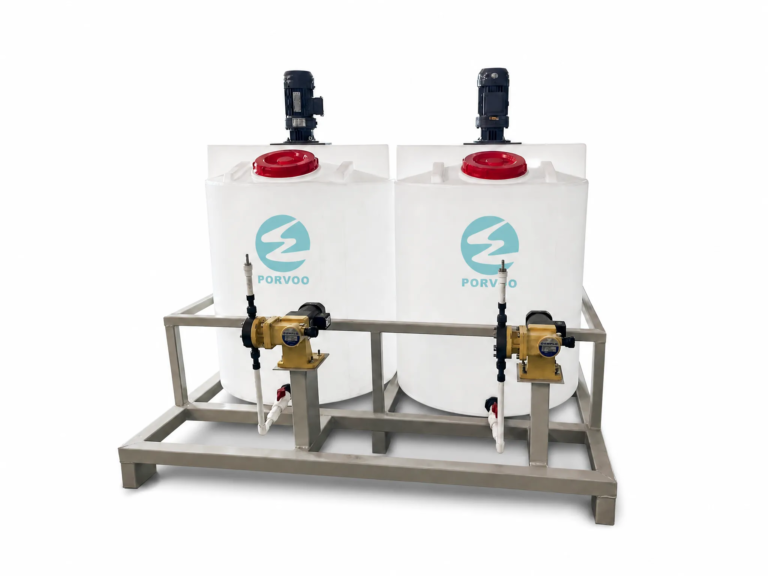
Settling behavior under each trial condition should be recorded and compared the same way the baseline settling was compared, so the trial produces an apples-to-apples improvement measure rather than an isolated observation. Sludge volume generated under each condition matters as well, because a dose that clarifies the supernatant while producing a disproportionately large or difficult sludge volume shifts the burden downstream to dewatering and cake handling rather than resolving it. Where floc strength, settling response, and filtrate quality are the specific focus of the trial, that relationship between dosing chemistry and floc characteristics is the same territory covered in dosing-focused evaluations of stone processing wastewater — the trial record described here is what generates the evidence such an evaluation would need. The project team reviewing these trial records, together with the baseline data and the site’s feed variability, is also the information a supplier’s configuration or quotation review depends on when sizing a dosing system such as a Интеллектуальная система дозирования химических веществ PAM/PAC to the site’s actual range rather than to a single test result.
Grit Removal and Mixing Problems to Exclude First
| Issue to exclude | Evidence check | Dosing boundary |
|---|---|---|
| Coarse grit | Check whether coarse particles are disturbing pumps or clarifier feed. | Address grit removal first; chemical dosing is not a substitute for mechanical removal. |
| Mixing problem | Compare the recorded mixing with floc behavior and settling in controlled trials. | A response under one mixing condition does not by itself establish the final dose; control logic remains project specific. |
Before attributing a settling or clarity problem to insufficient chemical dosing, the project should confirm that the problem is not actually a mechanical one. Coarse grit disturbing pump performance or arriving inconsistently at the clarifier feed can produce settling and clarity symptoms that look similar to an undosed or under-dosed slurry, but no amount of coagulant or flocculant corrects a problem that originates upstream in grit carryover. Where coarse particles are reaching the clarifier or disrupting pump operation, addressing grit removal is the first step, because chemical dosing is not a substitute for mechanical separation of material that a grit removal stage is meant to handle. This sequencing question is the same one addressed by evaluations of grit removal for stone slurry wastewater aimed at protecting pumps, clarifiers, and filter presses from coarse material that never should have reached them.
Mixing problems present a similar risk of misattribution. A dosing trial that shows weak floc formation or poor settling might reflect a genuine chemistry mismatch between the dose and the feed, or it might reflect inadequate mixing that never gave the chemical a chance to contact the suspended particles effectively. Comparing the recorded mixing conditions against the floc behavior and settling results from the controlled trials is what distinguishes these two explanations. A response observed under one mixing condition does not, by itself, establish that a different dose is needed; it may instead indicate that the mixing regime needs adjustment before the chemistry itself can be fairly judged.
This exclusion step protects the project from two different missteps. Increasing chemical dose to compensate for a grit or mixing problem adds cost and complexity without resolving the underlying mechanical issue, and it can also produce operating data that looks like a stable dosing regime when it is actually masking a mechanical limitation that will resurface under different feed conditions. Confirming that grit is under control and that mixing is adequate before finalizing a dosing decision keeps the eventual control logic tied to actual chemistry response rather than to symptoms of an unrelated mechanical gap — and that control logic, like the dose itself, remains specific to the project’s feed chemistry and site conditions rather than a fixed setting carried over from another site.
Project Evidence That Supports a Dosing Decision
Pulling this together, a dosing decision is supported when three separate pieces of evidence point the same direction: baseline sampling across production variability shows a clarity or settling gap against the project’s own downstream requirement; grit removal and mixing have been confirmed adequate, so the gap isn’t a mechanical artifact; and controlled trials, run across the same feed range, show a chemical addition and mixing combination that produces settling, floc behavior, and sludge volume the project can work with. Where all three line up, the case for dosing rests on demonstrated behavior rather than on an assumption about stone slurry as a material.
Where the evidence is incomplete, the gap itself indicates what to gather next. If sampling has only covered a narrow slice of production conditions, the missing piece is broader feed characterization before any dosing conclusion is drawn. If grit removal hasn’t been separately confirmed, the settling problem observed in baseline testing may resolve once coarse material is properly excluded, changing or eliminating the case for dosing entirely. If trials have been run but only under one mixing condition or one point in the feed range, the missing piece is trial coverage across the range the baseline already established as variable.
Where this evidence does support moving toward equipment, the way the pieces fit together also shapes what configuration makes sense. A feed that stays within a narrow, well-characterized range across production conditions supports a more fixed dosing configuration paired with straightforward downstream settling, potentially in equipment such as a вертикальная осадочная башня sized to the confirmed feed and clarity target. A feed that varies substantially across the conditions sampled supports a dosing configuration with more responsive control logic, and where the broader goal includes recovering process water for reuse within a stone or ceramic plant rather than only meeting a discharge target, that same evidence — baseline gap, excluded mechanical causes, and trial-confirmed dosing response — is what a modular water recycling configuration for ceramic and stone operations would need to be sized against. In either case, the dose and control logic that follow remain specific to what this evidence showed for this feed, not a setting transferred from a different site’s slurry.
Часто задаваемые вопросы
Q: Does the presence of stone slurry automatically justify chemical dosing?
A: No. First establish a clarification problem by comparing representative untreated samples across shifts for settling behavior and supernatant clarity against the project’s downstream reuse or discharge need.
Q: Can one successful beaker test be used as the operating setpoint?
A: No. Run controlled trials across the expected feed range and compare chemical addition, mixing, floc behavior, settling, and sludge volume; the final dose and control logic must reflect the project’s feed chemistry and variability.
Q: Do pH and suspended-solids results determine the required dose?
A: No. They provide baseline measurements, but the cited ISO methods do not set a dose, treatment guarantee, or legal limit; interpret them alongside settling, clarity, and the project’s downstream need.
Q: What should be done if coarse grit is disturbing pumps or clarifier feed?
A: Address grit removal first, because chemical dosing is not a substitute for mechanical removal. Reassess settling and clarity after the grit issue has been separated from the conditioning question.
Q: What project information should be ready before choosing a dosing approach?
A: Prepare the expected feed range, representative samples across shifts, baseline pH, suspended-solids and clarity results, the reuse or discharge need, grit and mixing checks, and a controlled-trial record including sludge volume.