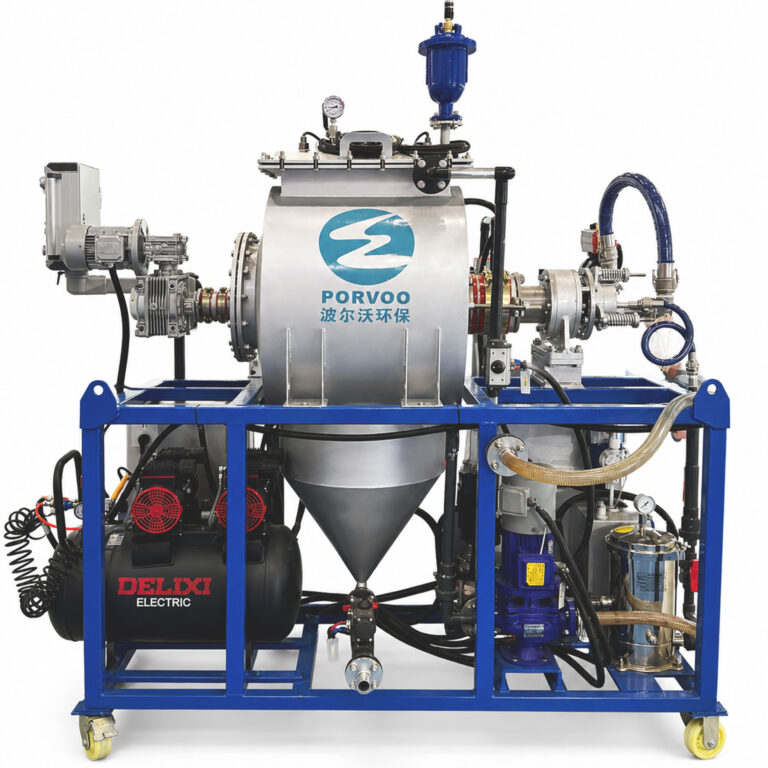
A press rated from a single trial run often disappoints once production variability shows up, and the gap usually traces back to how the pilot was framed rather than how the press was built. Before a recessed-chamber filter press gets sized, the pilot has to answer a narrower question than “did it filter”: it has to show whether the feed, the cycle, and the operating conditions tested represent what the production unit will actually see.
What the pilot must resolve before press sizing
A pilot exists to convert an unknown slurry into a defined design input, but that conversion only holds if the pilot is asked to answer the right question. The underlying issue is that a filter press cycle links several interacting variables together — feed solids concentration, particle and floc structure, conditioning chemistry, chamber fill rate, and cycle time — so a single pass/fail observation does not tell the supplier which of these variables is driving the result. If the feed used in testing does not match the range of conditions the production press will receive, the pilot answers a different question than the one the sizing decision needs.
This matters because sizing a recessed-chamber filter press is not a matter of scaling one good result upward. The press configuration — chamber volume, plate count, feed pump duty, cycle time targets — depends on how the solids behave across the range of conditions the plant will actually deliver to it, not on the best single run achieved under favorable sampling. Where the feed stream varies by shift, by upstream process state, or by seasonal conditions, a pilot built around one grab sample risks characterizing only the narrow band of conditions present when that sample was taken.
The pilot therefore needs to resolve three separate questions before any sizing number is proposed. First, whether the test feed is representative of the full range of feed states the press must handle, not just a convenient or favorable state. Second, whether the test conditions (conditioning dose, temperature, feed preparation) are documented well enough that a later reviewer can tell whether a difference in results came from the feed or from how the test was run. Third, whether the cycle was repeated enough on the agreed basis that the result reflects the process rather than one favorable pass. These three questions are addressed separately in the sections that follow, because conflating them is how a representative-sample problem gets mistaken for a press-performance problem, or the reverse.
Representative feed selection and sample controls
| Feed selection or control | What to define or record | Решение поддержано |
|---|---|---|
| Production feed states | The feed states the production press is expected to receive | Whether the pilot lot represents the intended duty |
| Solids condition | The solids condition for each sample | Whether a changed press response coincides with a changed feed condition |
| Кондиционирование | The conditioning basis used for each test | Whether cycle results are being compared on the same feed-preparation basis |
| Температура | The temperature recorded for each test | Whether a temperature change accompanies a different press response |
| Visible variability | Visible variation within or between the samples | Whether one favorable run represents the broader test lot |
| Sampling controls | The project-specific sampling site, preservation, frequency, and laboratory basis | What the sampling programme covers and what remains project-specific |
The core judgment here is whether the test lot stands in for the feed states the production press is expected to receive — not whether the sample filtered well. A sample drawn from one point in a batch process, one stage of a continuous process, or one condition of upstream operation characterizes that condition only. If the production press will receive feed that varies in solids concentration, particle size distribution, or chemical state across its operating life, a single unexplained sample cannot support a sizing decision for the full range, even if that one sample produces an excellent cake.
Recording solids condition, conditioning basis, temperature, and visible variability for each sample is what allows a later reviewer to separate a feed effect from a press effect. If two samples filter differently and no one recorded whether their solids condition or temperature differed, the difference becomes unexplained variability rather than an interpretable result. The Информационный бюллетень Агентства по охране окружающей среды США (EPA) по технологиям переработки биологических отходов: фильтр-прессы с утопленными пластинами, within its scope of municipal biosolids dewatering, supports the general principle that pilot or bench testing is used to inform design decisions and that the feed-pump, cloth, filtrate, and cake-discharge interfaces are part of what the test needs to characterize — a principle that holds for an industrial slurry pilot even though the fact sheet’s own figures do not transfer outside the municipal biosolids route it documents.
Sampling controls — where samples are drawn, how they are preserved before testing, how frequently they are taken, and what laboratory basis supports any companion analysis — are project-specific and are not resolved by a general testing principle. ISO 5667-10, within its scope as a wastewater sampling standard, supports planning a sampling programme and sampling technique, but the site-specific choices of sampling point, preservation method, frequency, and laboratory protocol remain decisions the project team has to make and document, not defaults the standard supplies. Where a project skips this step and tests whatever sample was easiest to obtain, the resulting pilot record cannot support a claim that it represents the press’s intended duty, regardless of how clean the resulting filtrate looked.
Test variables to hold, change, and record
Once feed representativeness is addressed, the pilot has to distinguish a changed input from a changed press response, and that distinction depends on which variables were held constant, which were deliberately changed, and which were simply recorded as context. A pilot that changes multiple variables between cycles — a different cloth, a different feed preparation step, a different pump setting — and then compares the results cannot attribute the outcome to any one of those changes with confidence. The value of a controlled comparison is that it isolates one variable’s effect; the cost is that it takes more cycles to cover the conditions of interest.
Cloth selection affects filtrate clarity and cake release, so if cloth is changed between tests that are otherwise being compared, a resulting difference in filtrate quality could reflect the cloth change rather than a feed or cycle difference. Feed preparation — how conditioning is dosed, mixed, and aged before it reaches the press — affects floc structure and therefore cake formation, so documenting the feed preparation basis for each test is what lets a reviewer separate a conditioning effect from a press effect. Pump behavior during the cycle (feed rate, pressure ramp) affects how solids build inside the chamber, and a cycle run with a different pump profile is not directly comparable to one run with another, even if the feed was identical.
The cycle end point — what signal is used to decide a cycle is complete, whether that is a pressure plateau, a filtrate flow decline, or a fixed duration — needs to be the same across cycles being compared, because changing the end point changes both the apparent cycle time and the resulting cake condition. Filtrate observations (clarity, flow pattern over the cycle) and cake handling (how the cake behaved during discharge, whether it released cleanly) are part of the record for the same reason: they let the supplier see whether an unusual result traces to the feed, the cycle parameters, or the press’s handling of that particular cake. Where any of these are left unrecorded, a result that looks anomalous cannot be diagnosed, and the pilot loses value for sizing purposes regardless of how the filtration result itself looked.
Results the supplier needs for scale-up
| Pilot evidence | Supplier scale-up statement to request | Граница принятия решения |
|---|---|---|
| Observed solids load | How the observed solids load is converted into the proposed press configuration | The conversion applies to the stated test basis and remains subject to site confirmation |
| Recorded cycle basis | How the cycle basis is carried into sizing | A favorable cycle alone is not a capacity guarantee |
| Observed chamber fill | How chamber fill influences the proposed configuration | The proposed configuration still requires site confirmation |
A pilot generates observations; a sizing proposal requires those observations to be converted into press configuration decisions, and that conversion is the supplier’s responsibility to state explicitly rather than leave implicit. The observed solids load from the pilot — how much solids mass the test cycle processed under its recorded conditions — informs chamber volume and plate count, but the conversion from a bench- or pilot-scale solids load to a production configuration involves assumptions about how that load behaves at full scale, under the production feed pump, and across the full range of feed conditions the plant will deliver. Asking the supplier to state that conversion, rather than accepting a proposed configuration without explanation, is what lets the buyer see which parts of the proposal rest on the pilot evidence and which rest on engineering assumption.
The same applies to cycle basis and chamber fill. A recorded cycle time and fill pattern from the pilot describes how that particular test behaved; carrying it into a sizing proposal means assuming the production press, running at its own scale with its own feed pump and piping, will reach a similar fill and cycle pattern. Where the supplier states this conversion and identifies what remains subject to site confirmation, the buyer can evaluate the proposal’s basis. Where the conversion is left unstated, the buyer has no way to know whether the proposed configuration reflects the pilot evidence closely or loosely.
This is also where project information supplied by the buyer enters a supplier’s configuration and quotation review: the pilot record, the feed description, and the site conditions the buyer provides are what the supplier’s sizing calculation works from, and the quality of that sizing is bounded by how complete and well-documented the supplied pilot evidence is. A pilot that recorded only a final result, without the solids load, cycle basis, and fill pattern that produced it, gives the supplier less to work with than one that documented all three, even if both pilots used the same press and achieved the same outcome on the test day.
Sizing assumptions and guarantees to keep separate
| Область принятия решений | Pilot basis to cite | Граница |
|---|---|---|
| Вместимость | Repeated results on the agreed feed and cycle basis | One favorable cycle is not a capacity guarantee |
| Влажность торта | Cake observations and cake handling recorded under the stated test conditions | One favorable cycle is not a moisture guarantee |
| Качество фильтрата | Filtrate observations recorded under the stated test conditions | One favorable cycle is not a filtrate guarantee |
| Final configuration | The supplier’s stated conversion from solids load, cycle basis, and chamber fill to the proposed press configuration | Items remaining subject to site confirmation must stay explicit |
A capacity, moisture, or filtrate figure drawn from a single favorable pilot cycle describes that cycle, not a guaranteed production outcome, and the distinction matters because sizing decisions and performance guarantees rest on different kinds of evidence. Capacity derived from repeated results on an agreed feed and cycle basis reflects a tested range of conditions; capacity inferred from one cycle reflects whatever happened to be true of the feed and conditions on that occasion, which may or may not recur across the production press’s operating life.
The same reasoning applies to cake moisture and filtrate quality. Where cake observations and cake handling were recorded under stated test conditions across repeated cycles, those observations support a sizing assumption about expected cake condition under similar conditions. Where only one cycle produced a favorable cake, that result describes what the press achieved once, under the conditions present that day, and does not by itself establish what the production press will achieve across its full range of feed variability. The same holds for filtrate quality: a single clear filtrate reading does not establish that the press will consistently produce filtrate at that quality once feed conditions shift outside what was tested.
Where the project genuinely needs a capacity, moisture, or filtrate commitment rather than a sizing estimate, the evidence required is different in kind — repeated testing across the feed range the production press will see, not a single successful run. This is a conditional distinction the buyer has to make explicitly: where the decision is press configuration (chamber count, plate size, pump duty), pilot evidence from a representative and adequately repeated test basis can inform that configuration; where the decision is a guaranteed performance outcome, the evidence bar is higher, and a single pilot result — however favorable — does not meet it. The supplier’s final proposed configuration should state its conversion from the observed solids load, cycle basis, and chamber fill explicitly, and should identify what remains subject to site confirmation once the production press is installed and running on the actual feed stream, which may differ from the pilot’s feed in ways the pilot did not test.
Pilot report inputs that belong in the RFQ
The RFQ is where the pilot record either does or does not carry forward the distinctions established during testing, and the quality of that carryover determines how much the quotation can actually rely on the pilot rather than on assumption. An RFQ that includes the feed states tested, the solids condition and conditioning basis recorded for each sample, and the visible variability observed across the test lot gives a supplier enough to judge whether the pilot represents the intended production duty or characterizes only a narrow condition within it.
An RFQ that also carries forward the cycle basis — what cloth was used, how feed was prepared, how the pump was run, what end point defined a complete cycle, and what was observed in the filtrate and cake handling — lets the supplier distinguish a feed-driven result from a press-driven result when reviewing the pilot data, rather than having to ask for that information after an initial proposal has already been drafted. Where the pilot was repeated on a consistent basis, stating how many cycles were run and under what conditions lets the supplier separate single-cycle observations from results that reflect a tested range.
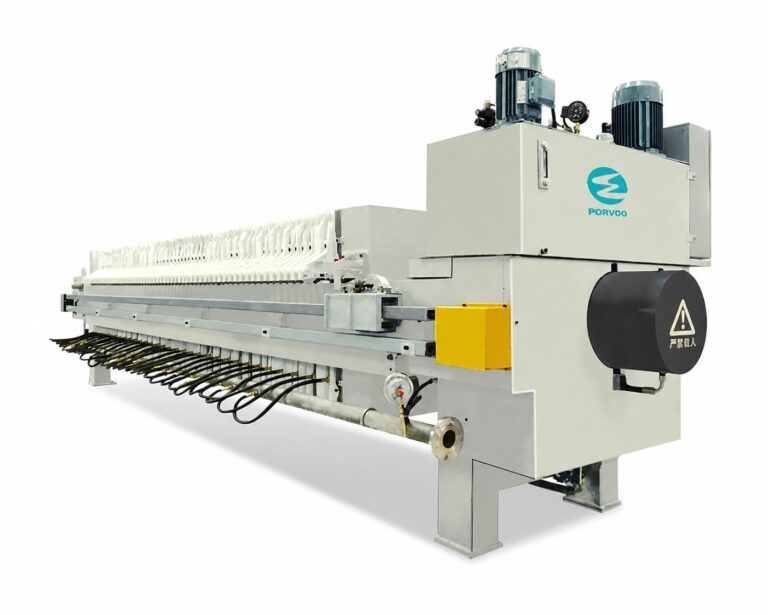
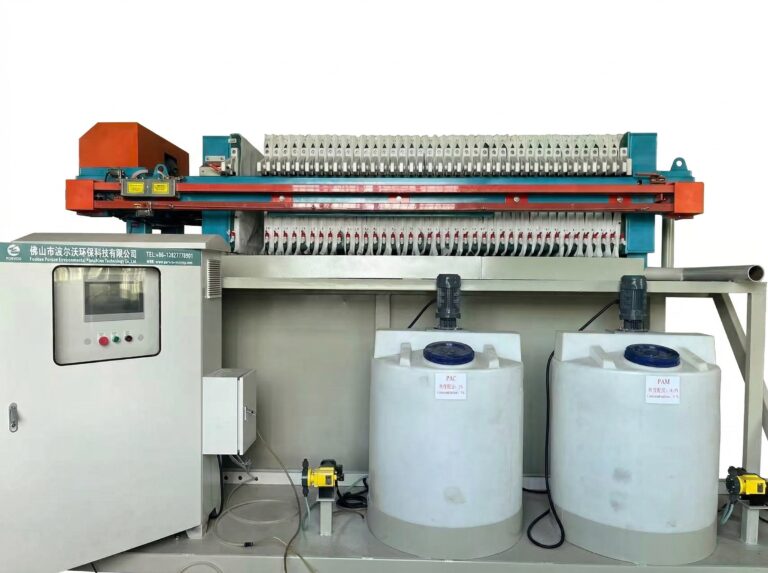
Equipment pages for the камерный фильтр-пресс с углублением describe the press configuration options this evidence feeds into, and the sizing conversion the buyer should expect a supplier to state connects directly to the press’s chamber, plate, and feed-pump configuration decisions reviewed against the submitted pilot record. An RFQ built on an incomplete pilot record forces the supplier either to request the missing information before quoting or to quote against assumptions the buyer has not had the chance to review, and either path adds a cycle to the sizing process that a more complete initial submission would avoid.
Часто задаваемые вопросы
Q: Should different production feed states be blended into one pilot sample?
A: Only if the blend genuinely represents the feed basis the production press will receive. Otherwise, keep the expected feed states identifiable and record their solids condition, conditioning, temperature, and visible variability so a change in press response can be traced to the relevant sample.
Q: What should the team do when two pilot cycles produce different results?
A: Compare the recorded feed condition, preparation, cloth, pump behavior, cycle end point, filtrate observations, and cake handling before drawing a sizing conclusion. Correct any unexplained change in the test basis, then repeat the agreed conditions to see whether the result is reproducible.
Q: Can the best pilot cycle be used as the sizing basis?
A: A favorable cycle can inform sizing, but it should not stand alone. Use repeat results on the agreed feed and operating basis, and keep capacity, cake moisture, and filtrate quality as separate project-specific commitments rather than conclusions from one run.
Q: What should be traceable in the supplier’s scale-up proposal?
A: The proposal should show how the observed solids load, recorded cycle basis, and chamber fill lead to the proposed press configuration. It should also identify which assumptions still need site confirmation so the buyer can distinguish test evidence from unresolved design inputs.
Q: Does a successful pilot test replace site confirmation or final acceptance requirements?
A: No. The pilot provides evidence under stated sample and test conditions; site confirmation and any final performance or acceptance terms remain separate project decisions. Record those boundaries explicitly in the request for quotation rather than treating the pilot outcome as an automatic guarantee.