A filter press that performs well during a supervised demonstration and then drifts into poor cake moisture, extended cycle times, or permit-threshold filtrate within months of commissioning is one of the more expensive equipment surprises a wastewater facility can inherit. The gap between demo performance and operational reality almost always traces back to the same source: acceptance conditions that were not locked to the feed assumptions underlying the original quotation. Cloth blinding, uneven cake formation, and inconsistent cycle times are not random — they follow directly from particle size distributions, compressibility values, and pre-coat decisions that were left undefined before the run. What the acceptance protocol must resolve is not whether the press can produce a good result once, but whether it can produce a repeatable result under documented, representative feed conditions.
Agree on feed conditions before the acceptance run
The single most common structural weakness in filter press acceptance is running the test before the feed has been characterized well enough to serve as a contractual reference point. If sludge particle size distribution, compressibility, and thixotropic behavior are not documented ahead of time, neither party can determine whether a good acceptance result reflects the press design or a particularly cooperative batch of feed that day.
Sludge characteristics directly influence the filtration rate the press can sustain and the feed pressure it requires to build a coherent cake. A result measured against feed that differs from normal plant output may look acceptable during acceptance and then fail to repeat once the press is processing real, variable production sludge. The acceptance protocol should define acceptable ranges for these parameters — not just nominal values — so that both buyer and supplier are working from the same planning baseline.
One specific threshold worth confirming before the run is whether the feed particle size distribution is predominantly below 5 microns. According to Jingjin’s technical guidance, feeds with fines concentrated below that threshold require a pre-coat cycle — typically diatomaceous earth — to protect the cloth from immediate blinding. Without it, sub-micron particles can blind the cloth at the start of filtration, which collapses throughput and produces wet cake before the first meaningful pressure build. If a pre-coat requirement exists but is not specified in the acceptance protocol, the test may proceed under artificially favorable conditions that cannot be replicated in normal operation.
| Параметр | Риск в случае отсутствия ясности | Что необходимо подтвердить |
|---|---|---|
| Sludge physical characteristics (particle size, compressibility, thixotropy) | Test conditions may not match normal operation, producing misleading performance data | Document actual values and agree on acceptable ranges before the run |
| Pre-coat requirement | Sub‑5‑micron particles can blind the cloth instantly, doubling cycle time and producing wet cake | Verify particle size distribution; if predominantly <5 microns, the pre-coat cycle must be specified |
The table captures the two highest-risk feed variables. The prose point to preserve is that these are planning criteria to be confirmed and agreed, not assumptions to be carried forward silently from the quotation stage.
Measure cake moisture filtrate clarity and throughput together
Measuring cake moisture, filtrate clarity, and throughput as separate line items at different points in the acceptance run often misses the relationship between them. Cloth condition connects all three: a cloth that is beginning to blind will produce wetter cake, slower filtrate flow, and extended cycle time simultaneously, but if only cake moisture is sampled at the end of a run, the early warning from filtrate flow and clarity is already gone.
Filtrate turbidity should be measured using a method such as ISO 7027-1 for turbidity or ASTM D5907-18 for filterable matter, giving a TSS result that can be compared against the supplier’s claimed performance. Jingjin’s commercial guidance positions TSS below 10 mg/L as an achievable target under normal operating conditions for pressure filtration — not as a universal regulatory threshold, but as a performance claim that carries real consequences if the press fails to meet it consistently. Permit limits are facility-specific, but an exceedance triggered by cloth degradation or inconsistent cake formation is a foreseeable operational risk that an acceptance protocol should stress-test.
The cycle-end criterion also needs to be agreed before the run. Ending a cycle when filtrate flow drops to the 10–15 L/min range is a planning benchmark used in Jingjin’s guidance to define the point of diminishing throughput return — continuing beyond that point adds time without meaningfully drying the cake further. Without an agreed cutoff, the acceptance run can be manipulated in either direction: ending early to show a fast cycle, or running long to demonstrate slightly lower moisture. Both distort the throughput calculation the quotation was built on.
| Измерение | Цель / показатель | Consequence if Not Met |
|---|---|---|
| Cake moisture / cloth condition | No cloth blinding; dry, firm cake | Clogged cloths can double cycle time and produce unacceptably wet cake |
| Filtrate clarity (TSS) | < 10 мг/л | Permit violations and fines exceeding $50,000 per event |
| Throughput cycle‑end criterion | Filtrate flow drops to 10–15 L/min | Reduced overall throughput if the cycle is ended too early or too late |
What the table cannot capture is the sequence dependency: filtrate clarity sampled at the start of a cycle reflects cloth condition, while moisture sampled at the end reflects both cloth condition and pressure profile. A single end-of-cycle snapshot misses the dynamics that determine whether the press will sustain those results across a shift.
Track pressure curve cycle time and cake release repeatability
The pressure curve across a filtration cycle is not just an operating record — it is a diagnostic. A curve that rises too steeply at the start of the cycle indicates either that initial feed pressure was set too high or that cloth resistance is already elevated. Jingjin’s guidance for GMP-oriented applications recommends starting at lower pressure and ramping up progressively to allow even cake formation across all chambers. Ramping too quickly creates uneven solids distribution and localised cloth blinding that cannot be corrected mid-cycle.
The maximum operating pressure is a hard limit, not a tuning variable. Setting hydraulic pressure above the plate design maximum to accelerate cake drying is a documented failure pattern: plates can crack and the hydraulic system can sustain damage that is not immediately obvious but shortens service life. The hydraulic relief valve should be set and locked at the manufacturer’s specified maximum before the acceptance run begins and should not be adjusted during the test to recover from a cycle that is running long. If locking the relief valve and running at correct pressure produces cake moisture above the quoted value, that is a result the acceptance protocol should capture — not a problem to be solved by exceeding the design limit.
Cake release inspection at the end of each cycle provides a practical repeatability check. The observable criterion is whether the cake discharges cleanly from the plates with no material sticking. Mud adhering to the plate faces after discharge indicates either that the cake was not fully formed, that cloth wear is introducing surface irregularities, or that the slurry adhesion characteristics were not matched to the plate surface during design. It is not always a dramatic failure, but it creates variability in the next cycle’s starting condition and, over time, increases manual cleaning frequency beyond what was assumed in the operating cost estimate.
| Контрольная точка | Требование | Риск в случае игнорирования |
|---|---|---|
| Cake release inspection | No mud sticking to the plates after discharge | Non‑repeatable operation; increased cleaning frequency |
| Initial pressure ramp | Start at low pressure, then ramp up slowly to allow even cake formation | Rapid pressure increase causes cloth blinding and uneven solids distribution |
| Maximum pressure limit | Never exceed plate design pressure; hydraulic relief valve set at manufacturer’s specified maximum | Plate cracking or hydraulic system damage |
Repeatability across multiple consecutive cycles — not one clean reference run — is the meaningful test. A single well-managed cycle that produces good results is less informative than three consecutive cycles run under normal operator conditions, with the pressure curve and cycle time compared across all three.
Include cloth washing and operator adjustments in the test
Cloth washing is part of the operating cycle, but it is frequently excluded from acceptance runs to keep the test clean and time-bounded. That exclusion carries a cost: the buyer accepts a press without ever observing how cloth condition degrades across cycles, at what point washing is triggered, and what effect washing frequency has on net throughput across a shift.
During acceptance, the washing sequence should be observed at least once under conditions that approximate normal operation, and the time required should be recorded as part of the cycle budget. If the supplier’s throughput claim was built on a washing interval of every ten cycles and the actual press requires washing every four cycles to maintain filtrate quality, that gap does not show up in a short acceptance run that skips the wash entirely.
Operator adjustments made during the run should also be logged explicitly. Adjustments to feed pressure, cycle timing, or flow rates that improve a result during acceptance but would not be standard practice for a shift operator are worth noting separately from the baseline result. Acceptance should reflect repeatable normal operation by a trained operator following the standard procedure — not the best achievable result under active expert supervision. If adjustments are necessary to hit the acceptance criteria, the protocol should record what those adjustments were, since they represent ongoing operational requirements, not one-time tuning.
Cloth condition is a maintenance variable that deteriorates over time, and acceptance testing captures only the starting condition. What the test can establish is whether the cloth, under normal operating pressure and feed conditions, produces consistent results across the run — and whether the washing procedure, when applied, restores performance to the starting baseline. Both observations feed directly into the maintenance assumptions behind the quoted operating cost.
Compare results with the quoted assumptions
Acceptance results only carry weight when they are measured against the specific assumptions in the supplier’s quotation, not against generic industry benchmarks. The quotation should state the feed characteristics, target cake moisture, expected cycle time, and throughput basis that the press was designed around. Acceptance becomes a comparison exercise between those documented assumptions and measured results — not a standalone performance demonstration.
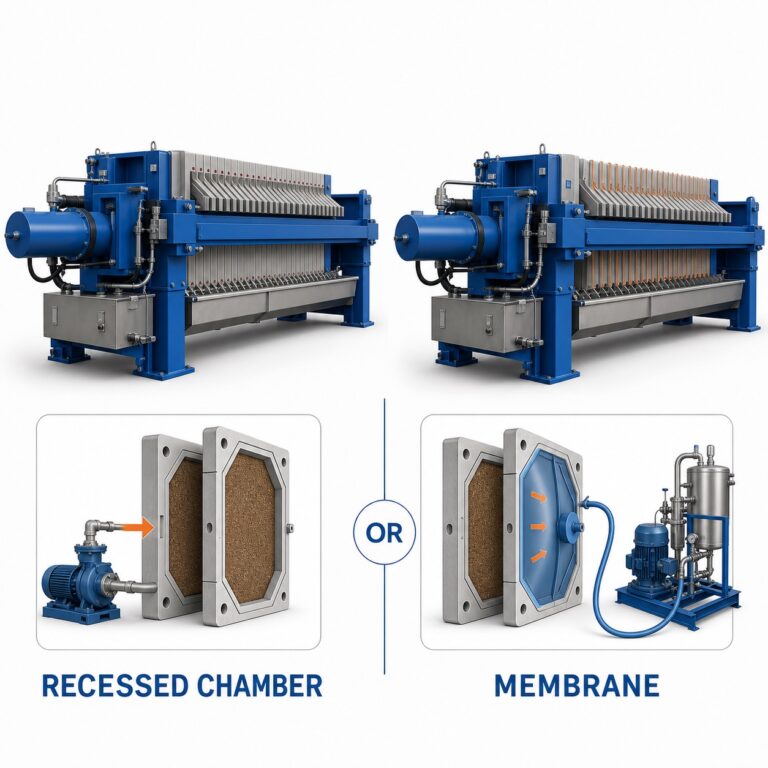
For cake moisture, Jingjin’s design-figure benchmarks are 60–75% for standard recessed chamber presses and 45–60% for membrane presses. These are reference ranges for evaluating whether acceptance results align with the quotation, not universal limits. The пластинчато-рамный фильтр-пресс с углублением и мембранный фильтр-пресс operate differently enough that comparing them on moisture alone, without reference to the specific feed and pressure assumptions in the quotation, produces a meaningless result. A membrane press producing 58% moisture might be performing as designed or might be significantly under-performing, depending on what the quotation assumed.
PLC data logging during acceptance provides the verification trail that makes this comparison credible. Automatically logged pressures, times, and temperatures for each cycle can be compared directly against the quoted operating parameters, making it straightforward to identify whether any deviation from the quoted result corresponds to a deviation in operating conditions or reflects a genuine performance gap. Without that log, post-acceptance disputes about whether the press was run correctly become difficult to resolve.
| Quoted Assumption | Typical Benchmark | Метод проверки |
|---|---|---|
| Cake moisture – standard chamber press | 60–75% | Moisture analysis of collected cake samples |
| Cake moisture – membrane press | 45–60% | Moisture analysis of collected cake samples |
| Cycle pressures, times, temperatures | As specified in the supplier’s quotation | Automatic PLC data logging for each batch, then compare with quoted values |
The sizing and specification assumptions that fed the original quotation are worth reviewing before acceptance, particularly the filtration area calculation and cycle time basis — both of which affect what the acceptance results should be compared against. This filter press sizing and specification guide covers how those figures are derived and what feed parameters drive them.
Record what changes if feed solids shift later
Acceptance testing locks a performance baseline to a specific feed condition. That baseline becomes less useful as a reference point the moment feed composition changes, but plants routinely treat the acceptance result as a fixed performance guarantee rather than a condition-dependent data point.
Feed solids concentration is the most consequential variable to track after acceptance. If solids loading increases — due to seasonal variation, upstream process changes, or a shift in the waste stream composition — the chamber fill time increases, the pressure build-up profile changes, and cycle time extends. Cake moisture may increase or decrease depending on whether the additional solids create a more permeable or less permeable cake structure. These are not precise predictions for any given feed change; they are directional consequences that illustrate why the acceptance baseline needs to be accompanied by a documented sensitivity range rather than a single quoted value.
The practical step is to record, at acceptance, the feed solids concentration and particle size distribution that produced each measured result, then use that record as a reference when troubleshooting later deviations. If cycle time has increased six months after commissioning and the PLC log shows that feed pressure and cloth condition are unchanged, the most productive place to look is whether feed solids have shifted outside the acceptance range. Without the acceptance baseline documented against feed conditions, that comparison cannot be made.
This is also the point at which pre-coat requirements can become operationally significant. If feed particle size distribution shifts toward finer fractions over time and the pre-coat procedure was not included in the original operating procedure because it was not required during acceptance, cloth blinding may begin appearing without an obvious immediate cause.
Close acceptance on repeatable normal operation
Acceptance should be signed off on the basis of consistent, repeatable performance across multiple cycles under documented conditions — not the best result achieved during a supervised test. A single cycle that produces good cake moisture, clean filtrate, and fast discharge can reflect genuine equipment performance or it can reflect a combination of favorable feed, attentive operator management, and clean cloth from the start of the run. Multiple consecutive cycles make those variables visible.
What repeatable normal operation looks like in practice: cycle time, cake moisture, and filtrate clarity that are stable across cycles without requiring progressive adjustments to pressure or feed rate; cake release that is clean and consistent without manual intervention between cycles; and cloth condition at the end of the acceptance run that is consistent with the washing interval assumed in the maintenance plan. These are observable indicators, not numerical pass/fail criteria, and the acceptance protocol should define what “repeatable” means for the specific installation before the run begins rather than after.
Closing acceptance before cloth washing behaviour, pressure curve stability, and cake release consistency have been observed across consecutive cycles leaves the buyer with an acceptance record that cannot support later warranty or performance disputes. The more defensible close is one where the PLC log, the cake samples, the filtrate measurements, and the operator’s run notes all reflect the same normal operating conditions — and where the results match the assumptions the quotation was built on.
What acceptance documentation ultimately needs to support is not a single performance claim but a reference baseline: a record of what the press produced under what feed conditions, using what operating parameters, with what cloth condition, and with what washing frequency. That record becomes the comparison point every time cycle time drifts, cake moisture rises, or filtrate quality degrades in operation. Before closing acceptance, confirm that the feed conditions are documented to the same level of detail as the performance results — particle size, solids concentration, and any pre-coat requirements — and that the PLC log covers every cycle included in the acceptance run. If those records are incomplete, the acceptance result is a data point without a reference frame, and its value as a performance baseline is limited from the start.
Часто задаваемые вопросы
Q: What if our filter press doesn’t have a PLC or automated data logging?
A: Manual logging can still support a valid acceptance, but the protocol must be tightened. Without automatic cycle data, the buyer and supplier should agree on a manual log sheet that captures time, pressure, filtrate flow rate, and any operator adjustments at agreed intervals during each cycle. The risk is that gaps between logged points can hide short pressure spikes or flow drops that would otherwise flag cloth issues; this risk is mitigated by increasing the frequency of manual readings and including a witnessed, hands-off cycle to verify the press can hold settings without intervention.
Q: After acceptance is signed off, how should we document the baseline so it supports future troubleshooting?
A: Package the acceptance record as a single reference baseline that lives with the equipment file. Include the agreed feed characterization (solids concentration, particle size distribution, pre-coat requirement), the PLC or manual cycle logs, cake moisture and filtrate TSS results, the washing sequence timing, and any operator adjustments that were made. Store it alongside the quotation’s design assumptions so that when performance drifts six months later, the operations team can check whether feed conditions, pressure profile, or cloth condition have diverged from that documented starting point.
Q: Do the cake moisture benchmarks of 60–75% for chamber presses and 45–60% for membrane presses hold for highly compressible or oily sludges?
A: Those ranges are typical reference points for conventional inorganic sludge, not guarantees for extreme feeds. Highly compressible cakes can trap moisture and exceed the upper end even at full pressure, while oily or greasy sludges may blind cloth so quickly that cycle-end moisture is driven more by cloth condition than by press type. In such cases, acceptance should set moisture targets based on lab-scale filtration tests with the actual feed rather than applying the general benchmark.
Q: If I’m buying a new press, is it worth paying more for a membrane system just to get lower cake moisture?
A: Only if lower moisture directly reduces your disposal cost enough to recover the premium. Membrane presses add secondary squeeze capability that can drop cake moisture by 10–15 percentage points compared to chamber presses, but the benefit matters most when hauling weight-based fees or meeting a strict landfill moisture cap. If your disposal is volume-based and the sludge can be landfilled at 70% moisture, a standard recessed chamber press may be the more cost-effective choice.
Q: Is this level of acceptance testing worthwhile for a small plant with only one filter press?
A: Yes, because a single press means zero redundancy. At a small plant, even a short performance drift that produces wet cake or fails a permit limit can halt dewatering entirely, triggering regulatory risk and expensive emergency measures. The acceptance effort — confirming cycle time, cake moisture, and cloth behavior under normal feed — is proportionally smaller than the cost of a single permit violation or unplanned cloth replacement that could have been caught during commissioning.