Selecting the wrong pump for a wastewater dosing line rarely announces itself at commissioning. The pump passes its bench check, the initial calibration looks acceptable, and the system goes live — then three weeks in, effluent pH readings drift, a discharge sample comes back outside permit limits, and the investigation traces back not to the chemistry but to a pump that was never sized against peak demand or real back-pressure conditions. The cost at that point is not just a replacement pump; it is the labor to recalibrate, the downtime to swap hardware mid-run, and the audit exposure if the deviation fell during a monitoring window. The judgment that prevents this is made upstream, during specification, by treating output range, system pressure, wetted material compatibility, and redundancy architecture as hard inputs rather than defaults. What follows will help you identify where each of those inputs changes the selection decision and where a seemingly lower-cost choice converts into a reliability or compliance liability.
Which pump sizing inputs matter before you compare models
Two sizing inputs consistently separate reliable installations from ones that require early rework: the pump’s usable output range and the actual system pressure it must sustain under your process fluid. Both are knowable at specification time, and skipping either tends to surface as an operational problem rather than a visible procurement error.
Output range means the pump must cover both minimum dosing demand — which can be very low during off-peak or startup conditions — and the peak demand the process requires during maximum load. For small-volume applications this is typically expressed in ml/min; for larger lines, in LPH. If the selected pump’s control range does not span from your minimum to your peak, you will either overdose at the low end or starve the process at the high end. Neither failure is obvious on a data sheet comparison unless you have already defined your actual operating envelope in specific units.
System pressure is the more commonly underestimated input. Pumps are pressure-sensitive devices, and viscous fluids compound the pressure demand the pump must overcome on every stroke. A pump that holds stable output against water at low back-pressure may deliver inconsistent volume when dosing a polymer solution at higher viscosity through long injection tubing. This is not a theoretical concern — it is a documented failure pattern for metering pumps in polymer and coagulant applications where undersizing for real system pressure produces feed rate instability that operators often attribute to chemical quality rather than pump performance.
| Sizing Input | Risk if Unclear | What to Confirm |
|---|---|---|
| Output Range (min/peak demand) | Pump cannot handle operational variability, leading to inaccurate dosing. | Confirm pump’s rated LPH/ml/min range covers both minimum and peak dosing demand. |
| System Pressure (with viscous fluids) | Undersizing for pressure causes unstable output and early pump failure. | Confirm pump is rated for the actual system pressure, accounting for fluid viscosity. |
Both inputs belong in the specification document before any vendor comparison begins. If they are left undefined, the comparison defaults to catalog-level output ratings that may have no relationship to how the pump will perform in your specific installation.
How wetted material compatibility changes long run reliability
Pump datasheets list wetted material options — PVDF, 316 stainless steel, PTFE, Hastelloy, and others — but the selection decision is only reliable if it is made against the full chemical profile of the fluid being dosed, not just the chemical name on the purchase order.
The common oversight here is treating the MSDS as a complete source for compatibility review. An MSDS identifies hazards and handling precautions; it does not systematically address long-term material degradation under continuous immersion, elevated temperature, or concentration variations. A polymer flocculant used at 0.1% active concentration may be benign to a pump head material, while the same product at 1.0% or with a different carrier solvent may gradually attack the same material. Corrosion guides and product data sheets from chemical suppliers give a more complete picture, and cross-referencing them against the pump manufacturer’s material compatibility data is a straightforward step that is frequently skipped under procurement time pressure.
The downstream consequence of a material mismatch is rarely dramatic at first. Degradation tends to be gradual — slight swelling of gasket material, early pitting of a valve seat, slow permeation through tubing walls. What this produces in practice is calibration drift and feed volume inconsistency that is difficult to attribute to a specific cause. By the time material failure becomes obvious, the pump has typically been running inaccurately for weeks, and the plant may have a period of suspect dosing records it cannot easily explain under audit review. Selecting wetted materials against the full chemical data is a short task during specification that eliminates a long and difficult problem during operation.
For lines handling oxidizing acids, concentrated alkalis, or chlorinated compounds, PVDF and PTFE wetted paths generally perform well across a wide range of concentrations. 316 stainless steel is often appropriate for neutral or mildly aggressive streams but should be verified against chloride content and oxidizing agents specifically. The point is not that one material is universally correct — it is that the selection requires deliberate matching, not a default choice.
When duty standby redundancy is worth the extra footprint
The footprint and cost argument against installing a duty-standby pump arrangement is straightforward: a second pump doubles the capital spend on that dosing point and occupies panel, piping, and skid space that could be used elsewhere. That argument is defensible when the wastewater stream is stable, the dosing chemical is low-risk if interrupted, and operator coverage is high enough to catch and respond to a pump failure quickly.
The argument breaks down under three conditions: when influent quality shifts significantly by shift or batch, when the discharge limit leaves little margin for a dosing interruption, or when the plant runs on reduced staffing during nights or weekends. In those conditions, a single pump failure converts from a maintenance inconvenience into a compliance event. The pump is out, dosing stops or becomes erratic, effluent quality deteriorates, and by the time the failure is discovered and the pump replaced or reset, the discharge window may have already recorded an exceedance.
Interlocks, pressure sensors, and flow alarms improve the reliability profile of a single-pump installation and should be treated as standard design inclusions regardless of whether redundancy is added. They alert operators to anomalies before the consequences compound. But they cannot dose the chemical themselves — an alarm that fires at 2:00 AM on a site with no overnight operator does not protect the treatment process. Interlocks and alarms reduce the detection lag; they do not eliminate the gap between detection and correction.
The practical threshold for redundancy is when the cost of a single exceedance event — including regulatory notification, potential fine, and production disruption — exceeds the installed cost of a standby pump. For plants operating under tight permits such as those aligned with GB 8978-1996 discharge standards, or handling streams with highly variable solids loading, that threshold is often crossed by the second year of operation. The footprint cost of a duplex arrangement is fixed; the cost of an exceedance event repeats and compounds.
Where calibration drift usually begins after startup
Initial calibration at commissioning gives the plant a dosing baseline, but that baseline assumes the operating conditions at the moment of calibration will remain stable. In most real installations, several factors change over time in ways that alter actual feed volume without triggering any obvious alarm.
Stroke length and pump speed are the most common origin points for drift. In mechanically adjusted pumps, vibration, temperature cycling, and normal wear can shift the effective stroke slightly over weeks of operation. Each small change in stroke translates directly into a change in delivered volume per cycle. If the pump’s speed is also being adjusted manually in response to flow changes, the combination of two drifting mechanical variables creates a feed rate that may be noticeably different from the commissioned setpoint within a few months. The problem is that neither change is dramatic enough to register as a failure, so the drift accumulates unnoticed until a calibration check or an effluent result flags it.
Tubing elasticity is a secondary but real contributor in peristaltic installations. New tubing has a consistent rebound behavior; as tubing ages and fatigues, it delivers slightly less volume per revolution. Falling tank levels change the suction head, and if the pump is not pressure-compensated or electronically controlled, the feed volume at a near-empty tank differs from the volume at a full tank. Pulsation behavior also changes if dampeners are not correctly sized or if system pressure changes.
Electronic stroke and speed control addresses the majority of these drift mechanisms by removing manual adjustment from the feedback loop and allowing the pump to hold a programmed setpoint against changing conditions. This is a practical recommendation, not a regulatory requirement — but plants that rely on manual calibration only and have no electronic feedback will face growing feed errors that become difficult to trace and expensive to correct once they are flagged in an audit or inspection. The chemical dosing system installation process is also a useful reference for understanding how commissioning and post-installation verification should be structured to catch early drift before it becomes a compliance issue.
The maintenance implication is straightforward: schedule calibration checks at defined intervals, document them, and treat unexplained drift as a prompt for mechanical inspection rather than just a setpoint correction.
How operator coverage should influence pump architecture
Operator coverage is a constraint that usually gets acknowledged during plant design and then quietly discounted during pump procurement when budgets are tight. The result is a pump architecture that was designed for full-time manual attention operating on a site that cannot reliably provide it.
The practical relationship is this: the less time a skilled operator will spend monitoring the dosing system in any given shift, the more the pump must compensate through automated control, feedback response, and alarm outputs that reach the right person at the right time. A simple manually adjusted pump with no remote alert capability is not a weakness in a plant where an operator checks it every two hours and can correct it within minutes. It becomes a liability in a plant where the dosing area is unattended for extended periods and a developing fault is not visible until a sampling event.
Control features that enable flow-proportional dosing, chemical metering feedback, and alarm outputs to SCADA or mobile systems materially change the reliability profile of a pump without requiring a full duplex installation. These features allow the pump to track process changes automatically and notify operators remotely when something is outside the programmed envelope. For plants with variable influent and limited staffing, this architecture can often be a more cost-effective path than installing a standby pump without adding any intelligence to the primary unit.
The architecture decision should treat operator coverage level as an explicit design input at the specification stage — not an assumption that defaults to full attendance. Sites running two shifts with overlapping supervision have different needs than a facility that is fully staffed on days and minimally staffed overnight. IFC Performance Standard 1’s framework for managing environmental and social risks is relevant here as a process reference: documenting and managing operational risk requires that known gaps in human oversight be compensated by system design, not left as standing vulnerabilities. That principle applies directly to dosing system architecture.
A useful specification check: identify the longest plausible interval between operator visits to the dosing area, then evaluate whether the pump architecture can detect, log, and alert on a developing fault within that window. If the answer is no, the architecture needs more automation, not better luck.
Which pump package fits your wastewater variability
The final selection question is whether a single pump can handle the actual variability of the stream, or whether the dosing demand swings widely enough to require a pump with a high turndown ratio, a duplex arrangement, or viscosity-specific design features.
Turndown ratio describes how wide a range a pump can accurately cover between its minimum and maximum controllable output. A pump with a 1800:1 turndown ratio can dose accurately across a far wider range of demand conditions than one with a 1000:1 ratio. For a wastewater line where flow varies significantly across shifts — from a low-flow overnight period to a high-load batch discharge — a higher turndown ratio means a single pump can follow that variability with maintained accuracy. A pump with insufficient turndown will either saturate at the high end or lose accuracy at the low end, and the plant ends up dosing outside its target band during the portions of the day the pump cannot resolve. These figures are design benchmarks for specification comparison, not regulatory minimums, but matching them to your actual flow variability is a concrete way to avoid mismatches that only appear during operation.
Variable viscosity is a related but distinct challenge. Streams that carry changing concentrations of solids or polymer residuals will present different viscosity to the pump at different times. Standard metering pumps sized for water-like fluids may deliver inconsistent output as the fluid thickens, because the flow resistance changes on every stroke. Selecting a pump with a performance range that explicitly covers your expected viscosity range — and verifying that specification against your actual process chemistry, not a generic default — prevents the common failure pattern where dosing appears stable during low-viscosity periods and becomes erratic when the stream chemistry shifts.
| Wastewater Characteristic | Impact on Pump Selection | Key Specification to Check |
|---|---|---|
| Variable Flow Demand | A single pump may not handle wide dosing swings, risking over/under-feeding. | Compare pump turndown ratios (e.g., 1800:1 vs. 1000:1) for required control range. |
| Variable Viscosity | Standard pumps may deliver unstable output as fluid thickness changes. | Select pumps with performance ranges specifically designed for high-viscosity chemicals. |
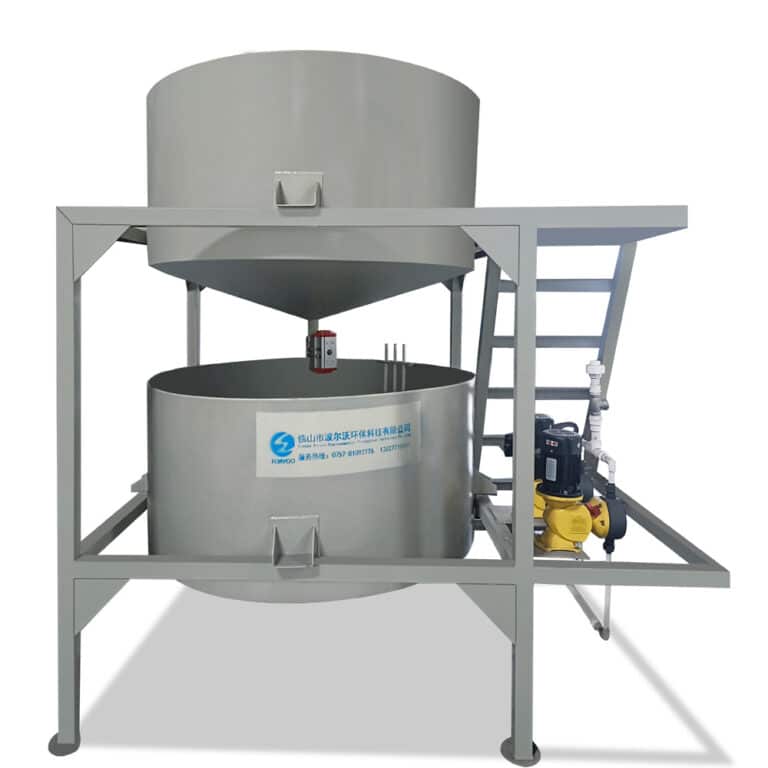
For streams with high and predictable variability, a PAM/PAC intelligent dosing system with electronic flow-proportional control and a wide turndown range addresses both the accuracy and the operator coverage constraints in a single package. For stable, well-defined streams with consistent chemistry, a simpler pump with verified material compatibility and documented calibration intervals may be entirely sufficient. The selection logic is the same in both cases: match the pump’s capabilities to the actual variability of your stream, not to an assumed average.
The most defensible pump selection is the one that was sized against real operating conditions — minimum and peak demand, actual system pressure, full chemical data for wetted material review, and an honest assessment of how often an operator will be present to catch and correct drift. Those inputs are available before procurement; the cost of skipping them is paid after commissioning in ways that are difficult to budget and hard to explain.
Before finalizing a pump specification, confirm three things: whether the output range in LPH or ml/min covers your full operating envelope, whether the wetted materials have been verified against complete chemical data rather than just the MSDS, and whether the control architecture — degree of automation, alarm outputs, and turndown ratio — matches your site’s actual operator coverage and influent variability. Those are the checkpoints where selection decisions are either protected or left exposed.
Часто задаваемые вопросы
Q: What happens if a chemical dosing pump is selected correctly for current conditions but the plant expands capacity later?
A: A pump that fits current demand but lacks sufficient turndown or maximum output headroom will become a bottleneck once throughput increases. Before finalizing the specification, document the anticipated capacity range over the next three to five years and verify that the selected pump’s maximum output rating and turndown ratio can accommodate that envelope — or confirm that the skid design allows a like-for-like pump swap without repiping the injection point.
Q: After commissioning and initial calibration, what is the first scheduled maintenance action that directly protects dosing accuracy?
A: A volumetric calibration check against a graduated cylinder or calibration column — conducted under actual operating pressure and with the real process fluid, not water — should be the first documented post-commissioning verification, typically within the first four to six weeks. This catches any discrepancy between the factory calibration baseline and real-site behavior before it accumulates into a compliance record, and it establishes a documented starting point for tracking drift over subsequent intervals.
Q: Does the duty-standby redundancy argument still apply when the dosed chemical is only a pH adjuster rather than a coagulant or flocculant with direct solids-removal function?
A: Not always — but the deciding factor is the discharge limit’s sensitivity to pH excursion, not the chemical type. GB 8978-1996 sets defined pH bands for effluent discharge, and if a dosing interruption of even short duration can push effluent outside that band, the compliance exposure from a single pump failure is the same regardless of whether the chemical is acid, alkali, or polymer. For pH-critical streams running without overnight staffing, the redundancy threshold is the same as for coagulant lines.
Q: Is a peristaltic pump or a diaphragm metering pump a better default choice for industrial wastewater dosing?
A: Neither is a universal default — the choice depends on the specific combination of fluid abrasiveness, required accuracy, and maintenance environment. Peristaltic pumps offer easy maintenance and handle abrasive or shear-sensitive fluids well, but tubing fatigue is a real drift source that the article identifies. Diaphragm metering pumps generally deliver higher volumetric accuracy and handle a wider pressure range, but the diaphragm and valve seats must be matched precisely to the chemical. The article’s material compatibility and calibration drift criteria apply to both types and should drive the comparison rather than a blanket preference.
Q: At what point does adding more automation to a single pump become more cost-effective than installing a full duplex arrangement?
A: When the plant’s primary risk is undetected drift or slow fault development — rather than total pump failure — automation typically delivers better value per unit spend than a standby pump alone. A standby pump protects against mechanical stoppage but does nothing if the duty pump is running and dosing inaccurately. Electronic flow-proportional control, SCADA alarm outputs, and feedback metering address the accuracy and detection gap that a standby pump cannot. The practical answer is to layer automation onto the duty pump first, then add standby hardware only if the stream variability or compliance exposure justifies protecting against outright failure as well.