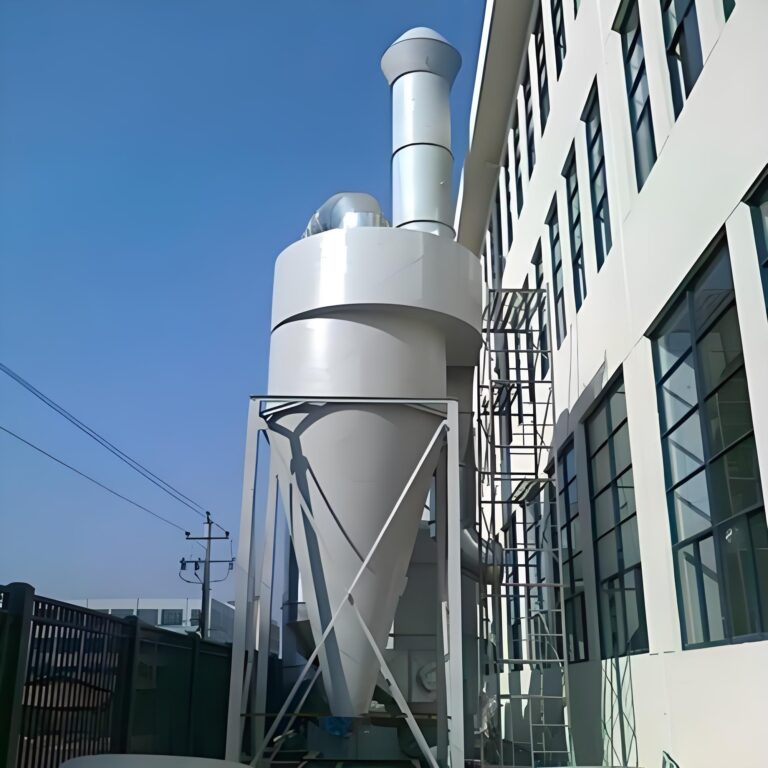
A cyclone that once ran clean and now shows dust past the outlet has not necessarily failed internally. The visible symptom is the same whether the cause is wear inside the unit, a change in what is being fed to it, a change in how air is moving through it, or a change downstream that has nothing to do with the cyclone body at all. Before opening it up, the more useful question is what changed, and when.
Carryover Symptoms and Operating Changes to Record First
Carryover is a symptom, not a diagnosis. Two cyclones showing the same visible dust at the outlet can have entirely different causes, and treating the symptom as the problem risks corrective work that does not match the actual disturbed condition. The first task is building a record that connects the appearance of carryover to what else was happening at the time.
This means treating pressure, airflow, any fan or damper adjustment, and any process event as data points to be checked against the timing of the carryover, not as separate unrelated observations. If carryover began after a damper was throttled, or after a process rate shifted, or after a pressure reading drifted from its earlier baseline, that correlation narrows the search considerably. If carryover has been present without any corresponding change in these variables, that also matters, because it points toward a condition internal to the cyclone rather than an operating shift.
Where the record shows a clean correlation between one changed variable and the onset of carryover, the investigation should start there rather than at the cyclone internals. Where no such correlation exists, or where several variables changed close together, the record still narrows the field, because it tells the reader which conditions can be ruled in and which can be set aside for now. Recording the visible dust itself matters too, but only as one entry among several, since visible dust alone does not indicate whether the cause is upstream, internal, or downstream of the unit.
This record-first approach also protects against a common misstep in troubleshooting sequence: opening the cyclone for inspection before establishing whether the operating envelope has moved. Inspection is warranted, but it answers a different question than the one this first step answers.
| Evidence to capture | Use in troubleshooting |
|---|---|
| Visible dust or carryover | Record it as a symptom and correlate it with operating changes; do not use visible dust as the sole acceptance measure. |
| Давление | Correlate pressure with the carryover condition. |
| Поток воздуха | Correlate airflow with the carryover condition. |
| Fan or damper changes | Check whether the carryover condition changed with the fan or damper change. |
| Process events | Check whether the carryover condition changed with the process event. |
Dust and Airflow Differences From the Original Cyclone Duty
A cyclone is sized for a duty: a dust with certain characteristics, a process rate, and an airflow, all considered together at the time the unit was selected. Separation performance is a function of that combination, not of the cyclone geometry alone. When any one of those three factors drifts from the original basis, the cyclone’s actual separation efficiency at the new condition can differ from what the original selection assumed, without any change to the equipment itself.
Dust characteristics changing is one path to this. If the material being fed to the cyclone has shifted toward a finer particle distribution, or its density has changed, the same cyclone geometry separates it differently, because cyclone separation is fundamentally a function of particle size and density interacting with the induced vortex. A cyclone selected for one dust profile does not automatically perform equivalently on another, even if nothing about the unit has changed.
Process rate changing is a second path. Where the volume of material passing through the system has increased or decreased from the original design case, the loading on the cyclone changes correspondingly, and with it the residence time and separation behavior inside the unit.
Airflow changing is the third and often most direct path, because cyclone separation efficiency is tied to the velocity of the air-solids stream entering and moving through the cyclone body. Where inlet velocity has dropped from the original design point, coarse-particle separation can be affected even though the cyclone geometry is unchanged; this relationship between inlet flow rate and separation performance is addressed in cyclone-performance literature examining two-stage cyclone behavior under varying inlet volumetric flow.
The practical implication is that before assuming internal damage or wear, the reader should establish whether the current dust, process rate, and airflow match the duty the cyclone was originally selected against. Where they do not match, the corrective path may be a configuration or operating adjustment rather than a repair. Where they do match and carryover persists, the search moves to the unit itself.
| Operating factor | Current condition to document | Original comparison |
|---|---|---|
| Пыль | Current dust | Dust basis used to select the cyclone |
| Process rate | Current process rate | Process rate used to select the cyclone |
| Поток воздуха | Current airflow | Airflow used to select the cyclone |
Inlet, Body, Vortex Finder, and Seal Inspection Points
If the operating comparison rules out a duty mismatch, the inspection path shifts to the physical condition of the cyclone itself: the inlet, the body, the vortex finder, and the seals along the assembly. These elements work together to establish and maintain the vortex that performs the separation, and disturbance at any one of them can degrade separation even when the others remain in good condition.
Wear is one category of disturbance to check for. Cyclone bodies experience erosive wear from the solids passing through them, concentrated at points where the vortex creates the highest particle velocity against the wall. Wear that changes the internal geometry, even locally, can alter the vortex pattern the cyclone depends on, and a worn surface at the inlet or body can allow particles to escape the separation path they would otherwise follow.
Deposits are a second category. Material building up inside the body, at the inlet, or around the vortex finder changes the effective internal geometry in a different way than wear does, by narrowing flow paths or altering surface roughness, and either mechanism can shift where in the vortex particles disengage from the airstream.
Air leakage is a third category, and it acts differently again. A cyclone depends on a controlled air path from inlet to outlet, with the vortex finder maintaining the separation between the outer downward vortex and the inner upward vortex that carries cleaned air out. Leakage at seals, or at any joint along the body, can allow air to bypass the intended path, pulling separated solids back into the outgoing air stream rather than letting them fall to the hopper.
Because these three mechanisms produce a similar symptom through different physical routes, inspection needs to check for all of them along the inlet, body, vortex finder, and seals rather than assuming a single cause. Where a project has a documented maintenance history, that history helps indicate which of these conditions has had time to develop and which has not.
Hopper and Discharge Problems That Can Disturb Solids Removal
Separation happening correctly inside the cyclone body does not guarantee that the separated solids leave the system cleanly. The hopper and discharge path handle what the vortex has already removed from the airstream, and a disturbance at this stage can reintroduce material into the air path even when the separation mechanism itself is functioning as intended.
A hopper that is not clearing solids at the rate they are being separated will accumulate material, and once that accumulation reaches the point where it interferes with the lower part of the vortex, separated dust can be re-entrained into the upward air path rather than continuing down and out through the discharge. This is a distinct failure mode from wear or leakage in the body, because the cyclone itself may be performing its separation function correctly right up until the point where the hopper condition disturbs it.
Discharge valve or seal problems at the base of the hopper create a related but separate issue: if the discharge path allows air to be drawn up from below, that inward air flow can disturb the settling solids and carry fine material back up into the vortex, producing carryover that originates from the discharge end rather than from the inlet or body. This is functionally similar to seal leakage higher up the assembly but occurs at a different point and calls for a different corrective response, since a valve or seal repair at discharge does not address a leak at the body, and the reverse is also true.
Because both hopper accumulation and discharge air ingress produce carryover that can look identical to carryover caused by inlet or body conditions, ruling these out requires checking the discharge path on its own terms rather than assuming that a clean body inspection means the disturbance must be there. Where the operating record from the first step points to no clear correlation with airflow or process changes, and the body inspection shows no significant wear or deposits, the hopper and discharge path becomes the next place to check before concluding that no cause can be found.
Pressure and Airflow Checks After Fans or Dampers Change
Where a fan or damper adjustment coincides with the onset of carryover, the correlation established earlier needs to be followed through with a direct pressure and airflow check rather than left as an inference. A fan speed change, a damper position change, or a change elsewhere in the ductwork that alters the system’s resistance curve all affect the airflow actually reaching the cyclone inlet, and that airflow is what determines the inlet velocity the separation depends on.
The relevant check here connects back to the duty comparison: if airflow has dropped as a consequence of a fan or damper change, the cyclone is now operating below the velocity its separation was designed around, and carryover under those conditions reflects an operating condition rather than a fault in the unit. Restoring the airflow, where that is the identified cause, addresses the carryover without any work on the cyclone itself.
Pressure readings across the cyclone serve as a useful corroborating check alongside airflow, because a cyclone’s pressure drop and its airflow are related through the resistance the unit presents to the system. A pressure reading that has moved in a direction inconsistent with the fan or damper change may indicate that something else has also shifted, such as a partial blockage or a leak, rather than the fan or damper change being the sole cause. Where pressure and airflow both point consistently to the same explanation, that agreement supports proceeding with a corrective action targeted at the fan or damper condition. Where they do not agree, further checcheck along the inlet, body, or discharge path is warranted before concluding the fan or damper change is the full explanation.
This step depends on having a documented baseline from before the change, which is part of why the original operating record matters: without it, a current pressure or airflow reading has no reference point to be compared against.
Performance Confirmation After the Corrective Work
Once corrective work has been carried out, whatever its target, confirming that it addressed the carryover requires checking performance under agreed operating conditions rather than relying on a visual check alone. Visible dust at the outlet is useful as an ongoing symptom to watch, but its absence does not by itself establish that separation performance has been restored to the level the project requires, and its presence in reduced but not eliminated form does not indicate how close the unit is to an acceptable condition.
A defined particulate check gives a basis for confirmation that a visual observation cannot. Manual gravimetric determination of particulate mass concentration in ducted stationary-source emissions, the method addressed in ISO 9096, provides a way to establish a mass-concentration figure at the point of measurement; this addresses emissions measurement specifically and does not by itself constitute a guarantee of collector efficiency, since efficiency also depends on the inlet condition against which the outlet is compared. Where airflow measurement is also part of the confirmation, the velocity and volume flow rate methods addressed in ISO 10780 are relevant to how that duct airflow figure is obtained, though the applicable project values and any compliance conclusion depend on the specific measurement setup rather than on the standard’s existence alone.
Confirmation results apply to the operating conditions under which they were taken. A cyclone confirmed clean at one dust, process rate, and airflow combination has not been confirmed at a different combination, which returns to the same duty-comparison logic that opened the diagnostic sequence: performance is a function of the operating condition, not a fixed property of the unit alone.
Where the project team is defining what this confirmation should include, the operating conditions, the airflow measurement approach, and the particulate check method are the specific items to agree with the supplier in advance, since agreeing on them after the corrective work leaves room for dispute about whether the result reflects the same duty the original troubleshooting addressed. For a cyclone being replaced or reconfigured rather than repaired, this same duty information, the dust, process rate, and airflow basis, is what a supplier needs to review a configuration or quotation against the actual operating condition rather than the original design assumption alone.
| Confirmation element | Supported use | Decision boundary |
|---|---|---|
| Agreed operating conditions | Confirm performance under the agreed operating conditions. | The result applies to those conditions rather than serving as an unconditional guarantee. |
| Duct airflow | Measure airflow when it is part of the confirmation. | ISO 10780 is broadly relevant to duct airflow measurement; the cited metadata supplies no project values or compliance conclusion. |
| Particulate check | Use a defined particulate check. | ISO 9096 addresses manual gravimetric particulate mass concentration in ducted stationary-source emissions; it does not establish a collector-efficiency guarantee. |
| Visible dust | Record visible dust as a symptom. | Visible dust is not the sole acceptance measure. |
Часто задаваемые вопросы
Q: How can I tell whether dust carryover comes from a changed operating condition or a problem inside the cyclone?
A: Start by comparing the current dust, process rate, and airflow with the duty used to select the cyclone, then match the timing of carryover with fan, damper, or process changes. If those conditions have not materially changed, use the inlet, body, vortex finder, seals, hopper, and discharge path as the inspection sequence rather than assuming one damaged component.
Q: What information should be prepared before troubleshooting starts?
A: Prepare a time-based record of carryover symptoms, pressure, airflow, fan or damper changes, and relevant process events, together with the current and original dust, process-rate, and airflow conditions. This lets the team test a specific changed-condition explanation instead of choosing corrective work from visible dust alone.
Q: Why should the hopper and discharge path be checked before changing the collector?
A: A problem in solids removal can disturb normal separation, so changing the collector before checking that path may leave the actual cause in place. Inspect the hopper and discharge route for deposits, leakage, or interrupted removal, and relate any finding to when the carryover occurs.
Q: Is the disappearance of visible dust enough to confirm that corrective work succeeded?
A: No. Treat visible dust as one symptom and confirm performance under agreed operating conditions with the defined particulate check, adding an airflow measurement when airflow is part of the acceptance decision. Record the test conditions so the result is not mistaken for an unconditional guarantee across other duties.