A slurry that dewaters slowly, releases cake poorly, or swings between batches puts filter press selection on the table well before anyone compares brands. The real question is whether a round-plate configuration earns its place against a standard chamber press for this specific feed, or whether the difference being observed on the floor has more to do with conditioning, cloth choice, or operating practice than with plate geometry at all.
Why a difficult slurry can expose differences between press configurations
A filter press separates solids from liquid by forcing the slurry into chambers formed between plates, holding it against a filter cloth while filtrate passes through and solids build into a cake. Where the slurry filters easily and releases cleanly, the chamber geometry matters less, because almost any sound configuration will produce an acceptable cycle. Where the slurry resists dewatering, resists release, or changes character across production campaigns, the chamber geometry and the way it is operated start to matter in ways that a basic specification sheet does not reveal.
This is the condition under which a round-plate configuration gets proposed as an alternative to a standard recessed chamber press. The proposal is a response to a specific difficulty, not a general claim that one geometry outperforms the other. If the slurry in question dewaters without incident, there is little basis for treating plate shape as the variable worth testing. If it does not, the question becomes which part of the difficulty is tied to chamber geometry and operating mode, and which part would persist regardless of which press is selected.
That distinction matters because a difficult slurry can expose weaknesses that have nothing to do with the plate shape itself. Conditioning dose, cloth selection, feed pressure profile, and cycle management can all produce the same symptoms as a geometry mismatch: long cycle times, wet cake, uneven cake formation, or poor release. Where any of these variables differ between the proposals being compared, the comparison no longer isolates geometry, and a conclusion drawn from it will not hold once the project moves to installed operation.
The practical implication is that a difficult slurry justifies a closer comparison between configurations, but it does not by itself justify a conclusion. It establishes that the stakes of getting the configuration wrong are higher than they would be for an easily dewatered material, which is why the feed and conditioning basis, the installed interfaces, and the trial evidence all need to be assembled on comparable terms before a configuration decision is treated as settled. Those three elements are what separate a geometry choice grounded in the material’s actual behavior from one grounded in a plate manufacturer’s general claim about its own shape.
Geometry, chamber construction, and operating mode in the comparison
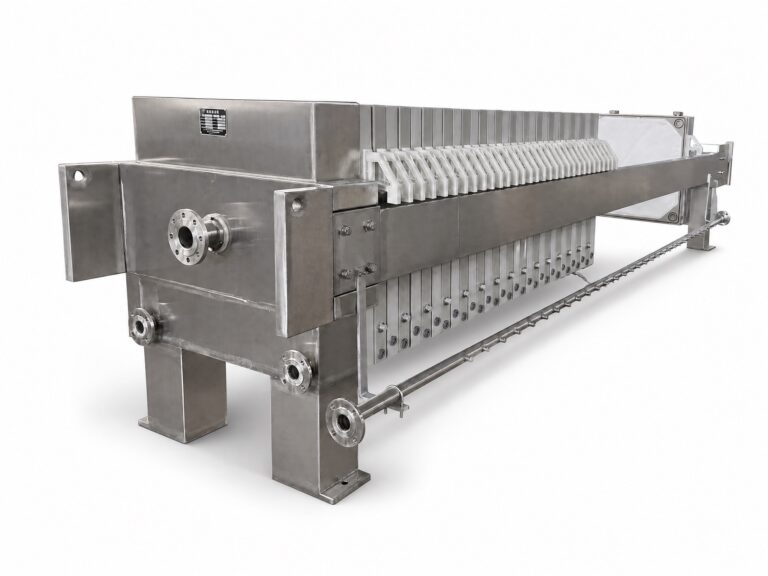
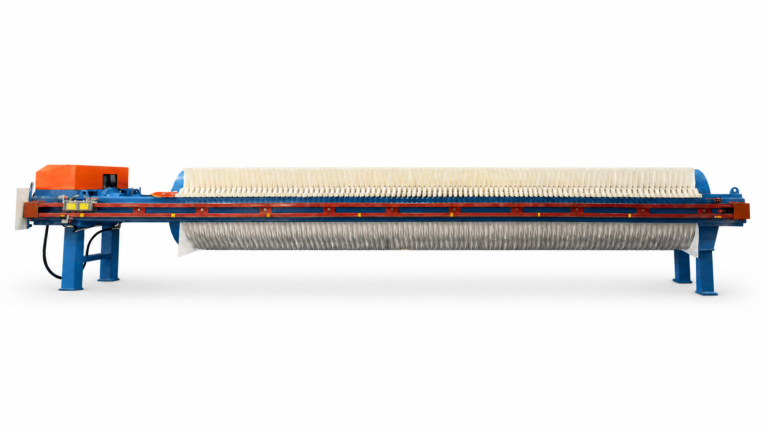
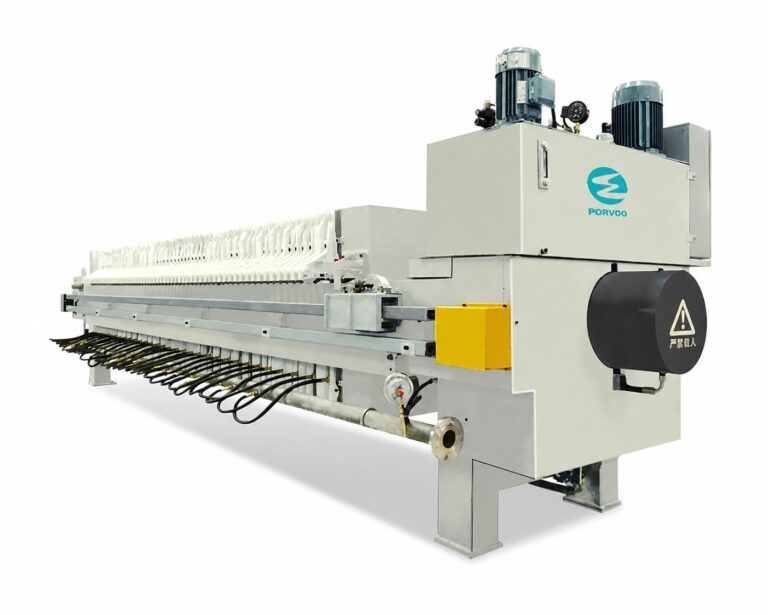
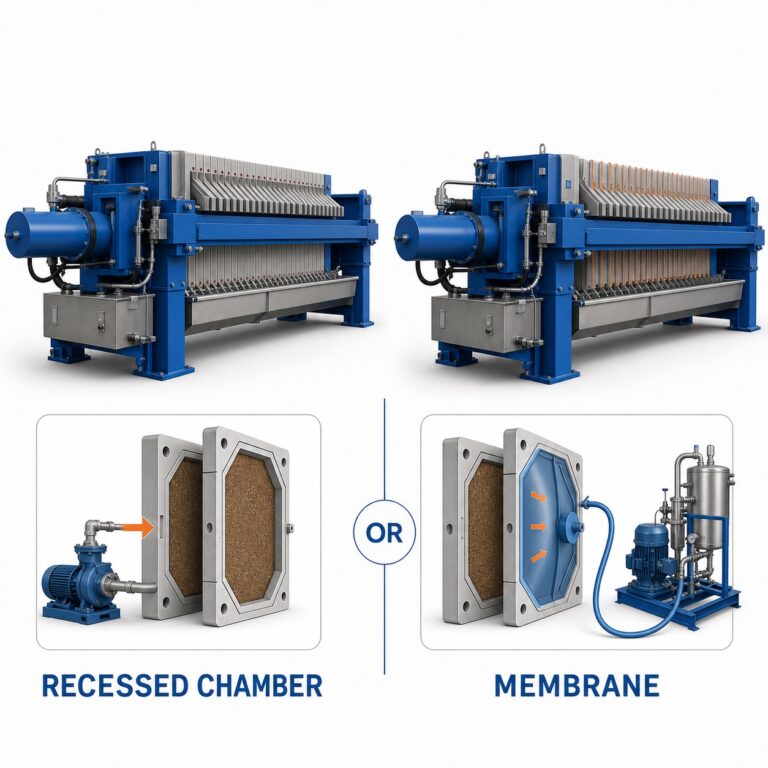
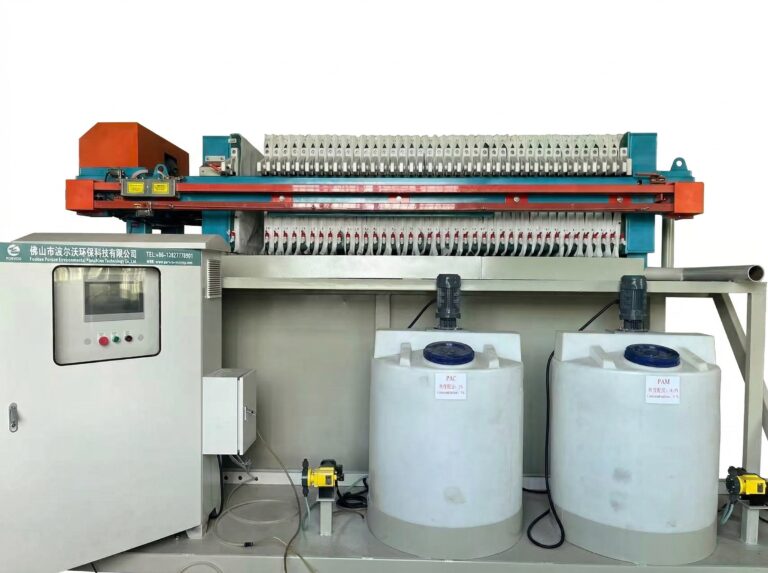
A standard recessed chamber press forms its chambers from plates with a recessed face; the plates tighten against each other and against the cloth, and slurry fills the resulting cavity until cake builds to the chamber’s depth. A round-plate press forms chambers differently, with a plate geometry and chamber arrangement intended to behave differently from the recessed design in situations where cake release or chamber filling is the point of concern. Both routes use filter cloth, a feed pump, a hydraulic or mechanical closing system, and a discharge method appropriate to the cake produced; the Информационный бюллетень Агентства по охране окружающей среды США (EPA) по технологиям переработки биологических отходов: фильтр-прессы с утопленными пластинами describes this general chamber, cloth, and discharge arrangement as the mechanical basis for comparison, within its scope as US municipal biosolids guidance rather than evidence of industrial-slurry superiority for either configuration.
The operating mode interacts with the geometry. A press cycle includes closing, feeding, cake formation, and opening for discharge, and the way each proposal manages feed pressure and chamber filling during that cycle depends on the chamber’s shape as much as its nominal size. Where a slurry forms cake slowly, the portion of the cycle spent filling the chamber lengthens, and the geometry’s effect on how evenly the chamber fills becomes more visible. Where a slurry releases poorly from the cloth or plate face, the geometry’s effect on how cleanly the cake separates from the plate at discharge becomes the more relevant difference.
Chamber construction also affects what the plate pack looks like in practice: the way plates stack, how chambers are counted toward total volume, and how the pack is accessed for cloth inspection or cake removal. These are configuration details rather than performance claims, but they are the details a buyer needs from both proposals in comparable terms. A proposal that specifies plate shape without specifying chamber depth, cloth type, and the closing and feed sequence used for that shape gives the buyer a label, not a configuration that can be evaluated against the project’s slurry.
The EPA fact sheet’s framing is useful here precisely because it treats chamber, cloth, filtrate, and discharge as separate mechanical elements rather than as a single performance figure. That same separation is what allows a buyer to ask where, specifically, a round-plate proposal claims to differ from a standard chamber proposal, rather than accepting a general assertion that round-plate presses perform better on difficult slurries.
Feed and conditioning data both proposals must share
| Входные данные проекта | Basis shared by both proposals | Why it matters to the decision |
|---|---|---|
| Типичный поток данных | Use the same representative slurry | Keeps the comparison tied to the material being evaluated |
| Conditioning state | Use the same conditioning state | Avoids treating a conditioning difference as a configuration difference |
| Cloth candidate | Evaluate the same cloth candidate | Keeps filter-medium choice from changing the comparison basis |
| Filtrate requirement | Apply the same filtrate requirement | Gives both proposals the same required filtrate outcome |
| Cake-handling objective | Apply the same cake-handling objective | Tests each proposal against the same downstream handling need |
A comparison between a round-plate and a standard chamber proposal only produces a usable answer if both proposals are built from the same slurry data. Where one proposal is evaluated against a feed sample taken at one point in production and the other against a sample taken under different conditions, any difference in predicted cake moisture or cycle time may reflect the sample rather than the chamber geometry.
Representative feed means slurry drawn from conditions the press will actually see in operation, including the range of composition the slurry shows across campaigns if that range is known. Conditioning state matters separately: a slurry that has been dosed with a flocculant or coagulant behaves differently from the same slurry untreated, and a proposal built around an assumed conditioning dose is only valid if that dose is confirmed and reproducible in operation. If the two proposals assume different conditioning states, the comparison measures the conditioning difference, not the chamber difference.
Cloth candidate works the same way. Filter cloth affects filtrate clarity, cake release, and effective cycle time independent of chamber shape, so evaluating a round-plate configuration with one cloth against a standard chamber configuration with a different cloth confounds the two variables. Holding the cloth candidate constant across both proposals isolates what the chamber geometry itself contributes.
The filtrate requirement and the cake-handling objective define what counts as an acceptable outcome for either configuration. A filtrate requirement stated as a clarity or quality target tells both proposals what they are being measured against; a cake-handling objective, whether that is a moisture target, a handling consistency requirement, or compatibility with downstream cake transport, does the same for the solids side. Without a shared target, two proposals can both appear to perform adequately while actually optimizing for different outcomes.
This shared basis is also what a supplier needs to do meaningful configuration or quotation review. When a buyer submits matched feed, conditioning, cloth, filtrate, and cake-handling information for both routes, the resulting proposals address the same project rather than two different interpretations of it, which is what allows the round-plate and standard chamber options to be compared rather than merely listed.
Pump, footprint, discharge, and maintenance interfaces to compare
| Интерфейс | Compare between proposals | Plant-fit question |
|---|---|---|
| Feed-pump duty | Duty required by each proposed configuration | How does each requirement fit the project pump basis? |
| Support footprint | Installed support footprint | How does each proposal fit the available support area? |
| Plate-pack access | Access around the plate pack | Can the layout provide the access each proposal needs? |
| Filtrate routing | Route from the press into the project filtrate system | How does each proposal connect to the planned filtrate route? |
| Discharge clearance | Clearance needed for cake discharge | Does the layout preserve the required discharge space? |
| Operator work | Work associated with running and discharging the press | Which proposal better fits the intended operating practice? |
Chamber geometry does not operate in isolation from the rest of the installation. A feed pump sized and controlled for one chamber configuration may not suit the other, because chamber filling behavior affects the pressure and flow profile the pump needs to deliver across the cycle. Comparing the feed-pump duty each proposal assumes is therefore not a secondary check; it is part of confirming that either configuration can be fed the way its proposal assumes.
Support footprint and plate-pack access follow a similar logic. A press that fits a given layout on paper may still constrain how the plate pack is accessed for cloth replacement or cake-adhesion checks if the surrounding structure limits movement around the pack. Where an existing building or platform defines the available space, the installed footprint of each configuration, including the clearance needed to open the plate pack, becomes a project-fit question rather than a general specification comparison.
Filtrate routing is another interface that differs by installation context rather than by chamber geometry alone. Each proposal’s filtrate outlet needs to connect into the project’s existing filtrate handling, and the point at which it does so, along with any pressure or flow implications, is worth confirming independent of which chamber configuration is chosen.
Discharge clearance and operator work are where chamber geometry’s practical consequences become most visible. A configuration that changes how cake releases from the plate also changes what the operator does at discharge and how much clear space the discharge motion requires. If round-plate geometry is being proposed specifically to improve release behavior for a difficult slurry, the installed discharge clearance and the resulting operator task are exactly where that claimed improvement needs to be checked against the real layout, not just against a general description of the plate shape.
None of these interfaces are visible from a plate specification alone. A proposal that only states round-plate or standard chamber, without stating the feed-pump duty, footprint, access, routing, clearance, and operator task it assumes, leaves the buyer unable to confirm whether the configuration fits the plant as installed.
Representative trial observations that separate fit from sales claims
| Trial observation | Matched comparison | Граница принятия решения |
|---|---|---|
| Filtration behavior | Observe whether the slurry filters slowly with each configuration on the same feed, conditioning, and cloth basis | The observation compares trial behavior; the configuration label alone does not establish throughput |
| Выпуск торта | Compare release behavior against the same cake-handling objective | The observation applies to the tested basis; the label alone does not establish ease of discharge |
| Variation across campaigns | Where the slurry varies, compare observations for the relevant campaign conditions | Results for tested conditions do not establish performance for untested feed variation |
Where a slurry is identified as filtering slowly, releasing poorly, or varying across campaigns, the question a trial needs to answer is not which plate shape is better in general, but how each configuration behaves on this slurry under the matched feed, conditioning, and cloth basis already established. A trial run on a sample that does not represent the feed condition, or run with conditioning that would not be reproduced in operation, produces an observation that does not transfer to the installed decision.
Filtration behavior observed in a trial should be read against the same basis for both configurations: same representative feed, same conditioning state, same cloth candidate. If one configuration’s trial used a different dose or a different cloth, an apparent difference in filtration rate reflects that difference rather than the chamber geometry. The observation is evidence about how this slurry filtered under these tested conditions in this configuration, not a general statement about which chamber type filters faster.
Cake release is evaluated against the cake-handling objective set for the project, not against a general standard of good release. A configuration that releases cleanly against one handling objective may not have been tested against a different one, and release behavior that looks acceptable in a short trial may not represent what happens across a longer operating campaign.
Where the slurry is known to vary across campaigns, a single trial run captures only the conditions present during that run. Comparing observations across the range of campaign conditions that matter to the project, rather than relying on one favorable or unfavorable run, is what allows the trial result to speak to the project’s actual operating pattern. A result obtained under one set of campaign conditions does not establish how either configuration performs under conditions that were not part of the trial.
This is also where a sales claim about round-plate performance on difficult slurries needs to be distinguished from a trial observation. A general claim about round-plate release behavior describes the geometry’s intended mechanism; a trial observation describes how that mechanism performed on this slurry, under this conditioning, with this cloth, measured against this cake-handling objective. The acceptance testing approach described in Filter Press Acceptance Testing: Cake Moisture, Filtrate Quality, and Cycle Time addresses how cake moisture, filtrate quality, and cycle time are checked once a configuration is installed, which is the same kind of matched, conditions-stated observation a pre-purchase trial needs to produce if it is going to inform the configuration decision rather than just support it.
Selection record for choosing the configuration without assuming an outcome
| Запись | Basis to document | Limit on the conclusion |
|---|---|---|
| В пересчете на суспензию | Representative feed, conditioning state, and cloth candidate | The choice applies to the stated material and comparison basis |
| Required outcomes | Filtrate requirement and cake-handling objective | The choice does not establish outcomes beyond the stated requirements |
| Installed fit | Feed-pump duty, support footprint, plate-pack access, filtrate routing, discharge clearance, and operator work | Configuration fit includes these project interfaces, not plate shape alone |
| Trial comparison | Observed filtration, cake release, and relevant campaign variation | Trial evidence applies to the conditions that were actually compared |
| Configuration choice | Selected route and the evidence supporting it | The record supports a project choice, not a claim that the other route is generally inferior |
A configuration decision between round-plate and standard chamber is defensible when it can be traced back to the slurry basis, the required outcomes, the installed fit, and the trial comparison that were actually used to reach it. Recording that basis is what turns the decision into something the project team, the EPC contractor, or a future maintenance planner can review later, rather than a choice that has to be re-justified from memory.
The slurry basis establishes which representative feed, conditioning state, and cloth candidate the decision rests on. If that basis changes, for example because the plant later sources material from a different supply or changes its conditioning chemistry, the recorded basis tells the project team that the original configuration decision may no longer apply without being re-checked.
The required outcomes, stated as the filtrate requirement and cake-handling objective, define what the chosen configuration was selected to achieve. This matters because a configuration chosen to meet one cake-handling objective should not be assumed to meet a different one if the project’s downstream handling needs change.
Installed fit carries forward the feed-pump duty, footprint, access, routing, clearance, and operator-work findings from the comparison stage. This is where the decision connects to delivery and integration: the selected press’s data sheet and layout drawings become the reference the plant uses when planning installation, feed-pump coordination, and the maintenance access the plate pack will need over its operating life. The relevant product references, Фильтр-пресс с круглыми пластинами для суспензий, сложных для обезвоживания и Камерный фильтр-пресс со встроенной камерой, describe each configuration’s intended basis for buyers who need that reference point when checking a proposal against the installed fit recorded here.
The trial comparison carries forward the filtration behavior, cake release, and campaign-variation observations actually obtained, with the conditions under which they were obtained stated alongside them. This keeps the trial evidence usable: a reviewer can see what was tested and what was not, rather than inheriting a conclusion without its basis.
The configuration choice itself, recorded against this basis, supports a decision for this project’s slurry and conditions. It does not establish that the selected configuration is the better choice generally, or that the alternative configuration would fail on a different slurry. Where the project’s conditions later diverge from what was recorded, for example a change in representative feed, the recommended response is to revisit the comparison in Расчет размеров фильтр-пресса для керамической и каменной суспензии: данные, которые необходимо уточнить перед отправкой запроса на предложение rather than carry the earlier decision forward unchanged.
Часто задаваемые вопросы
Q: Does a difficult-to-dewater slurry automatically favor a round-plate filter press?
A: No. Difficult filtration is a reason to compare configurations on matched conditions, not evidence that one plate shape will perform better. Require observations from the same representative feed, conditioning state, and cloth candidate before attributing an outcome to configuration.
Q: When is a representative trial especially important before choosing a configuration?
A: A trial is especially important when the slurry filters slowly, releases poorly, or changes between campaigns. Test the relevant campaign conditions and record filtration behavior and cake release against the same filtrate requirement and cake-handling objective; apply the conclusion only to the conditions actually compared.
Q: How should a buyer handle proposals that use different feed or conditioning assumptions?
A: Treat them as not yet comparable. Issue one common comparison basis covering the representative slurry, conditioning state, cloth candidate, filtrate requirement, and cake-handling objective, then identify and resolve any proposal deviation before treating a difference as evidence about plate geometry.
Q: Can a configuration with acceptable trial behavior still be a poor plant choice?
A: Yes. Check the required feed-pump duty, support footprint, plate-pack access, filtrate routing, cake-discharge clearance, and operator work against the planned installation. An unresolved interface mismatch can prevent a configuration from fitting the project even when its tested filtration behavior is acceptable.
Q: What should decide the choice if both configurations perform similarly in matched trials?
A: Use installed fit and operating practice as the tie-breakers. Compare how each proposal fits the available area, pump basis, access, discharge space, filtrate route, and intended operator work, and document the project-specific reason for the choice without turning it into a general superiority claim.