Before a filter press is specified for a sludge or slurry dewatering duty, the buyer needs evidence that the proposed chamber type, cloth, and automation level will actually perform on the material in question. A representative test run, done ahead of final equipment selection, produces that evidence — but only if the reader knows which observations answer which question, and which ones still require confirmation at project scale.
Test Outputs That Distinguish Feasible Press Configurations
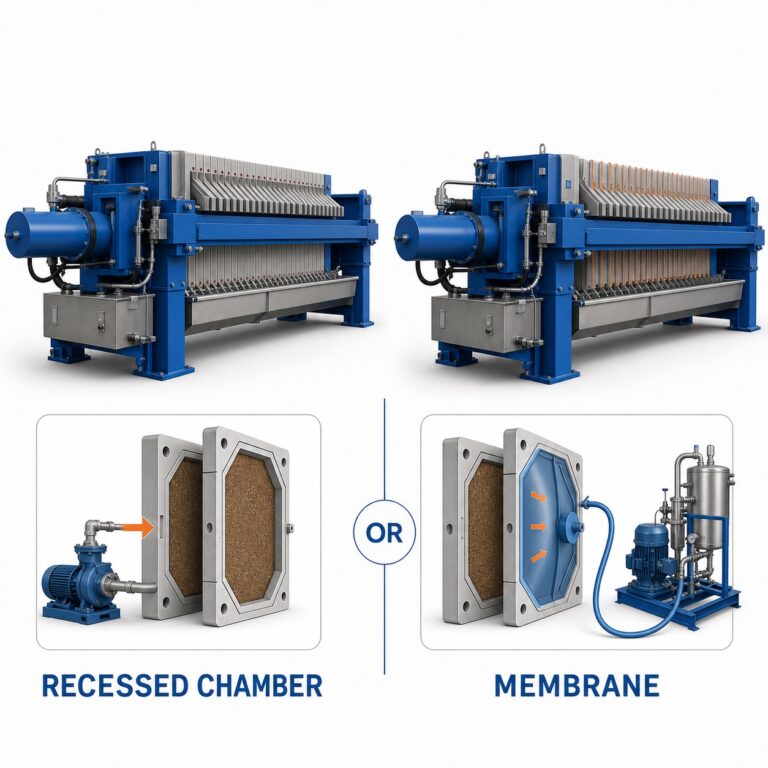
A filter press trial exists to narrow a field of possible configurations before price and automation comparisons begin, not to produce a single predicted outcome. Where the feed material is well characterized and consistent, a trial can quickly separate configurations that are mechanically workable from those that are not — for instance, whether a recessed-plate design can adequately handle the cake formed, or whether the material instead points toward a membrane press because of how it compresses or releases. Where the feed varies across batches or sources, the same trial still narrows the field, but the narrowing applies only to the tested condition, and the buyer must treat untested variability as an open question rather than an assumption the trial has already answered.
This distinction matters because a press configuration that appears feasible on one feed sample can become marginal or unworkable on a different one, even where the chemical composition looks similar. Particle size distribution, solids concentration, and conditioning chemistry all influence how a cake forms and compresses under pressure, and a trial run captures the combined effect of these factors for the specific feed tested — not the individual contribution of each. When the buyer changes feed source, conditioning dosage, or pretreatment method after the trial, the configuration conclusion drawn from the earlier test no longer carries forward automatically.
The practical value of this stage is in eliminating options early, before the buyer invests in detailed engineering or automation comparisons for a configuration that the material itself rules out. A press configuration that fails to form a stable cake, or that produces excessive filtrate turbidity under trial conditions, signals a mismatch that no amount of automation or controls sophistication will resolve. Conversely, where multiple configurations perform acceptably in the trial, the choice between them shifts toward secondary factors — footprint, operator involvement, or automation level — rather than basic feasibility.
Сайт EPA’s Recessed-Plate Filter Press fact sheet describes representative bench or vendor pilot testing as the basis for design decisions touching the feed-pump interface, chamber selection, cloth choice, filtrate handling, cake discharge, footprint, and operator-work interfaces. That scope — tied to US municipal biosolids — supports using the same general testing logic and selection dimensions for industrial slurries, without extending its findings into direct performance guarantees or scale-up conclusions for a different feed category.
Cake Release, Cloth Behavior, and Filtrate Evidence
| Trial evidence | Что записывать | Selection question it informs | Граница доказательств |
|---|---|---|---|
| Выпуск торта | How the tested cake releases during trial discharge | Press-configuration and cake-discharge implications | Applies to the tested feed and trial conditions; project-scale release still requires verification |
| Cloth behavior | Cloth behavior through the test cycle and discharge | Cloth choice and maintenance implications | Supports a conditional choice for the tested conditions, not an unconditional project result |
| Фильтрат | Filtrate observed during the trial | Filtrate-interface and press-configuration implications | Does not establish performance beyond the tested feed and stated conditions |
Three distinct observations emerge from any representative trial, and each answers a different equipment or maintenance question rather than a single combined one. Cake release — how cleanly the formed cake separates from the cloth during trial discharge — speaks directly to the press-configuration and discharge-mechanism question. Where cake releases poorly in testing, that behavior points toward either a different chamber type, a different cloth weave or finish, or a design that anticipates manual intervention at discharge; where it releases cleanly, the discharge interface for the tested configuration is less likely to need special provision. In either case, the observation is tied to the trial feed and conditions, and a different moisture content, conditioning chemistry, or pressure profile at project scale can produce different release behavior.
Cloth behavior through the test cycle is a separate line of evidence. A cloth that blinds progressively across cycles, or that shows differential wear at specific zones, signals a maintenance and consumable-life consideration distinct from the configuration question itself. This observation supports a conditional cloth choice for the tested feed and cycle time — it does not establish how that cloth will behave across a full project duty cycle, under different pressure ramps, or with different cleaning intervals than the trial used.
Filtrate clarity and flow behavior observed during the trial form the third distinct line of evidence, and it speaks to the filtrate-handling interface and to whether the proposed press configuration is consistent with downstream filtrate quality requirements. A press that performs acceptably on cake formation can still produce filtrate that doesn’t meet the project’s downstream handling needs, which is a separate finding from either the cake-release or cloth observations. Where the buyer’s downstream filtrate destination has its own quality expectations — reuse, discharge, or further treatment — the trial’s filtrate evidence should be read against that destination’s requirements, not against cake performance alone.
Each of these three observations is bounded to the tested feed and stated trial conditions; none of them, on its own, establishes performance beyond that scope, and the buyer should record all three separately rather than let a strong result in one area substitute for evidence in another.
Pump, Chamber, and Pressure-Flow Implications
| Trial basis | Использование при отборе | Граница, которую необходимо сохранить |
|---|---|---|
| Pressure-flow response | Inform the feed-pump and press selection interface | Treat the response as evidence from the tested feed and setup, not as a fixed project duty |
| Chamber geometry used in the test | Tie the observed result to the tested press configuration | A different chamber geometry requires an explicit scale-up assumption |
| Cycle progression | Support comparison of feasible press configurations and conditional sizing inputs | Keep the tested cycle conditions and scale-up assumptions visible |
The pressure-flow response observed during a trial — how flow rate changes as chamber pressure builds across a cycle — is the evidence that connects most directly to feed-pump selection and to the press’s chamber-filling behavior. A feed pump must be matched to the pressure-flow characteristic of the material being dewatered, because a pump sized without reference to that response can either underfill chambers within the available cycle time or push flow in a way that interferes with proper cake formation. The trial’s pressure-flow curve, read against the tested chamber geometry, gives the buyer a basis for discussing pump duty with the supplier — but that basis is evidence from the tested feed and setup, not a fixed project operating duty, because feed concentration, temperature, or conditioning changes at project scale can shift the pressure-flow relationship the trial recorded.
Chamber geometry used in the test is inseparable from the result the test produced. A given cake thickness, fill time, and pressure profile are all functions of the specific chamber geometry tested, so where the project calls for a different chamber size or a different number of chambers, the buyer is applying a scale-up assumption rather than extending the test result directly. This is a point worth raising explicitly with the supplier: if the proposed project press uses a different chamber geometry than the one tested, the trial’s pressure-flow and cycle-time findings need an explicit translation step, and that translation is a design judgment rather than a measured fact.
Cycle progression — how the full fill-to-discharge sequence unfolds over the trial — supports comparing feasible configurations against each other and developing conditional sizing inputs for the project, such as an expected cycle count per operating period. But the cycle observed in the trial reflects the tested chamber geometry, feed condition, and operating pressure together; changing any one of these at project scale changes the cycle the buyer should expect, so the tested cycle conditions and the scale-up assumptions connecting them to the project should remain visible in the selection record rather than collapsed into a single projected number.
Automation and Operator Work Revealed by the Trial
| Trial observation | Использование решения | Limit of the evidence |
|---|---|---|
| Cycle progression | Identify where the automation package must address the tested cycle | The trial does not establish the final project automation design |
| Operator interventions | Record the work required during the trial and use it when comparing automation packages | Trial interventions do not by themselves define project staffing or final operating practice |
| Выгрузка жмыха | Assess the cake-discharge interface and the work exposed by the trial | Project-scale discharge behavior still requires verification |
A trial run surfaces where manual intervention becomes necessary across a cycle, and this observation feeds directly into automation-package comparison. Where the tested cycle proceeds from fill through compression to discharge with minimal manual input, that supports a lighter automation specification; where operators needed to intervene — clearing a discharge obstruction, adjusting a parameter mid-cycle, or managing an uneven cake — that intervention points to where an automation package would need to address the cycle if manual steps are to be reduced or removed at project scale. The trial does not, on its own, specify what that automation package should look like; it identifies where attention is needed, leaving the design response to be worked out separately.
Operator interventions recorded during the trial carry a parallel but distinct implication for operating practice and staffing discussions. An intervention that occurred because of a specific trial-scale condition does not necessarily recur at a different scale or cycle frequency, so recording what happened and why is more useful than treating the trial’s intervention count as representative of ongoing project operating practice. Where the buyer is comparing automation packages partly on the basis of reduced operator load, the trial’s intervention record gives a starting point for that comparison, provided the buyer keeps in view that staffing and operating practice at project scale depend on cycle frequency, shift pattern, and site operating procedure — none of which the trial itself determines.
Cake discharge deserves separate attention from cake release discussed earlier, because discharge is an interface and workflow question rather than purely a cake-behavior question: how the cake exits the chamber, where it falls or is directed, and what handling step follows discharge all affect how much operator attention the configuration requires on an ongoing basis. A trial that exposes an awkward or labor-intensive discharge sequence is useful evidence for comparing configurations on this dimension, even where cake release itself was acceptable, because discharge interface design and cake-release behavior are related but not identical considerations. Project-scale discharge behavior — including how it interacts with downstream cake handling — still requires confirmation once the project configuration is fixed.
Scale-Up Assumptions That Stay Outside the Test Result
| Scale-up item | What must be stated | Why it remains conditional |
|---|---|---|
| Tested feed | The feed represented in the trial | The evidence is tied to that feed |
| Feed preparation | The preparation used in the test and any planned project difference | A changed preparation sits outside the direct test result |
| Геометрия камеры | The tested geometry and the geometry proposed for selection | Translation between them is a scale-up assumption |
| Conditional sizing inputs | Which test evidence is used and which assumptions connect it to sizing | A sizing input is not a guaranteed project capacity |
| Project scale | What must be verified at the intended project scale | The trial alone does not establish the final project outcome |
Every trial result is anchored to a specific tested feed, and that anchor is the first assumption the buyer must carry forward explicitly rather than let it fade into the background. Where the project feed is expected to match the tested feed closely — same source, same pretreatment, same conditioning — the trial’s findings transfer with less translation required. Where the project feed is expected to differ, even in ways that seem minor, each difference becomes a specific question: does this change in feed character affect cake formation, cloth blinding, or filtrate quality in a way the trial did not test?
Feed preparation is a related but separate assumption. A trial conducted on feed prepared one way — a particular conditioning dosage, a particular degree of pre-thickening — produces results tied to that preparation. If the project intends to prepare feed differently at full scale, whether for cost, chemistry, or logistical reasons, that difference sits outside what the trial directly demonstrated, and the buyer should treat the preparation method as a variable requiring its own confirmation rather than assuming the trial result holds regardless of preparation.
Chamber geometry carries the same logic discussed earlier in the pump and chamber context, but it belongs here too as a scale-up assumption in its own right: the tested geometry and the geometry proposed for the actual project selection must both be stated, and the relationship between them — same geometry scaled up, or a different geometry entirely — is itself a judgment the buyer and supplier need to make explicit rather than leave implied.
Conditional sizing inputs drawn from the trial are exactly that — conditional. A sizing figure derived from test evidence, chamber geometry, and stated feed-preparation assumptions is useful for moving the project toward a supplier’s detailed design work, but it is not equivalent to a guaranteed project capacity. The distinction matters because a sizing input can be revised as more information becomes available, while a guaranteed capacity implies a fixed commitment the trial alone cannot support.
Project scale itself is the final category of assumption that stays open after any bench or pilot trial. Flow rates, cycle frequency, ambient conditions, and feed consistency over time at full project scale are not directly observed in a bench or pilot test; they must be verified once the project is operating, and the selection record should identify this verification as a distinct, still-open step rather than treating the trial as having already closed it.
Selection Record for Supplier Design and Project Verification
| Record element | Что снимать | Статус решения |
|---|---|---|
| Evidence basis | Tested feed, trial conditions, and observed cake release, cloth behavior, filtrate, cycle progression, pressure-flow response, and operator interventions | Supported only within the stated evidence boundary |
| Feasible configurations | The press configurations that remain feasible after the trial | Shortlist for comparison before price and automation choices |
| Conditional sizing basis | Test evidence, chamber geometry, feed preparation, and stated scale-up assumptions used as sizing inputs | Input to supplier design, not a final guaranteed size or capacity |
| Supplier design responsibility | Pump, chamber, cloth, filtrate, cake-discharge, footprint, and automation details still requiring supplier design | Open until the supplier completes the project-specific design |
| Project verification | Items that must be checked at the intended project scale | Open until project-scale verification is completed |
A usable selection record separates three categories of information so that supplier design work and project-scale verification don’t get confused with what the trial already demonstrated. The first category is the evidence basis itself: the tested feed, the trial conditions under which it was tested, and the specific observations — cake release, cloth behavior, filtrate condition, cycle progression, pressure-flow response, and any operator interventions — that the trial produced. This evidence is supported only within the boundary already stated for each observation, and restating that boundary in the record prevents it from being read later as a broader claim than the trial supports.
The second category is the shortlist of feasible configurations that survived the trial — the press types, chamber arrangements, or cloth choices that performed acceptably on the tested feed. This shortlist is the basis for comparing price and automation packages, but it is a shortlist, not a final selection; price and automation comparisons proceed from here rather than substituting for the feasibility screening the trial already did.
The third category is the conditional sizing basis, built from test evidence combined with the stated chamber geometry, feed preparation, and scale-up assumptions used to connect trial results to project dimensions. This sizing basis is an input to supplier design work, not a guaranteed size or capacity — a distinction worth keeping explicit when a project team reviews a supplier’s proposal against the original trial findings.
What remains, once these three categories are recorded, is a clear statement of what supplier design work is still open — pump duty, chamber specification, cloth selection, filtrate handling, cake-discharge arrangement, footprint, and automation detail among them — and what project-scale verification is still required before the selection can be treated as final. This is also the point in the process where the project information a buyer supplies — feed characteristics, operating conditions, and the trial record itself — enters a supplier’s configuration and quotation review; a filter press proposal built on that information carries forward the same evidence boundaries the trial record established, rather than treating a conditional sizing input as a settled project capacity. Keeping the record organized this way allows the buyer and the supplier to agree on what the evidence shows, what remains the supplier’s design responsibility within categories such as those covered by filter presses for sludge dewatering, recessed-chamber designs, or membrane press configurations, and what the project team must still confirm once equipment is installed and operating at the intended scale.
Часто задаваемые вопросы
Q: How can I tell whether a filter press test represents my project feed?
A: Compare the tested feed and its preparation with the planned project feed, and record every material difference. If feed preparation or composition will change, treat the result as screening evidence and state that difference as an open scale-up assumption.
Q: Can one trial determine whether a recessed chamber or membrane filter press should be selected?
A: A representative trial can help narrow the feasible press configurations, but it does not make the final selection by itself. Compare cake release, cloth behavior, filtrate, cycle progression, pressure-flow response, and the chamber geometry used before asking the supplier to complete the project-specific design.
Q: What trial information should be included when requesting comparable equipment proposals?
A: Provide the tested feed and preparation, trial conditions, chamber geometry, observed pressure-flow response, cycle progression, cake discharge, cloth behavior, filtrate, and operator interventions. Also identify which sizing inputs are conditional and which items still require supplier design or project-scale verification.
Q: How should operator interventions during a trial affect the automation decision?
A: Record where each intervention occurred and what part of the tested cycle required it, then use that record to compare how proposed automation packages would address the work. Do not translate trial interventions directly into final staffing or operating practice without project-specific design and verification.
Q: When should filter press performance be verified again at project scale?
A: Plan project-scale verification whenever the proposed feed preparation, chamber geometry, operating setup, or scale differs from the trial basis. Keep those differences visible so conditional sizing inputs are not mistaken for guaranteed capacity or final project performance.