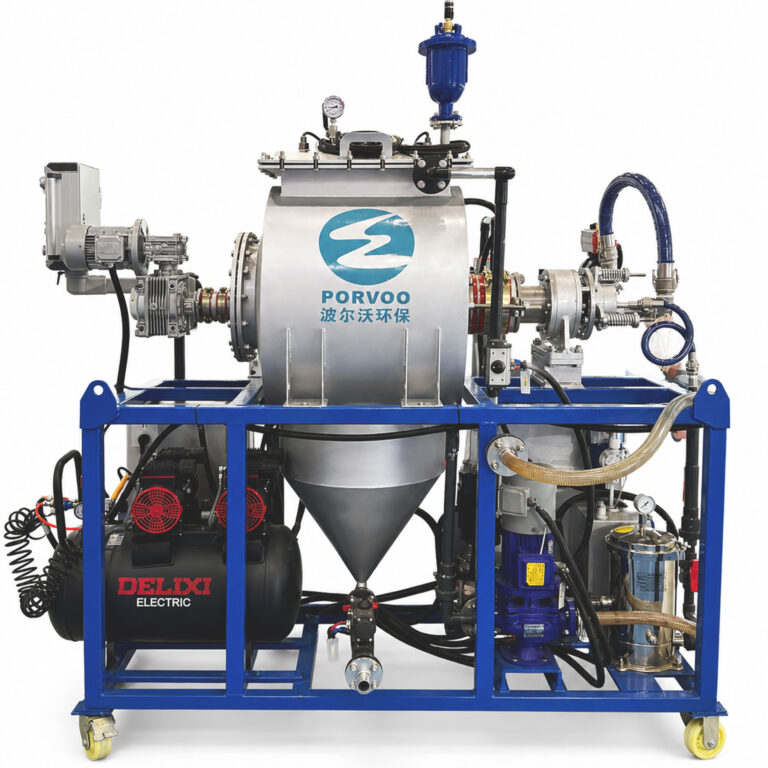
A filter press feed test can tell a buyer something about how a slurry behaves under pressure, but it cannot by itself answer whether a given press configuration will perform on the plant floor. The gap between those two statements is where equipment decisions go wrong, particularly when a single number from a bench or pilot run gets treated as a plant guarantee rather than a conditional result tied to a specific feed and setup.
What a Feed Test Can and Cannot Predict
A feed test exposes a defined slurry sample to a defined set of pressures, cloth, chamber geometry, and cycle steps, then reports what happened to that sample under those conditions. What it can support is a comparison: how one conditioning approach, cloth type, or pressure profile performed against another, when everything else about the test stayed fixed. That comparison has value for screening options before committing to a plant-scale configuration.
What it cannot support, on its own, is a direct prediction of plant performance. The slurry used in the test represents one lot, drawn at one point in time, with whatever variability existed in the feed source at that moment. If the plant feed varies in solids concentration, particle-size distribution, or chemical composition over time, a result generated from a single lot does not describe the full range of conditions the plant press will encounter. The test result stays true for the tested material; it becomes conditional the moment the buyer asks it to describe a moving target.
This distinction matters most when a project team is deciding how much weight to put on early test data. Where the test was run to screen configuration options under controlled, stated conditions, the result supports that screening use directly. Where the same result gets carried forward into a sizing or acceptance discussion without re-examining whether the tested feed matches the plant’s actual feed variability, the evidence is being asked to do something it was not designed to do.
The practical question for a buyer is not whether the test was done correctly, but what question the test was set up to answer. A test designed to compare two cloth types under one feed condition answers a narrower question than a test designed to establish sizing inputs for a specific plant. Both are legitimate, but they support different decisions, and conflating them is where a defensible equipment choice turns into an assumption dressed as evidence. Before relying on any feed-test result, the buyer should confirm which of these two question types the test was actually built to answer, because that determines how far the result can travel.
Feed Conditions That Must Stay Attached to Every Result
| Condition group | Information that stays attached to every result |
|---|---|
| Feed identity | Tested slurry lot |
| Feed preparation | Preparation and conditioning state |
| Test hardware | Cloth and chamber |
| Условия эксплуатации | Operating sequence |
Every number or observation that comes out of a filter press feed test is only as meaningful as the conditions it was generated under. If a result is separated from its feed identity, preparation method, conditioning state, cloth, chamber, and operating sequence, it stops being evidence and becomes an unverifiable claim. This is not a matter of record-keeping discipline alone; it changes what the result can legitimately be used for.
Consider feed identity first. A slurry lot pulled from one point in a process, on one day, under one set of upstream conditions, is not interchangeable with a lot pulled at a different time unless the project has evidence that the two are equivalent. Where the upstream process is prone to compositional drift, treating one lot’s test result as representative of all future feed introduces a gap the buyer needs to close through sampling or process knowledge, not through assumption.
Preparation and conditioning state matter for a related but distinct reason: conditioning changes the particle and floc structure that the press actually sees. A result generated from a conditioned sample does not describe how an unconditioned or differently conditioned feed would behave, because the mechanism of cake formation depends on what state the solids are in when they reach the cloth. If the plant’s dosing approach differs from what was used in the test, the cake and filtrate behavior documented in the test no longer describes the plant condition without further confirmation.
Cloth and chamber selection in the test unit also shape the result. Different cloth permeability and chamber depth change cake formation time, filtrate clarity, and how the cake releases at discharge. A result tied to one cloth-and-chamber combination describes that combination, not the press configuration the plant will ultimately install, unless the two match.
Operating sequence rounds out this set. The order and timing of pressure stages, feed cycles, and any intermediate steps the test followed are part of what produced the result. A buyer reviewing a test report should be able to trace each reported outcome back to these conditions; where that trace is incomplete, the result cannot be relied on for anything beyond the narrowest possible comparison.
Cake, Filtrate, Cycle, Pressure, and Flow Evidence
Cake moisture, filtrate quality, cycle behavior, pressure, and flow are often reported as if each were an independent measure of press performance. They are not. They are five views of the same dewatering event, and treating any one of them in isolation produces a misleading picture of what the test actually showed.
Cake moisture describes how much liquid remains in the solids after the press cycle completes, but that figure only means something alongside the pressure and cycle time that produced it. A lower moisture result achieved under a longer cycle or higher pressure is not directly comparable to a similar moisture result achieved faster or at lower pressure, because the operating cost and equipment demand behind each differ. Reporting cake moisture without its paired pressure and cycle data invites a false equivalence between two outcomes that were not reached the same way.
Filtrate quality works similarly. Clear filtrate suggests effective solids capture at the cloth, but filtrate clarity achieved early in a cycle can degrade as the cake builds, and a single filtrate sample does not describe the full cycle’s behavior. Filtrate quality also depends on the conditioning state of the feed, so a clean filtrate result tied to one conditioning approach does not transfer to another without re-testing.
Cycle time and flow rate connect directly to throughput, but a short cycle achieved at the cost of higher residual moisture represents a different trade-off than a longer cycle that produces drier cake. Neither is correct in isolation; the choice depends on what the downstream handling of the cake and filtrate requires, which is a project-specific condition, not a property of the press itself.
Pressure sits underneath all of these. It is the variable that most directly drives both cake formation rate and ultimate moisture, and a pressure figure reported without its corresponding cake and filtrate outcomes tells the reader little about whether that pressure was appropriate for the material tested. A defensible read of feed-test evidence requires looking at cake, filtrate, cycle, pressure, and flow together, because a favorable number in one category can mask an unfavorable trade-off in another, and no single result stands in for the full picture of how the slurry behaved under test conditions.
Scale-Up Risks Between a Test Unit and the Plant
| Scale-up area | Test condition or evidence available | Plant question that remains project-specific |
|---|---|---|
| Лента новостей | Tested slurry lot, preparation, and conditioning state | How plant feed variability relates to the tested feed |
| Оборудование | Tested cloth, chamber, operating sequence, pressure, and flow | How the plant equipment interfaces relate to the test-unit conditions |
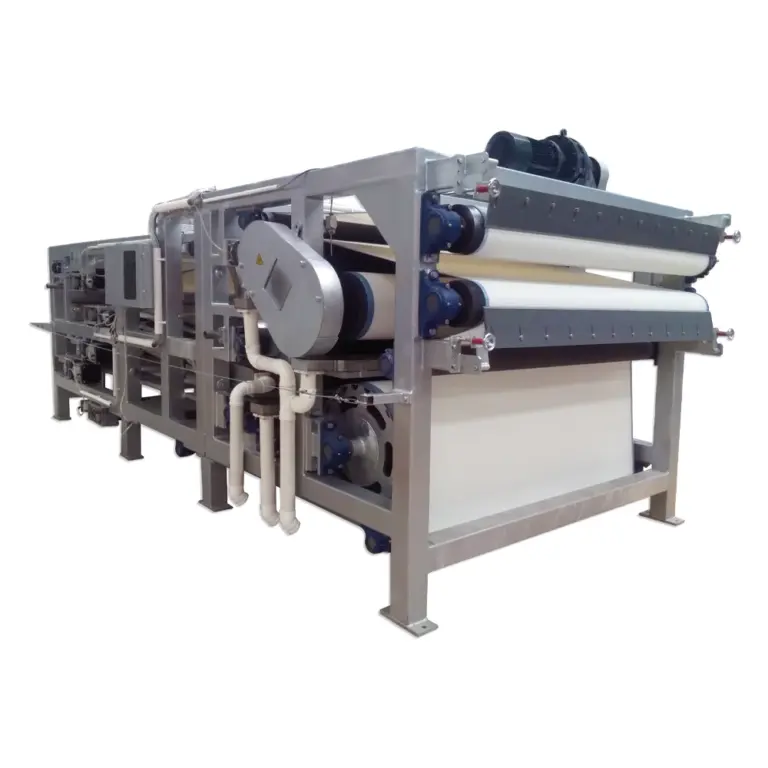
A test unit and a plant-scale press differ in more than size, and those differences are where a well-documented bench or pilot result can still fail to predict plant performance. The Информационный бюллетень Агентства по охране окружающей среды США (EPA) о фильтр-прессе с утопленной пластиной describes the feed-pump, plate-chamber, filter-cloth, filtrate-removal, and cake-discharge interfaces that make up a filter press system, along with the role of representative bench or vendor pilot testing in evaluating these interfaces before full-scale commitment; this framing is useful for understanding the mechanics of the route and the dimensions along which test and plant units should be compared, though its scope is municipal biosolids and its specific results and chemical-conditioning findings do not transfer to an industrial slurry without independent verification.
The feed side of scale-up risk centers on variability. A test unit processes a defined lot under defined preparation; a plant feeds continuously or in batches from a source that may vary over time, by shift, by upstream process state, or by raw material change. Where the project has evidence that plant feed stays within a narrow, well-characterized range, a single test lot carries less uncertainty. Where the feed source is known to vary, or where that variability has not been characterized, the test result describes only one point in a range the plant will actually experience, and the buyer needs additional sampling or process data to close that gap.
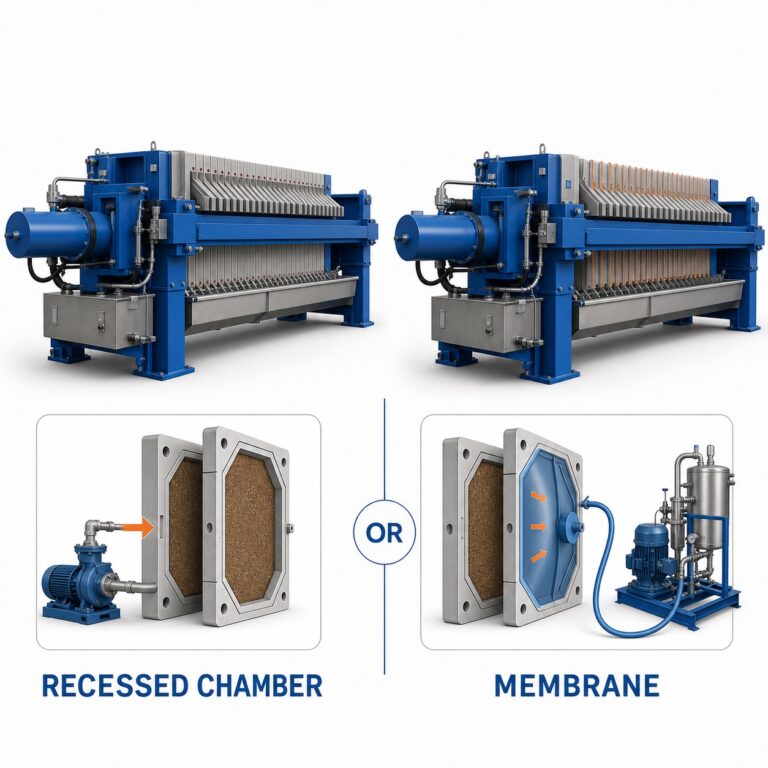
The equipment side of scale-up risk centers on interfaces. A test unit’s feed pump, plate chamber, cloth, filtrate removal, and cake discharge are built to a scale and configuration chosen for testing convenience, not necessarily matched to how a plant-scale press will integrate with upstream conveyance, downstream cake handling, or the pumping system that delivers slurry to the press. A cloth that performs well at test scale may behave differently when chamber depth, feed pressure delivery, or discharge mechanics change at plant scale. These are not flaws in the test; they are the reason a test result supports configuration screening and directional feasibility rather than a direct plant guarantee.
Closing this gap requires the project team to state explicitly what in the test matches the planned plant equipment and what does not. Where cloth, chamber type, and operating sequence carry forward unchanged into the plant design, the test evidence travels further. Where any of these change at scale-up, the buyer should treat the plant performance as an open question until the interfaces are confirmed, not as something the test has already answered.
Evidence Package for a Defensible Equipment Decision
| Использование решения | What the evidence package can support | Граница, которую необходимо сохранить |
|---|---|---|
| Feasibility | A feasibility judgment under the stated test conditions | Directional evidence is not a plant guarantee |
| Sizing inputs | Inputs tied to the tested slurry lot, setup, operating sequence, and connected evidence set | Scale-up remains conditional on plant feed variability and equipment interfaces |
| Configuration screening | Comparison of options under stated conditions | Results do not extend beyond those stated conditions |
| Contractual acceptance proposal | A proposal grounded in the recorded test conditions and evidence set | The proposal does not turn the test result into an unconditional plant guarantee |
The same feed-test data can support different decisions depending on what the project record says that data was collected for. A defensible decision record states, for each test result, whether it is being used to support feasibility, sizing inputs, configuration screening, or a contractual acceptance proposal, because each of these uses carries a different evidence boundary.
For feasibility, the evidence only needs to show that the slurry can be dewatered under the stated test conditions well enough to justify moving forward with further evaluation. This is the lightest-weight use of test data, and it remains valid as long as the conclusion is understood as directional rather than a guarantee of plant outcomes.
For sizing inputs, the evidence needs to be tied closely to the tested slurry lot, the preparation and conditioning state used, the operating sequence followed, and the connected set of cake, filtrate, cycle, pressure, and flow results taken together. Sizing decisions carry more consequence than feasibility screening, so the traceability requirements are correspondingly tighter, and the scale-up questions around plant feed variability and equipment interfaces need to be addressed before the sizing inputs are treated as final.
For configuration screening, the evidence supports comparing two or more options, such as different cloth types or operating sequences, under conditions that were held constant across the comparison. This use depends on the comparison being fair, meaning the conditions that varied were the ones under evaluation and the conditions that should have stayed fixed actually did.
For a contractual acceptance proposal, the evidence needs to be grounded in the recorded test conditions and the full connected evidence set, and the proposal itself needs to state clearly that it does not convert a test result into an unconditional guarantee of plant performance. This is the use case with the most at stake if the evidence boundary is not preserved, since a contractual document carries obligations that a feasibility note does not.
When a project team submits test conditions, slurry characteristics, and intended use of the evidence as part of a configuration or quotation review, that information is what allows a supplier such as PORVOO to match a конфигурация фильтр-пресса to the stated application rather than to a generic assumption about the slurry. The clarity of that submission, including which of the four uses above the test is meant to support, has a direct bearing on how closely the resulting configuration recommendation can match the project’s actual conditions.
Часто задаваемые вопросы
Q: Can results from two filter press feed tests be compared directly?
A: Only when the comparison preserves or explicitly accounts for the slurry lot, preparation and conditioning state, cloth, chamber, and operating sequence. Otherwise, an apparent performance difference may come from changed test conditions rather than the option being compared.
Q: Is the driest cake automatically the best test result?
A: No. Review cake condition together with filtrate quality, cycle behavior, pressure, and flow, because one result cannot represent the whole dewatering outcome. The preferred option should match the project’s decision priorities across that connected evidence set.
Q: What plant information should be prepared before test evidence is used for sizing or configuration screening?
A: Document expected feed variability and the relevant plant equipment interfaces, then map them against the tested feed, hardware, and operating sequence. Any gaps should remain explicit because scale-up is conditional until those differences are addressed.
Q: Can a result be reused for a different slurry lot or test setup?
A: Do not treat it as equivalent evidence without checking how the new lot, preparation, conditioning, cloth, chamber, and sequence differ from the original test. Use the recorded conditions to decide whether a fresh comparison is needed.
Q: What makes a feed-test record ready for an equipment decision?
A: It should identify the intended use—feasibility, sizing inputs, configuration screening, or a contractual acceptance proposal—and keep every conclusion tied to the stated test conditions and connected evidence set. It should also state the remaining plant-specific uncertainties rather than convert directional evidence into a guarantee.