Selecting a cyclone for abrasive dust is not the same exercise as sizing one for a general nuisance-dust duty. The separation geometry that gives good fractional efficiency can also be the geometry that concentrates wear at specific internal surfaces, and a bid that only promises “heavy-duty” construction without naming where and how that duty is delivered leaves the buyer unable to compare offers on a consistent basis. The decisions below—what dust and process data to supply, how to compare airflow and pressure-drop terms, how to read wear-related construction claims, and how to interpret any separation figure a supplier offers—determine whether the unit selected actually matches the abrasive duty it will see.
Dust Data That Define an Abrasive Cyclone Duty
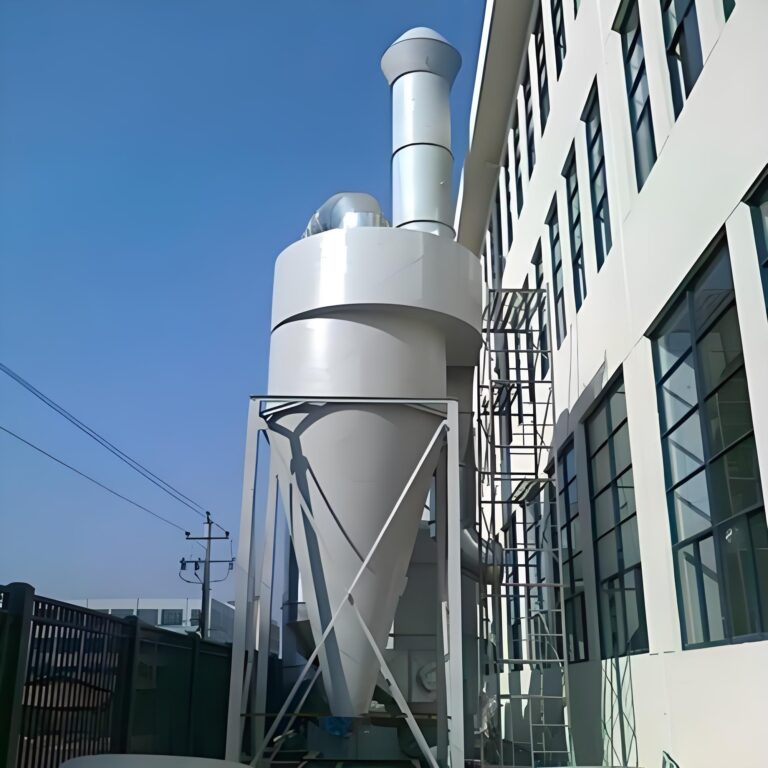
A cyclone separates particles by imparting a rotational flow that drives denser or larger particles toward the outer wall while the cleaned gas exits through the core. Whether that mechanism produces acceptable separation, and where it produces wear, depends on the physical character of the dust entering the unit. Particle-size distribution determines how much material stays in suspension long enough to reach and repeatedly strike the wall versus how much drops out quickly near the inlet; a duty weighted toward coarser, denser particles concentrates impact energy differently than one weighted toward fines. Bulk density affects the momentum each particle carries into the wall, which is a primary driver of erosive wear independent of the chemical hardness of the material. Moisture changes how the dust behaves on contact with internal surfaces—dry abrasive particles tend to abrade by repeated impact, while damp material can build up on surfaces or change how it slides along the wall, altering both wear pattern and separation behavior. Temperature affects gas density and viscosity, which changes the rotational velocity field the cyclone must sustain, and it can also affect the material’s cohesiveness. Dust loading, the mass of solids per unit of gas, sets how frequently particles contact the wear surfaces; the same particle characteristics at a higher loading create more frequent contact events than at a lower loading, even where nothing else about the duty changes.
None of these parameters can be assumed from a general process description. A supplier evaluating an abrasive-duty cyclone needs the actual particle-size distribution, bulk density, moisture, temperature, and loading for the specific stream, because each one independently shifts either the separation performance or the wear behavior, and sometimes both. Where this data is incomplete, any geometry or construction proposal a bidder returns is built on assumptions rather than the project’s actual duty, and the buyer has no basis for comparing that proposal against a competing bid built on different assumptions.
| Duty-data group | Project information to include | Use in bid evaluation |
|---|---|---|
| Характеристики пыли | Particle-size distribution, bulk density, and moisture | Supplies the feed basis for evaluating the actual duty |
| Process conditions | Temperature and dust loading | Supplies the operating basis for evaluating the actual duty |
Airflow and Pressure-Drop Conditions for Comparing Bids
Cyclone geometry and airflow are linked: a given body diameter and inlet configuration produce a rotational velocity field that depends on the volumetric flow passing through it, and that velocity field is what determines both separation performance and pressure drop. Raising the airflow through a fixed geometry increases rotational velocity, which can improve fine-particle separation but also raises pressure drop and increases the velocity at which particles strike the wear surfaces. Lowering the airflow below the design range reduces wear-inducing velocity but can also let coarser separation performance fall off. Because these effects move together, a supplier cannot propose a defensible geometry without knowing the operating airflow range the unit will actually see, including how far that range varies during normal operation rather than only at a single design point.
Pressure-drop allowance is the other half of this comparison. A cyclone that is undersized relative to its duty will produce a higher pressure drop at a given airflow than a correctly sized one, and that additional resistance has to be met by the fan serving the system. Comparing two bids on efficiency claims alone, without checking that each bidder is calculating against the same airflow range and the same pressure-drop allowance, risks comparing two different design points rather than two solutions to the same problem. A bidder proposing a smaller-diameter, higher-velocity design and a bidder proposing a larger-diameter, lower-velocity design may both claim acceptable separation, but they carry different implications for wear rate, fan sizing, and energy draw, and those implications only become visible when the buyer holds airflow and pressure-drop terms constant across the comparison. This is also where the fan interface enters the decision: a cyclone’s pressure-drop behavior is not independent of the fan that must overcome it, so any pressure-drop figure a bidder quotes needs to be read against the fan capability assumed in that same bid, not evaluated as a standalone number. The relationship between inlet volumetric flow and separator performance has been documented in cyclone-performance literature, including work specifically examining inlet flow rate effects on two-stage cyclone separation, which supports treating airflow as a variable that changes performance rather than a fixed input.
Geometry, Construction, and Replaceable Wear Provisions to Compare
Once the duty data and the airflow/pressure-drop basis are established, the geometry a bidder proposes should be read as a direct response to those inputs rather than a stock offering. The same body diameter, inlet type, and cone angle that suit one loading and particle-size profile can be a poor match for another operating at the same airflow but a different dust character. Where the buyer has supplied representative duty data, the bidder’s geometry choice becomes something that can be checked against that data instead of taken on trust.
Wear in an abrasive cyclone is not distributed evenly across the internal surface. The zones exposed to the highest particle concentration and impact velocity—typically where the rotating stream first meets the wall and along the lower cone where particles concentrate before discharge—wear at a different rate than surfaces the flow contacts more lightly. A specification that describes the unit only as heavy-duty does not indicate whether the bidder has identified these zones for this duty or applied uniform construction regardless of where wear actually concentrates. Asking a bidder to identify the exposed internal zones for the proposed geometry, and to state what construction or liner treatment is applied specifically to those zones, converts a generic durability claim into a comparable technical position.
Construction and liner choices trade off in ways that depend on the duty. A liner that resists abrasive wear well may add cost or reduce internal clearance in ways that change the flow pattern; a thicker base-metal construction avoids that clearance change but may wear over a larger area rather than concentrating replacement at a liner. Where the abrasive loading is high enough that wear is expected as a normal consequence of operation, the practical question shifts from preventing wear entirely to managing where it occurs and how it is addressed—which is why replacement scope matters as much as the construction material itself. A bidder should state clearly what is intended to be replaceable, at what boundary, and what remains part of the fixed structure. Two bids proposing similar base construction can differ substantially in what the buyer can service later versus what requires returning the unit or replacing a larger assembly. This comparison connects directly to Porvoo’s Промышленный циклонный пылеуловитель configuration review, where the exposed-zone and construction data the buyer supplies is what allows a wear-appropriate geometry and liner arrangement to be matched to the stated duty rather than assumed from a standard offering.
| Bid comparison point | Bidder information to compare | Buyer decision use |
|---|---|---|
| Geometry basis | Proposed geometry against the stated airflow range and pressure-drop allowance | Compare geometry on the same project basis |
| Exposed internal zones | Identification of zones exposed to abrasive dust | See where each bid locates wear exposure |
| Construction or liners | Proposed construction or liner provision for the exposed zones | Compare named wear provisions; a generic heavy-duty label is insufficient |
| Replacement scope | Identified replacement scope | Compare what each bid treats as replaceable |
Inspection Access and Discharge Interfaces That Affect Wear Management
Wear that is not visible is wear that cannot be managed before it becomes a failure. Inspection access on an abrasive-duty cyclone determines whether the zones identified as exposed to concentrated wear can actually be checked without extensive disassembly. Where access points are positioned at or near the zones expected to wear fastest, deterioration can be observed and addressed before it progresses to a point that affects separation performance or structural integrity. Where access is limited to points convenient for fabrication rather than points relevant to wear location, the buyer’s ability to track condition depends on removing more of the unit than the inspection itself requires.
The discharge interface carries a related but distinct set of considerations. Material leaving the cyclone at the discharge point has already completed its path through the highest-wear zones, and the discharge mechanism itself is exposed to continuous contact with concentrated, often coarser material. How that interface is configured affects whether separated material moves cleanly away from the unit or accumulates in ways that change the internal flow pattern and, in turn, the wear pattern upstream of the discharge itself. Because discharge conditions depend on the specific downstream handling arrangement at the site, the buyer’s own layout and equipment interfaces are part of what determines whether a given discharge configuration performs as intended, and that connection should be confirmed against the site’s actual arrangement rather than assumed from the cyclone specification alone.
Acceptance Evidence for the Agreed Feed and Operating Conditions
| Acceptance element | Agreed project basis | Decision boundary |
|---|---|---|
| Separation target | Project acceptance value | Judges the project result; it is not a universal cyclone rating |
| Evidence conditions | Representative feed and agreed operating and test conditions | Defines where the acceptance evidence applies |
A separation figure attached to a cyclone proposal is only meaningful in relation to the conditions under which it was established. A percentage or efficiency value generated from a different particle-size distribution, a different loading, or a different airflow than the project’s actual duty does not describe how that same geometry will behave under the project’s conditions—it describes how it behaved under the conditions it was tested against. Treating any such figure as a general rating for the equipment, rather than a result tied to specific feed and test conditions, misrepresents what the evidence actually shows.
The alternative is to treat the target separation result as a project acceptance value, established against feed material and operating conditions that represent what the unit will actually process at the site. This shifts the burden from “does this cyclone type separate well” to “does this specific configuration, under these agreed conditions, meet this specific target”—a narrower and more useful question for a buyer making a purchasing decision. Establishing that value requires agreement, before acceptance testing, on what feed sample or feed condition will be used, what operating point (airflow, loading, and the other duty parameters already established) will apply during the test, and what measurement approach will be used to determine the achieved result.
Where representative feed and agreed test conditions are used, the resulting acceptance value describes the performance the buyer can rely on for that project. Where the test conditions diverge from actual operating conditions—a cleaner feed sample, a lower loading, or a different airflow than the unit will see in service—the acceptance value describes only the tested condition and does not extend automatically to variations the site may experience afterward. This distinction matters because abrasive duties are often variable rather than constant; a unit accepted against one feed condition may face a different condition in subsequent operation, and the acceptance evidence does not, by itself, establish performance outside the conditions it was generated under. Buyers preparing acceptance criteria should confirm what conditions the target figure is tied to and how those conditions compare with the full operating range the unit will experience, not only the point at which it was tested.
Часто задаваемые вопросы
Q: What project information should be ready before requesting a cyclone proposal for abrasive dust?
A: Prepare the particle-size distribution, bulk density, moisture, temperature, dust loading, operating airflow range, and allowable pressure drop. Put the same data in every request for quotation and mark any unknown values explicitly so bidders do not base their proposals on different assumptions.
Q: How can I compare cyclone bids that use different geometry or construction?
A: Compare them against the same dust data, airflow range, and pressure-drop allowance, then ask each bidder to explain how its geometry affects the fan and operating basis. Record any departure from those common conditions before comparing the proposed construction or wear provisions.
Q: Is a heavy-duty description enough for abrasive service?
A: No. The proposal should identify the internal zones exposed to abrasive dust, the construction or liner proposed for those zones, the inspection access, and the replacement scope. If those items are not named, the label does not give you a usable basis for comparing wear management.
Q: What should I check about inspection and discharge arrangements before selection?
A: Confirm that the proposed arrangement lets the planned wear areas be inspected and that the discharge interface is defined for the project layout. Treat unclear access or interface details as open design items because they can prevent a realistic inspection and replacement plan.
Q: How should a separation acceptance requirement be written?
A: State a project-specific target together with the representative feed and the agreed operating and test conditions. Use the resulting evidence only within those conditions, and require a fresh evaluation if the feed or operating basis changes materially rather than treating the result as a universal cyclone rating.