Before committing sludge to equipment sizing, a plant manager or process engineer needs to know whether the material actually forms a filterable cake under vacuum ceramic disk conditions, or whether it behaves in a way that no configuration change will fix. That answer does not come from the word “sludge” on a data sheet. It comes from a test run against the specific feed, and the decision to proceed, retest, or choose another route should follow from what that test shows.
Screen the Sludge Before Treating It as a Ceramic-Filter Duty
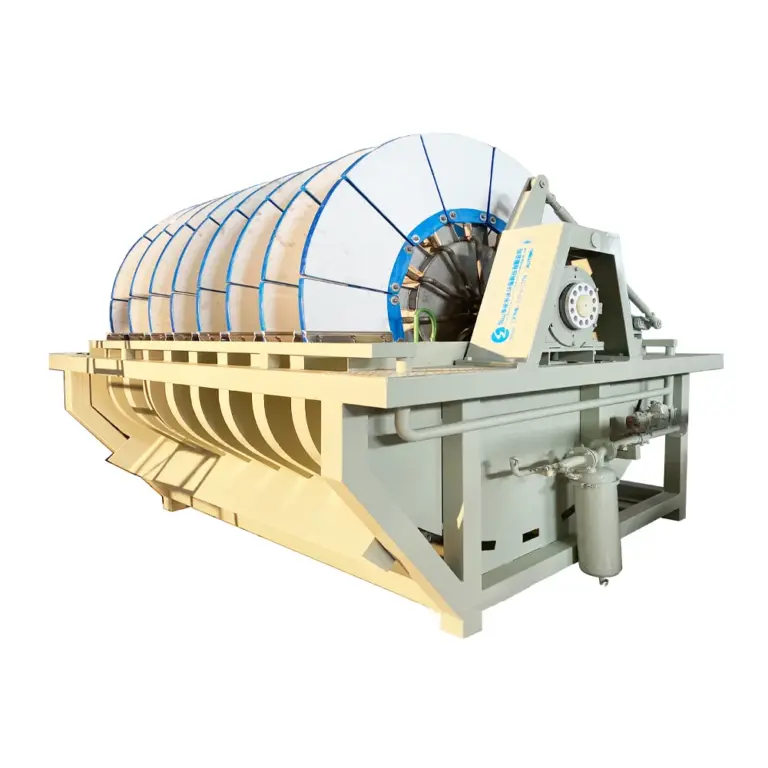
“Sludge” describes a state, not a filtration behavior. Two streams labeled the same way can respond to a ceramic disk filter in entirely different ways, because the variables that govern cake formation and release sit underneath the label: particle size distribution, particle shape, surface chemistry, the presence of oils or polymers, temperature, and how consistent the feed stays from batch to batch or hour to hour. A вакуумный керамический дисковый фильтр separates solids from liquid by drawing filtrate through a porous ceramic medium while solids build up as a cake on the disk surface; whether that cake forms as a coherent, releasable layer or as a smeared, sticky residue depends on those underlying properties, not on the general category the sludge belongs to.
This is why screening has to start before any test request is written, not after. If the sludge source varies — different production lines, different feedstock batches, or seasonal changes in an upstream process — the screening step has to identify which source, or which range of sources, the intended equipment will actually see. A screening pass that looks only at a single grab sample risks defining a duty around conditions that will not repeat in operation.
Chemistry matters as much as particle size. Where the sludge carries residual coagulant, flocculant, or process chemicals from an upstream step, those additives can change how particles aggregate and how the cake releases from the ceramic surface, independent of the raw solids content. Where temperature varies with the process schedule, viscosity and particle behavior can shift enough to change filtration behavior between a morning sample and an afternoon one. None of this is visible from a solids percentage alone.
The practical implication is that screening is a scoping exercise, not a formality. It defines what “the sludge” means for this duty: which source, which condition range, which chemistry, and which variability the buyer needs the filter to handle. That scope is what makes a subsequent test meaningful, because a test result only applies to the sludge it represents — treating a favorable result as proof for the general category, rather than for the specific source and condition set tested, is the most direct way to carry an invalid assumption into equipment sizing.
Build a Representative Sample and Test Condition Set
| Test-basis question | Что необходимо установить | Граница принятия решения |
|---|---|---|
| Sludge source | Identify the plant source represented by the sample | A result applies to the represented source, not to sludge as a general category |
| Solids, chemistry, and temperature | Define the condition set under which filtration behavior will be observed | The result is bounded by the tested condition set |
| Feed variability | Include the variability that matters to the intended duty | A single condition does not establish behavior across untested variation |
| Upstream conditioning | State any conditioning applied before the test | A prepared-sample result does not establish untreated-feed behavior |
Once the sludge duty is scoped, the next judgment is whether the sample and test conditions actually stand in for the feed the equipment will see in operation. A test is only as informative as its representativeness, and representativeness has several independent dimensions that can each fail separately.
The sludge source has to be identified explicitly, not assumed. A sample pulled from one point in a process may not represent the blended or averaged stream that reaches the filter in practice, particularly where multiple waste streams converge upstream of the dewatering step. Where the test report does not state which source the sample represents, the result cannot be generalized beyond that unstated origin.
Solids content, chemistry, and temperature together define the condition set under which any observed filtration behavior is valid. A cake that forms cleanly at one solids concentration or one temperature may behave differently outside that range, because concentration affects cake thickness and resistance, and temperature affects viscosity and particle interaction. The test record needs to state these conditions explicitly so that the result can be bounded rather than treated as universal.
Feed variability is a separate dimension from any single condition. A duty where the feed stays consistent across the operating cycle poses a different testing challenge than one where solids, chemistry, or temperature shift meaningfully over time. Testing only the average or the best-case condition does not establish how the filter will behave across the range the plant actually produces. Where variability matters to the duty, the test condition set has to include it, not merely the midpoint.
Upstream conditioning deserves particular attention because it is easy to omit from the test basis without noticing. If a sample was dosed, diluted, heated, or otherwise adjusted before testing, the result reflects the conditioned sample, not the raw plant feed. A favorable result obtained this way does not establish how the untreated stream will behave unless that same conditioning step is part of the intended process design. Any test report needs to state plainly whether conditioning was applied and, if so, what it was, so that the result can be matched to the correct point in the process train.
Observe Cake Formation, Release, Filtrate, and Cleaning Behavior
| Observation area | What to check under the stated test conditions | What the record must show |
|---|---|---|
| Формирование торта | Whether a stable cake forms | The observed cake-forming behavior and any limit |
| Выпуск торта | Whether the cake releases consistently | The observed release consistency and any limit |
| Filtrate | Whether the filtrate meets the intended next-step requirement | The result against that project-specific requirement |
| Очистка | The cleaning demand during the test | The cleaning method needed for the tested behavior |
With a representative sample and a defined condition set, the test itself needs to produce observations across several distinct behaviors, because a ceramic disk filter‘s suitability for a duty is not a single pass/fail outcome — it is a combination of independent performance dimensions that can each succeed or fail on their own terms.
Cake formation is the first and most basic behavior to observe: does the sludge build a stable layer on the ceramic surface under vacuum, or does it fail to consolidate, channel, or remain too thin or too soft to function as a filtering layer? A sludge that does not form a stable cake under the tested conditions has failed the most fundamental requirement of this filtration mechanism, regardless of how well it might perform on any other measure.
Cake release is a separate question from cake formation. A sludge can form a workable cake and still fail to release consistently from the disk surface during the discharge step, leaving residue that builds up over repeated cycles. Release behavior depends on cake cohesion, surface adhesion to the ceramic medium, and how the cleaning mechanism interacts with the cake — three factors that do not necessarily correlate with how well the cake formed in the first place.
Filtrate quality is a third, independent measure, and its acceptance depends entirely on what the next step in the process requires. A filtrate that would be acceptable for discharge to one downstream step may not meet the requirement for reuse or for a stricter downstream treatment stage. The test has to be judged against the specific next-step requirement for this project, not against a generic filtrate-clarity expectation.
Cleaning behavior ties the first three together. Every cycle of formation, release, and filtrate production is followed by a cleaning demand on the ceramic medium, and the test needs to record what that cleaning requirement looks like for this sludge — because a sludge that fouls the ceramic medium quickly will demand a different cleaning method or frequency than one that releases and cleans easily. Where the cleaning demand observed in testing is severe relative to what the intended cleaning method can address, that mismatch is itself a finding, not a detail to defer to later commissioning.
Translate Test Findings into Equipment and Interface Requirements
| Test record | Project item to define | Boundary to preserve |
|---|---|---|
| Documented test conditions | Basis for equipment sizing review | Sizing follows the tested conditions rather than the sludge label alone |
| Observed performance limits | Limits used in equipment review | Test observations do not become unconditional guarantees outside the test basis |
| Cleaning behavior | Cleaning method to agree with the supplier | Carry forward the method required by the tested feed and conditions |
| Filtrate result | Project-specific acceptance measure | Judge the result against the intended next-step requirement |
| Upstream conditioning used in the test | Feed-preparation interface | Keep the conditioning step in the project basis unless untreated feed is tested separately |
A completed test is not yet a specification. The step that converts observations into a project definition requires deciding, item by item, what carries forward and what stays bounded by the conditions under which it was observed.
The documented test conditions become the basis for any equipment sizing review a supplier performs — sizing conversations, including those Porvoo would review for a vacuum ceramic disk filter configuration, depend on the buyer supplying exactly what was tested: the sludge source, the solids and chemistry range, the temperature, and any variability covered. A sizing review conducted against an undocumented or loosely described feed carries the same risk as a test conducted against an unrepresentative sample — the conclusion may not apply to the actual operating feed.
Observed performance limits belong in the project record as limits, not as universal guarantees. If the test showed that cake formation degraded outside a certain condition range, or that release became inconsistent under certain chemistry, that boundary needs to travel into the equipment review as a stated limit of the tested basis — not as evidence that the equipment will perform acceptably indefinitely regardless of feed drift.
Cleaning behavior observed during testing should translate directly into the cleaning method agreed with the supplier. If the test required a particular cleaning intensity or frequency to maintain consistent release, that requirement is part of the equipment specification, not an operational detail to be resolved after installation.
The filtrate result needs to be checked against the project-specific acceptance measure defined earlier, and that acceptance measure — not a general filtrate-quality expectation — is what determines whether the filtration step satisfies its role in the treatment train.
Finally, where upstream conditioning was part of the tested basis, that conditioning step has to remain part of the project definition as a feed-preparation interface. A vacuum ceramic disk filter selected and sized around a conditioned feed depends on that conditioning step actually being present and functioning in the operating plant; omitting it from the built system, after testing with it included, breaks the connection between the test result and the equipment’s expected behavior.
Set a Go, Retest, or Alternative-Route Decision Gate
| Gate | Evidence position | Next action |
|---|---|---|
| Go | The representative test shows stable cake formation, consistent release, and a filtrate result that meets the intended next-step requirement; the cleaning method, observed limits, and acceptance measures are agreed | Proceed to equipment sizing on the documented test basis |
| Retest | The sample or condition set is not representative, relevant variability is not covered, or upstream conditioning makes applicability to the intended feed unclear | Rebuild the sample and condition set, then test again |
| Alternative route | Representative testing does not support the agreed cake, release, filtrate, or cleaning basis for the intended duty | Evaluate a different dewatering route instead of advancing this duty to sizing |
The test record, taken as a whole, points to one of three positions, and the decision at this gate should follow directly from which position the evidence actually supports — not from a general preference to move the project forward.
A go decision is supported where the representative test showed stable cake formation, consistent release, and a filtrate result meeting the intended next-step requirement, and where the cleaning method, observed limits, and acceptance measures have been agreed as part of the project basis. Under these conditions, the documented test basis becomes the foundation for equipment sizing, and the project can proceed on that basis rather than on assumptions about the sludge category in general.
A retest decision is the correct response where the sample or condition set used in testing does not adequately represent the intended plant feed — where relevant variability in source, chemistry, or temperature was not covered, or where the applicability of a result obtained with upstream conditioning to the actual untreated or differently-conditioned feed remains unclear. Retesting here is not a failure of the process; it is the correct response to an incomplete evidence base, and proceeding to sizing without it risks specifying equipment around an unrepresentative result.
An alternative-route decision applies where representative testing has been completed and still does not support an agreed cake, release, filtrate, or cleaning basis for the intended duty. Where the sludge, even under conditioning and across its relevant variability, does not form a releasable cake or does not produce filtrate meeting the next-step requirement, that outcome indicates the duty may not suit this dewatering mechanism, and a different dewatering route should be evaluated rather than pursued through equipment modification alone.
Where the evidence sits between these positions — a partially representative test, or a result that meets some criteria but not others — the decision gate itself should specify exactly what additional testing or conditioning information would resolve the remaining question, rather than defaulting toward sizing on an incomplete basis.
Часто задаваемые вопросы
Q: Is one successful sludge sample enough to move to ceramic disk filter sizing?
A: Only when the sample and test conditions represent the intended plant feed and the relevant variability. If the source, solids characteristics, chemistry, temperature, or feed variation falls outside that basis, test the missing conditions before using the result for sizing.
Q: Should upstream sludge conditioning be included in the filtration test?
A: Include it when conditioning is part of the intended operating basis, and document exactly what was applied. If the project may feed untreated sludge, test that route separately because a prepared-sample result does not establish untreated-feed behavior.
Q: What information should accompany a ceramic disk filter sizing request after testing?
A: Provide the documented feed conditions, observed cake formation and release, filtrate result against its intended next-step requirement, cleaning method, performance limits, and any upstream conditioning. These details keep the equipment review tied to the tested duty.
Q: What should happen if the cake forms but another acceptance measure is not met?
A: Do not advance on cake formation alone. Compare cake release, filtrate, and cleaning behavior with the agreed project requirements, then retest if the basis was incomplete or evaluate another dewatering route if a representative test does not support the intended duty.
Q: How should a buyer define acceptance before the representative test?
A: State what acceptable cake formation and release look like for the project, what the filtrate must satisfy for its next step, and what cleaning method will be carried into the equipment basis. Agreeing these measures before sizing prevents test observations from becoming unconditional promises outside the tested conditions.