A slurry that looks easy to dewater on paper can still behave unpredictably on a filter press, and the gap between the two is almost always a testing gap rather than an equipment gap. Before a plate size, chamber count, or cloth type gets specified, the question a buyer actually needs answered is narrower: does this slurry, under the conditions it will really arrive in, form a cake that releases and cycles the way the process needs? That question can only be answered with a test plan that represents the feed honestly, not with a single convenient sample.
What the slurry test must decide before equipment selection
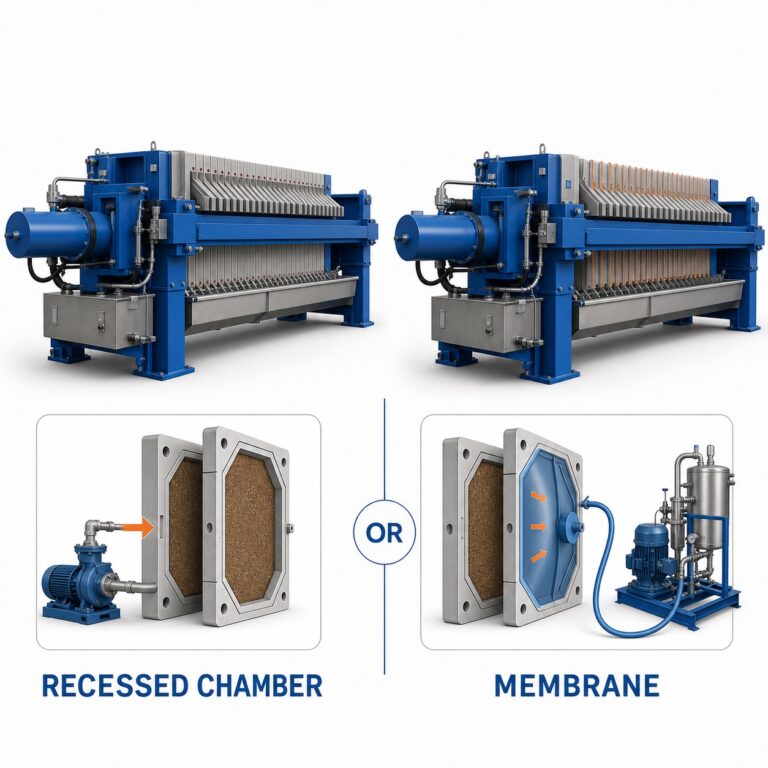
A filter press feasibility test is not a yes/no screen on whether “pressing works.” It is a way of deciding which design questions are already closed and which remain open. Filter presses operate by forcing liquid through a cloth under pressure while solids build into a cake inside the chamber; the mechanical principle is consistent across applications, but how a specific slurry fills, compresses, and releases from that cake is not. That behavior depends on particle characteristics, chemistry, and the degree to which the slurry has been conditioned before it reaches the press, none of which can be inferred reliably from a general material description.
Сайт EPA Biosolids Technology Fact Sheet on recessed-plate filter presses frames this directly in its description of the feed-pump, plate-chamber, filter-cloth, filtrate, and cake-discharge interfaces, and in its recommendation that design decisions rely on representative testing rather than assumed behavior. That guidance applies to a different material stream, but the underlying logic transfers: each interface in the press train can behave differently depending on what arrives at it, so a decision made at one interface without supporting data is a decision made on an assumption.
This matters because equipment selection and configuration choices get made from test results, and a test result only supports the configuration conclusions that its conditions can justify. If a test is run on a sample that does not represent the feed the plant will actually generate, including its harder-to-handle states, the resulting conclusion about pressability applies only to that narrower condition. A buyer who treats a favorable bench result as proof that “the slurry filter-presses well” without checking what feed condition produced that result risks carrying an untested assumption into chamber sizing, cycle time expectations, or cloth selection.
The decision this section establishes is what the test is actually meant to settle: not a single pass/fail outcome, but a structured basis for judging where the slurry’s filtration behavior holds steady and where it changes with feed condition, conditioning, or cloth. Everything that follows, from sample planning through cloth trials to the evidence sent with a press inquiry, exists to keep that distinction intact rather than letting one test result stand in for the whole range of feed the press will eventually see.
Representative feed conditions and the sample plan
| Sample-plan element | What to capture | Why it matters to the test decision |
|---|---|---|
| Feed-condition coverage | The normal and difficult feed conditions the sample is intended to represent | Shows the operating range to which the test observations can be applied |
| Sample condition | Whether the grab sample was settled, diluted or otherwise different from the intended feed | Prevents an altered sample condition from standing in for representative feed |
| Solids concentration | The solids concentration tested and its expected variability | Keeps the result tied to the concentration range represented by the sample |
| Slurry density | The density of the tested sample | Identifies the physical feed condition behind the recorded behavior |
| Conditioning history | Any conditioning step applied before testing | Identifies a treatment that may change filtration behavior and the resulting decision |
The single most common way a filter press feasibility test produces a misleading answer is through the sample itself, not through the press trial. A slurry sample that has settled, been diluted, or been drawn from an atypical point in the process does not represent the feed the press will actually receive, and any filtration result built on that sample inherits the same distortion. Settling concentrates or separates particles differently than active process flow; dilution changes the solids concentration that governs cake formation; and a sample taken under one operating condition says nothing about how the slurry behaves under a harder condition the process can also produce.
Before testing begins, the buyer and the party running the trial need to agree on what range of feed the sample is meant to stand in for. A press configured around a single, favorable feed condition can underperform once the plant’s normal variability, including its more difficult states, reaches the equipment. Where a process generates a fairly uniform slurry, a narrower sample plan may be adequate; where solids concentration, particle size, or chemistry shift across a production cycle, the sample plan needs to capture that range deliberately rather than average it away.
Solids concentration and slurry density are not incidental details recorded for completeness. They are the physical basis against which every later filtration observation is interpreted. A cake that forms cleanly at one concentration can load differently at another, and a density reading taken without noting whether it reflects a settled or active sample can misstate the feed condition behind the result. Any conditioning step applied before testing, whether chemical or physical, needs to be documented as part of the sample record, because conditioning can change filtration behavior independently of the slurry’s untreated characteristics. A result obtained after conditioning cannot be read as evidence of how the raw slurry performs, and the reverse is equally true.
The sample plan, in effect, defines the boundary of what the subsequent test observations are allowed to claim. A test built on a well-documented, representative sample plan supports conclusions across the feed range it covers; a test built on a convenient grab sample supports conclusions only about that single, possibly unrepresentative, moment.
Test observations for filtrate, cake release and cycle behavior
| Observation | Доказательства, подлежащие сохранению | Использование решения |
|---|---|---|
| Filtrate clarity | The observed clarity for each tested feed condition | Compares how the filtrate result changes across the represented conditions |
| Выпуск торта | The observed release behavior for each trial | Informs cloth-trial follow-up and release assumptions |
| Loading behavior | The observed loading behavior during each trial | Adds condition-specific evidence to cycle and scale-up questions |
| Elapsed cycle steps | The elapsed time for each recorded cycle step | Builds cycle assumptions without collapsing the test into one overall result |
Once a representative sample is in hand, the trial itself needs to produce more than a single outcome. Feasibility is not established by one acceptable-looking cake; it is established by a pattern of observations across the conditions tested, because a filter press has several distinct functions happening in sequence, and a slurry can perform well at one and poorly at another.
Filtrate clarity shows how effectively solids are being retained during the filtration phase, but clarity recorded under one feed condition does not establish clarity under a harder one. Where the sample plan has covered a feed range, each condition needs its own clarity observation rather than a single reading applied across the board. Cake release is a separate question entirely, governed less by the slurry’s solids content and more by its adhesion behavior against the cloth surface; a slurry that filters cleanly can still cling to the cloth in a way that complicates discharge, and that outcome has direct consequences for which cloth gets selected and how cycle time is estimated. Loading behavior, meaning how the cake builds and compresses as the cycle proceeds, affects how chamber volume and pressure assumptions get set, and it can differ meaningfully between a dilute and a concentrated feed.
Elapsed time for each cycle step, rather than a single total cycle duration, lets the buyer see which step is governing the cycle. A feed phase that takes longer than expected points to a different design question than a cake-release phase that lags, even if the total elapsed time looks similar in both cases. Collapsing these steps into one aggregate number removes the diagnostic value of the test.
Where a slurry performs consistently across filtrate clarity, cake release, loading, and cycle steps under every represented feed condition, the test supports a reasonably confident feasibility conclusion. Where performance diverges between conditions, for example filtering cleanly under typical feed but showing inconsistent cake release under a harder one, that divergence is itself the finding, and it should carry forward into cloth and conditioning trials rather than being smoothed into a single average result.
Cloth and conditioning trials that can change the decision
| Исследуемая переменная | What must stay linked to the result | Граница принятия решения |
|---|---|---|
| Фильтрующая ткань | The cloth used for each set of clarity, cake-release, loading and cycle observations | The result supports cloth-fit questions only for the stated test conditions |
| Conditioning step | The conditioning step, if any, used for each set of observations | The interpretation must remain conditional on that stated treatment because conditioning can change filtration behavior |
A filtration result is only meaningful in relation to the specific cloth and conditioning used to produce it. Filter cloth governs how solids are retained, how the cake forms against the surface, and how cleanly it releases at the end of the cycle; changing the cloth can change all three outcomes even when the slurry itself is unchanged. A test record that reports clarity, release, loading, and cycle behavior without stating which cloth produced those results cannot be used to judge whether a different cloth would perform better or worse. The result is conditional on the cloth, and that condition has to travel with the result rather than being treated as incidental test metadata.
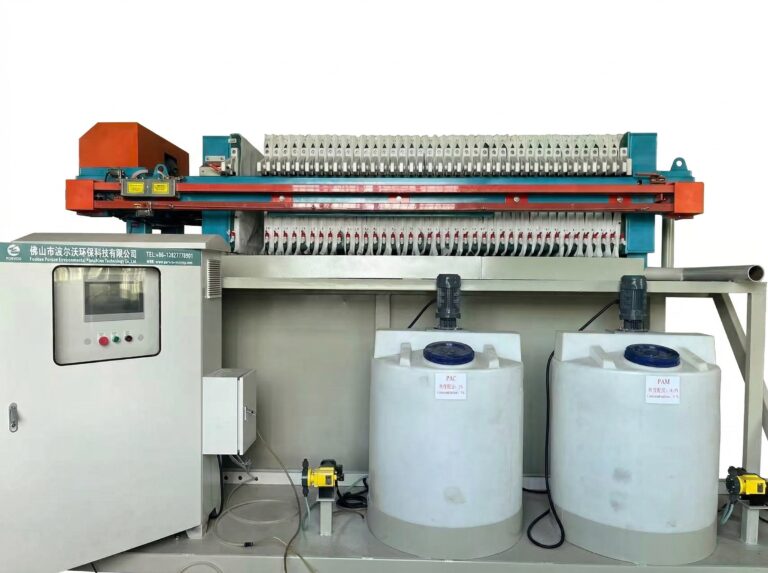
Conditioning works the same way, but through a different mechanism. A conditioning step, where one is applied, changes the slurry’s filtration characteristics before it ever reaches the cloth, which means a favorable test outcome achieved with conditioning says nothing about how the untreated slurry would perform, and an unfavorable outcome without conditioning does not rule out that a conditioning step could change the result. These are not interchangeable test paths; they answer different questions. A buyer deciding between accepting a slurry as-is versus investing in upstream conditioning needs test results for both conditions, run and reported separately, rather than a single blended conclusion.
This is also where a feasibility test can shift from a configuration question to a process question. If cake release remains inconsistent across multiple cloths tested under representative feed conditions, the issue may not be solvable through cloth selection alone, and the trial outcome points toward evaluating conditioning instead, or toward accepting a different cycle profile in the eventual configuration. Where a conditioning step resolves a release or loading problem that cloth trials alone could not, that result supports moving the conditioning step into the accepted process design rather than treating it as merely a test adjustment.
Reported results need to specify, trial by trial, which cloth and which conditioning step, if any, produced them. A test record that merges several cloths or blends conditioned and unconditioned trials into one summary loses the information a buyer needs to make a cloth-fit or conditioning decision with confidence.
Scale-up evidence to send with the press inquiry
| Inquiry evidence | What to send | What it supports |
|---|---|---|
| Representative feed basis | How the sample represents normal and difficult feed conditions, including solids concentration, density and variability | Establishes the conditions represented by the test |
| Trial conditions | The filter cloth and any conditioning step used for each trial | Frames cloth-fit questions and identifies results that depend on treatment |
| Test observations | Filtrate clarity, cake release, loading behavior and elapsed cycle steps for the tested conditions | Supports cycle assumptions and the next scale-up questions |
| Scale-up discussion | Chamber-volume questions, the configuration under discussion and the acceptance conditions to be agreed | Keeps final duty subject to the chosen configuration and agreed acceptance conditions rather than treating one test result as a guarantee |
The test record only becomes useful to a supplier once it is organized into evidence that supports specific configuration questions, rather than handed over as raw notes. A press inquiry built on a well-documented feasibility test can move directly into chamber-volume and configuration discussion; one built on a single informal trial usually prompts the supplier to request the missing basis before any sizing conversation can proceed meaningfully.
The representative feed basis, including how the sample covered normal and difficult conditions, the solids concentration and density ranges tested, and any variability observed across the sample plan, establishes what range of operation the rest of the evidence actually speaks to. Without that basis stated plainly, a supplier reviewing the inquiry has no way to judge whether the attached test observations apply to the plant’s full operating range or only to a narrow slice of it.
The trial conditions, meaning which cloth and which conditioning step produced each set of results, need to travel with the observations themselves. This lets a supplier separate questions that are genuinely about cloth fit from questions that depend on whether a conditioning step is part of the accepted process design. Related sizing questions, such as how slurry characteristics translate into chamber and plate requirements, are addressed in more depth in resources on filter press sizing for ceramic and stone slurry data to lock before RFQ, but the inquiry itself still needs the trial conditions stated explicitly rather than assumed.
The test observations, filtrate clarity, cake release, loading behavior, and elapsed cycle steps, carried forward by feed condition, give the supplier the basis to discuss cycle assumptions rather than guess at them. This information feeds directly into how a configuration gets reviewed: the supplied project data on feed conditions, trial results, and conditioning becomes the basis the supplier’s configuration or quotation review works from, rather than a generic assumption about the material category.
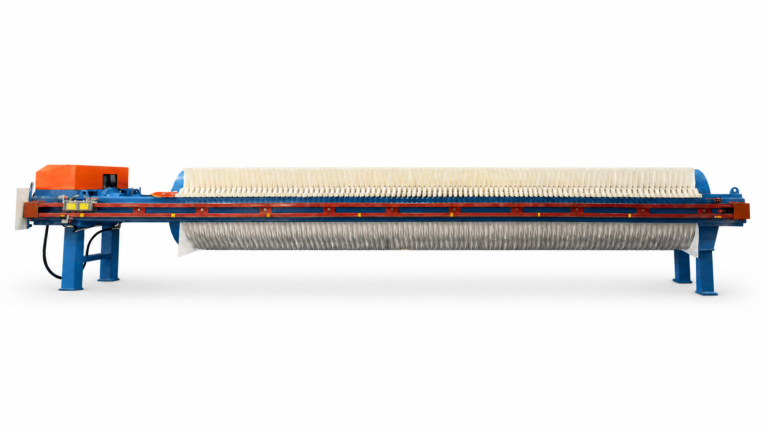
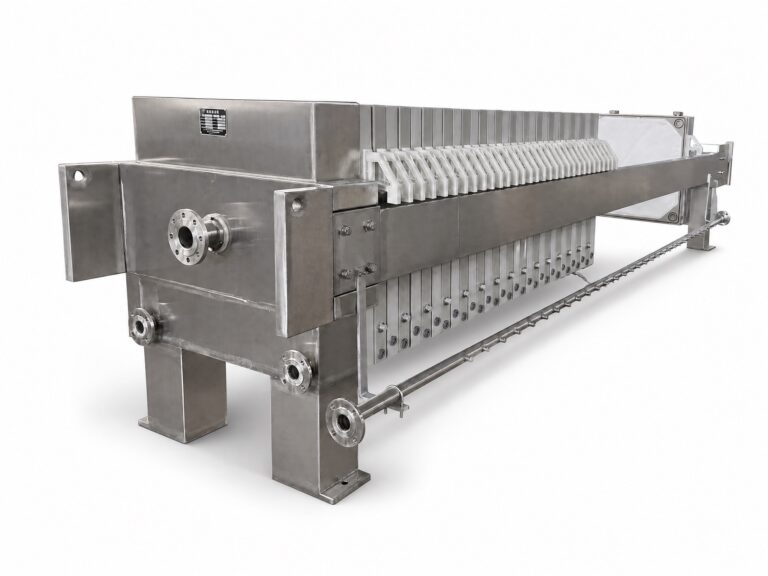
What remains open at this stage is the chamber-volume question and the final configuration, because these depend on throughput, cycle targets, and acceptance conditions that sit outside the feasibility test itself. The evidence package establishes what the slurry has demonstrated; the configuration and the acceptance conditions still need to be agreed between buyer and supplier, and the пластинчато-рамный фильтр-пресс under consideration is selected and configured against that agreed basis rather than against the test result alone. Where the test has shown consistent behavior across representative conditions, that discussion can move toward sizing with confidence; where it has shown divergence tied to conditioning or cloth, that divergence needs to be resolved, or at least explicitly carried into the acceptance conditions, before chamber volume is finalized.
Часто задаваемые вопросы
Q: Can a settled or diluted grab sample support a filter press decision?
A: Only if that condition represents the intended feed. Otherwise, limit the conclusion to the tested sample and run trials that cover normal and difficult feed conditions, recording solids concentration, density, variability, and any conditioning step.
Q: Does producing one acceptable cake prove that the slurry is ready for press sizing?
A: No. Review filtrate clarity, cake release, loading behavior, and elapsed cycle steps across the represented feed conditions. Use that complete record to form cycle and scale-up questions instead of treating one cake result as proof of final duty.
Q: When should cloth or conditioning results be treated as separate trials?
A: Separate the records whenever the filter cloth or conditioning step changes. Link each set of clarity, release, loading, and cycle observations to the exact trial conditions so the effect is not attributed to the wrong variable.
Q: What should a buyer send with a filter press inquiry after slurry testing?
A: Send the representative-feed basis, solids concentration, density and variability, cloth and conditioning details, and the recorded filtration observations. Also identify the configuration under discussion, chamber-volume questions, and the acceptance conditions that still need agreement before final duty is confirmed.