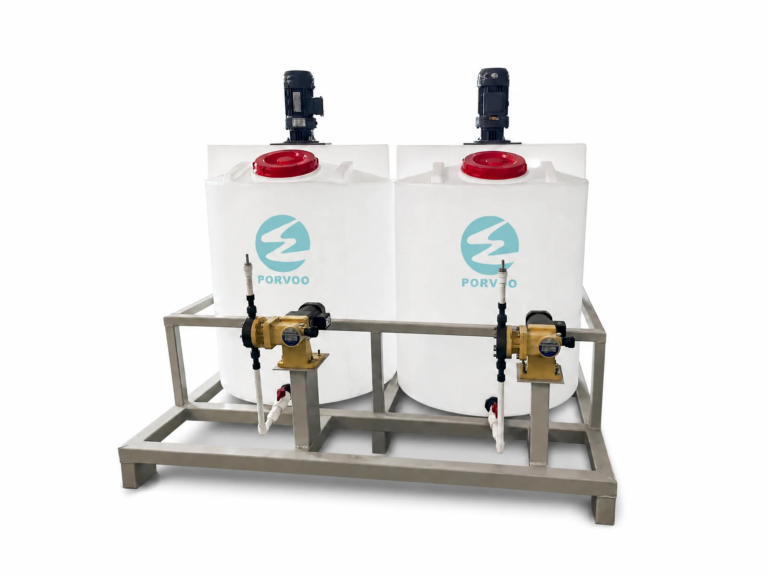
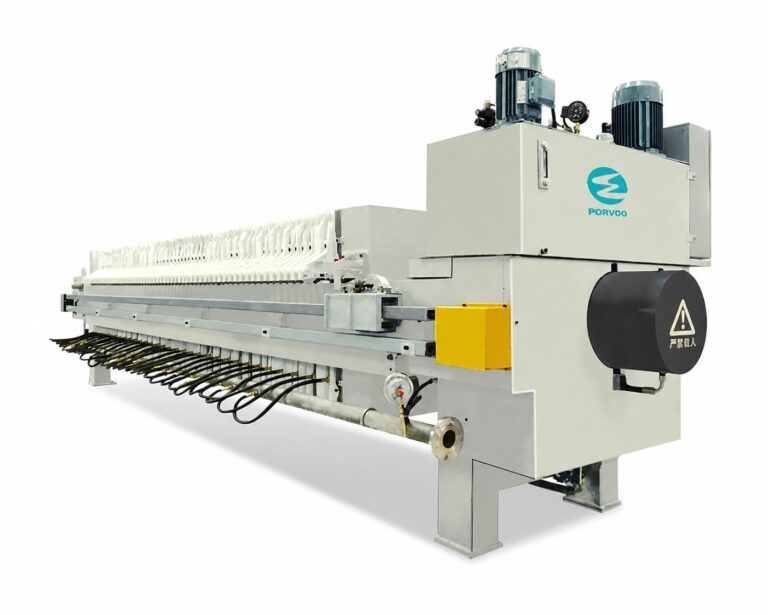
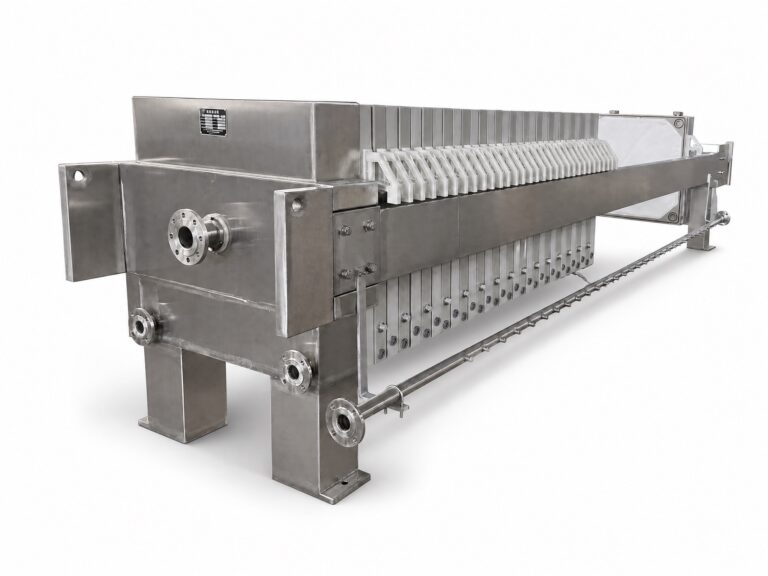
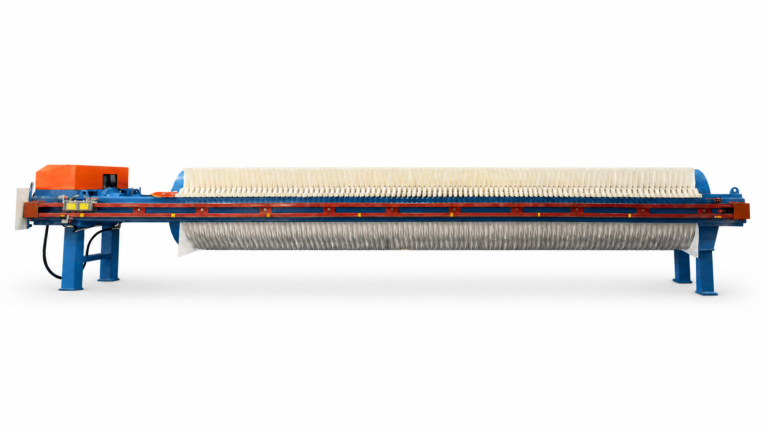
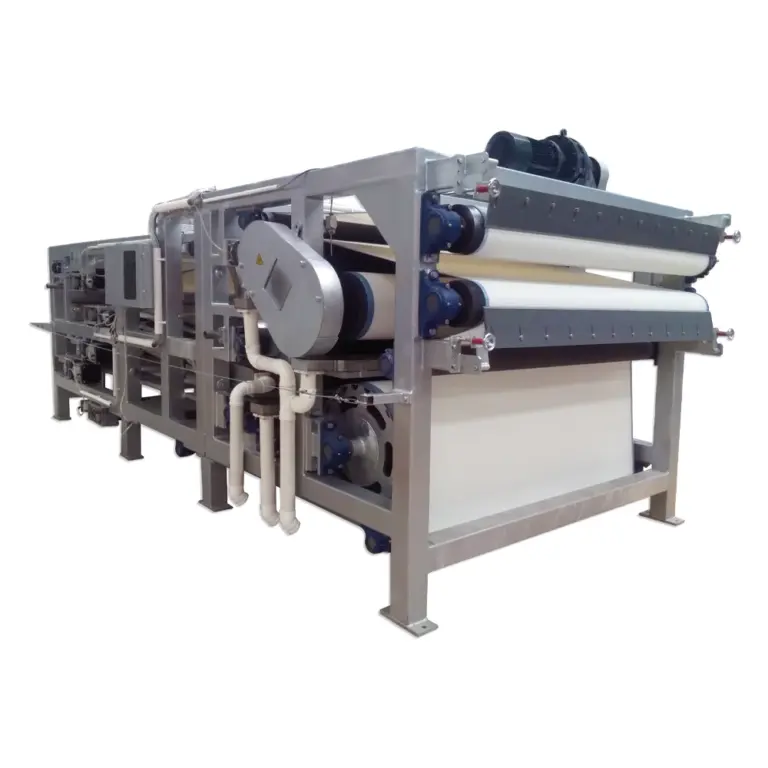
“Fully automatic” on a filter press quotation describes a sales category, not a defined function list. The useful scope statement breaks the press into its separate mechanisms — feed, plate pack closing, filtration, optional squeeze or blow, opening, plate shifting, cake discharge and cloth washing — and marks each one as included, manual or optional. What decides whether the automation matches your plant is the combination of the sludge’s cake-release behavior, the availability of feed and receiving capacity around the press, and whether the quoted scope includes the utilities that the optional functions consume.
Mark each press function as automatic, manual or optional
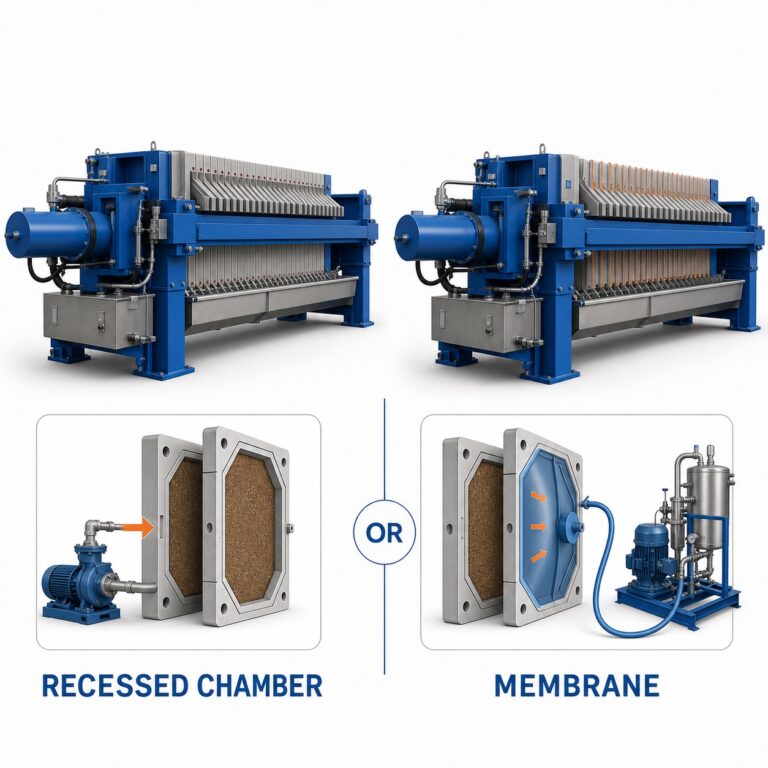
The first thing to do with an automatic filter press automation scope is to split the machine into functions and demand a status against each one. A recessed-chamber press is a batch machine built from several independent mechanisms, and automating the hydraulic closing and the plate shifter can still leave feed preparation, cake handling and cloth cleaning dependent on people. One label covering all of it hides which of those jobs stays on your operator.
The function list that works for a quotation review is: feed (pump start, pressure ramp, end-of-filtration decision), plate pack closing, filtration, squeeze if offered, core blowing or air drying if offered, opening, plate shifting, cake removal, and cloth washing. Each of these gets one of three marks. Included means the quoted package performs it without an operator present. Manual means an operator performs it or confirms it. Optional means it is available at extra cost and is not currently in the price.
Drop a function from the list only when the filtration arrangement on offer genuinely does not have it. A press without membrane plates has no squeeze step to mark, and a press without a cloth-washing manifold has no automatic wash to grade. Everything else that the machine physically does stays on the list with a status, including the functions you expect to perform manually, because an explicit “manual” is a far more useful answer than silence.
This function review is separate from dewatering performance. Whether the press reaches the cake moisture, filtrate clarity and cycle time your process needs is a different question answered by acceptance testing on your own slurry; the automation review asks only who or what performs each step.
Distinguish plate movement from successful cake discharge
Moving a plate and releasing its cake are two different events, and a completed shifter stroke is not evidence that the chamber emptied. The shifter reports position. Cake release depends on the sludge, the cloth condition and the plate surface, and a sticky ceramic or glaze cake can stay bridged in the chamber while the mechanism finishes its travel normally and the sequence advances to the next plate.
If automatic cake discharge is a purchasing requirement, the questions to put to the supplier are how the quoted machine identifies an unsuccessful drop, what it does with the sequence when it identifies one, and what controlled response the operator is then able to make. Some arrangements detect nothing and simply keep shifting. Others stop and signal. The difference matters most on the first restart after a cloth change or a feed-solids swing, when release behavior is least predictable.
Build sticky-cake behavior into whatever demonstration you agree. A press shifting plates on a free-releasing test material proves the mechanism works; it says nothing about your slurry at your target cake moisture. Met-Chem’s published guide to its plate shifters illustrates the range in this area: it describes semi-automatic, pendant-controlled and PLC-controlled shifting, retains an operator cake check in some arrangements, and offers a Super Shifter with model-specific release assistance and chamber-by-chamber washing with drainage troughs. Those are product-family examples from that manufacturer; whether any similar arrangement releases your cake reliably is a question for testing with your material.
An attended discharge is a legitimate answer. If the offered arrangement deliberately keeps an operator at the discharge end to confirm each chamber empties, that is a defensible design for difficult cakes — but it belongs in the scope as a named operator action, not inside a “fully automatic” headline.
Define squeeze, blow and utility boundaries
Squeeze, air drying and core clearing share similar names across suppliers while performing different duties with different media, so record each one separately before you agree the operating sequence. For every optional function in the scope, write down four things: the medium it uses, where the piping boundary sits between the supplier’s package and your plant, where the displaced liquid or air returns, and what signal declares the function complete.
The medium matters because it determines which utility you must provide. A membrane squeeze may use water or compressed air behind the diaphragm; a core blow and a cake air-dry both use compressed air but at different durations and for different purposes, and they discharge different mixtures of filtrate and air. If the quotation names a function without naming its medium, the supplier’s documentation for that specific press is what settles it, not the generic term.
The piping boundary decides who supplies the pumps, receivers, regulators and drains. A quoted squeeze function that assumes a pressurized water skid you do not have is not a complete package, and an air-drying step sized to an air demand your compressor cannot sustain will stretch the cycle or stall it. Ask for the flow and pressure demand at the boundary flange so your utility engineer can check it against existing capacity.
The return destination and completion signal matter for the sequence logic and for residual energy. A squeeze that returns water to a dedicated tank behaves differently from one that dumps to the filtrate line, and a function with no defined completion signal becomes a timer that an operator eventually learns to distrust. These functions also leave pressurized media in plates and lines after they finish; the plant’s approved procedure and its designated approver decide when the press may be opened or worked on, not the sequence display. ISO 12100 sets out the general methodology for identifying machinery hazards, estimating and evaluating risk, and documenting the risk reduction applied — it is a method, not a conformity statement about any particular press, and the protective design of the machine you buy needs confirmation against the supplied documentation.
A press configured without the optional function needs none of this. If you are not buying membrane plates, there is no squeeze utility package to specify and no return line to argue about.
Specify interrupted states and operator recovery
An unattended sequence is defined by what it does when something goes wrong, not by what it does when everything works. Alongside the normal cycle, the scope needs four things written down: the permissives that must be satisfied before a batch may start, the states the control system enters when a condition fails mid-cycle, the operator action required in each of those states, and who holds authority to restart.
Different failures leave the press in different conditions, and they do not share a recovery. Losing feed part-way through filtration leaves a partly formed cake in every chamber and a decision about whether to resume feeding or open and clear. A cake that fails to clear during shifting leaves one chamber occupied and the pack unable to close properly on the next batch. A receiving conveyor that stops or a bin that fills leaves the press mechanically ready but with nowhere to put the cake. Each of these needs a named response, and none of them is covered by “automatic mode”.
Without that definition, an apparently automatic cycle simply waits. The machine sits in a state no one has specified, the batch does not advance, and the first person to notice is whoever walks past. That unplanned intervention is precisely the labor the automation was bought to remove, so it belongs in the scope conversation rather than in the commissioning surprise.
Where a step is intentionally attended — an operator confirming cake release, or a supervisor authorizing a restart after an abnormal stop — name the operator action rather than listing it as an interruption. Restart authority after an abnormal state is a release decision; the plant’s approved procedure and its designated approver determine when the sequence may continue.
Assign feed and cake-handling interfaces
An automatic press can complete its internal sequence perfectly while the surrounding plant prevents the next batch from starting, so package automation and whole-system continuity need separate checks. The interface checklist assigns responsibility for four things: feed availability, receiving capacity, utility availability, and external start and stop signals.
Feed availability means someone owns the question of whether sufficient conditioned slurry at the expected solids content is in the tank when the press calls for it, and whether the feed pump and any agitation are under the press controller or under plant control. The EPA fact sheet on recessed-plate filter presses, written for municipal biosolids, describes this batch arrangement and its feed-pump and plate-cloth interfaces, filtrate removal and cake discharge as the mechanical structure of the operation; the mechanisms transfer to industrial work, while its numbers, conditioning practice and cycle figures do not apply to ceramic or stone slurries.
Receiving capacity means the conveyor, bin or truck below the press, its volume relative to one batch of cake, and what signal tells the press that the receiver is unavailable. Utility availability covers compressed air, wash water and hydraulic power at the demands the optional functions need. External signals cover who may start and stop the press from the plant system and what the press reports back.
Standalone installations do not escape this. A press feeding a bin that a loader empties still needs its feed arrangement and its receiving volume defined against batch size, or the automation stalls on the same boundary for different reasons.
Compare retained work under the same test conditions
| Элемент сравнения | Record on the same basis for each supplier | What it helps you judge |
|---|---|---|
| Function coverage | The same function list, with each function marked included, manual or optional | Which functions the offered automation actually covers |
| Operator interventions | Operator actions required during the agreed demonstration | How much work remains dependent on people |
| Washing work | Washing work retained in the demonstrated arrangement | Whether the cleaning workload matches the quoted scope |
| Cycle interruptions | Interruptions and the operator actions needed before continuation | Where the sequence depends on intervention |
| Excluded auxiliaries | Excluded feed, utility and cake-handling equipment or responsibilities | What remains to be supplied or coordinated outside the press package |
| Feed representativeness | The feed case used and any substitute material in the demonstration | Which sludge behavior remains untested and needs site confirmation |
Supplier offers only become comparable when they are measured against the same feed case and the same function list, with the retained operator work recorded rather than the count of automatic devices. Two quotations can both say “fully automatic” while one leaves cloth washing, cake breaking and feed valve switching to an operator and the other does not; the function-by-function status and the observed demonstration are what expose the difference.
The point of recording these observations on a common basis is to move the discussion away from the number of actuators in the bill of materials and away from any labor-saving percentage, which no supplier can support without having run your sludge in your plant. What you are buying is the removal of specific tasks from specific people, and that is measurable only as the tasks that remain.
Treat a factory demonstration on substitute material as evidence about the mechanism, not about your cake. If the demonstration uses a stand-in sludge, label which release and washing behaviors remain untested and schedule their confirmation on site with your own feed. Reviewing a supplier’s fully automatic filter press configuration against this function list — rather than against its marketing description — is what turns a scope conversation into a decision.
For that conversation to be productive, have the following ready: a representative feed description including solids content and the slurry’s known cake-release behavior, your target batch size and batches per shift, the receiving arrangement and its volume, available compressed air and wash water at the press location, and the list of functions you intend to keep manual.
Часто задаваемые вопросы
Q: Can I plan staffing on the assumption that a fully automatic press needs no operator?
A: No. The label alone does not establish how much attended work remains. Base staffing on the actual feed preparation, cake checks, washing and interruption responses retained in the offered arrangement, including when those tasks occur during a batch.
Q: What project information should I prepare before comparing automation quotations?
A: Prepare a common feed case, any known sticky-cake behavior, the existing feed and cake-receiving arrangements, and the parts of the sequence you expect to run unattended. Identify available utilities and equipment outside the press package so each quotation addresses the same operating situation.
Q: Can a demonstration with substitute material prove that my sludge will discharge automatically?
A: No. It can demonstrate the offered sequence and plate movement, but your sludge’s cake-release behavior remains untested. Keep that limitation explicit and arrange representative-feed checks that distinguish successful cake release from completed motion, including the response to an unsuccessful drop.
Q: If my existing cake conveyor is outside the quotation, can its controls be settled later?
A: Define the interface before agreeing the operating sequence. Even an excluded conveyor can prevent the press from continuing when receiving capacity is unavailable. Establish responsibility for its availability signal, the resulting interruption state and the authority to restart; exclusion from supply does not remove the operating dependency.
Q: Does a successful automation demonstration also prove dewatering performance?
A: No. Showing that the mechanisms and sequence operate does not establish cake moisture, filtrate quality or cycle time for your feed. Set separate dewatering-performance checks alongside the automation demonstration and identify which conclusions still require representative-material confirmation.