A filter press test request is only as useful as the sample and conditions behind it. When a plant sends slurry to a laboratory or equipment supplier for bench or pilot testing, the data accompanying that sample determines whether the resulting cake-dryness, cycle-time, or throughput figures mean anything for the actual production stream — or whether they describe a condition the plant will never see again. Getting the request right the first time avoids a second round of sampling and testing before a press configuration can be proposed with confidence.
The Decisions the Test Request Must Support
Before any sample leaves the plant, the test request should state what decision the results need to support. A press test can answer different questions depending on where the project stands: whether a particular press family is appropriate for the slurry at all, how a chosen configuration performs against the feed, or how a known process variation affects dewatering behavior. Each of these questions requires a different test design, and conflating them produces results that answer none of them well.
If the project is still comparing process routes, the test should be structured to reveal how the slurry behaves under genuinely different conditions — different pressures, different cloth types, different conditioning. If the project has already selected a press family and needs sizing confirmation, the test should instead hold configuration constant and focus on reproducibility across the production time window the plant actually experiences. Treating a comparative test as if it were a sizing test, or the reverse, leads to a laboratory report that looks complete but does not support the decision the plant is actually trying to make.
The test request should also state how the results will be used downstream — for budgetary sizing, for formal quotation, or for contractual guarantee. A laboratory or supplier evaluating a sample for preliminary configuration guidance does not need the same rigor as one being asked to stand behind a cake-moisture guarantee. Where the request leaves this unstated, the laboratory has no way to know how much replication, documentation, or conservatism the results need, and the plant risks receiving a report whose confidence level does not match its intended use. Stating the decision upfront, rather than only describing the slurry, is what keeps the rest of the test request — sample identity, feed condition, press configuration, and return format — aligned to a single purpose instead of becoming a generic characterization exercise.
Slurry Identity, Sampling Point, and Production Context
| Sample context field | Request entry | What the entry establishes |
|---|---|---|
| Process source | Identify the process source | What the slurry came from |
| Sampling point | Identify the sampling point | Where in the process the sample was taken |
| Production state | State the production condition during sampling | The operating state represented by the sample |
| Time window | Record the sampling time window | When the represented material was collected |
A filter press test result is only valid for the material it was taken from, and that material is defined by more than its name. The same nominal slurry stream can behave differently depending on where in the process it was drawn, what the upstream equipment was doing at the time, and how long after generation the sample was collected before testing began. A test request that identifies the slurry only by its general process origin, without specifying the sampling point and production state, leaves the laboratory to assume representativeness it cannot verify.
The process source establishes which unit operation generated the material being tested, which matters because slurry composition upstream of a thickener differs from the same nominal stream after concentration. The sampling point establishes exactly where in the piping or vessel the sample was drawn, since solids can stratify or settle between generation and any downstream point. The production state matters because a plant that is not running at steady output, or that is between batches or product changes, will generate a slurry whose solids loading and particle characteristics do not represent routine operation. ISO 5667-10, the water-quality sampling standard, addresses the design of sampling programs along these lines — where the site, preservation method, frequency, and site-specific sampling plan remain decisions the project team and its laboratory must still make rather than ones a general standard can resolve in advance.
The time window the sample represents also changes how the result should be read. A single grab sample describes a moment; a composite drawn across a production cycle describes an average that may conceal variability the press will still have to handle. Where the plant’s production is relatively stable, a single representative sample may be adequate to anchor a configuration discussion. Where the stream varies across shifts, feed material changes, or seasonal conditions, a single sample describes only one operating point, and the test request should say so rather than letting the laboratory assume the sample is universally representative. This distinction changes how conservatively the supplier should size the press relative to the tested result.
Feed Solids, Particle Behavior, Chemistry, and Temperature
| Condição da ração | What to report | Limite da evidência |
|---|---|---|
| Feed solids | The available value and its measurement basis | Preserve the method and relevant interferences; a suspended-solids result does not establish a treatment guarantee or legal limit |
| Comportamento das partículas | Available particle data and observed behavior | Do not substitute guessed particle values |
| Química | Available pH and chemical-addition context | Report known conditions without filling gaps with guesses |
| Temperature and settling | Available temperature and settling context | Report known conditions without filling gaps with guesses |
Once the sample’s identity and context are established, the test request needs to report what is actually known about the feed’s physical and chemical condition — and to report it honestly, without filling gaps with assumed values. A guessed pH or an assumed particle size carried into a press sizing calculation does not disappear; it becomes an unstated source of error in whatever conclusion the laboratory produces.
Feed solids concentration is foundational to dewatering behavior, and the way it was measured matters as much as the number itself. ISO 11923 describes the determination of suspended solids by filtration through glass-fibre filters, along with the interferences that method is subject to. Reporting a suspended-solids figure without its measurement basis leaves the laboratory unable to judge whether the number reflects total solids relevant to press loading or a narrower fraction defined by that particular method. A suspended-solids result, however it was obtained, establishes a measured condition — it does not by itself establish a treatment guarantee or a compliance limit, and the test request should not be written as though it does.
Particle behavior — settling tendency, apparent floc structure, any tendency to compress or resist compression under load — changes how a press is expected to perform, because cake formation and permeability depend on how the solid phase packs under pressure. Where this information exists from prior sampling or process knowledge, it should be reported as observed behavior rather than inferred from the slurry’s general type. Chemistry, including pH and any chemical addition already occurring upstream (coagulant, flocculant, or pH adjustment), changes how particles aggregate and therefore how the press will respond; a slurry already receiving conditioning upstream is not the same feed as its unconditioned equivalent, and the test request should state which condition is being submitted. Temperature and settling behavior at the time of sampling complete this picture, since both affect how closely the submitted sample’s behavior will track the plant’s actual feed. Where any of these fields is unknown, the honest entry is “not available,” not an estimate presented as data.
Press Configuration and Operating Questions to Declare
| Test-request question | Project input to declare | Comparison enabled |
|---|---|---|
| Press family | Intended press family | Compare test configurations against the intended equipment family |
| Tecido filtrante | Cloth questions the test must examine | Compare supplier responses to the same cloth questions |
| Manuseio de bolos | Required cake-handling outcome | Interpret results against the stated handling need |
| Destino do filtrado | Intended filtrate destination | Interpret results against the stated filtrate route |
| Plant constraints | Constraints the test must examine | Check whether each response addresses the same plant limits |
The feed data establishes what the laboratory is testing; the configuration questions establish what the laboratory is testing para. A test request that supplies excellent feed characterization but leaves the press family, cloth type, and downstream handling requirements unstated forces the laboratory to guess at the comparison basis, which undermines the usefulness of the result regardless of how well the sample itself was described.
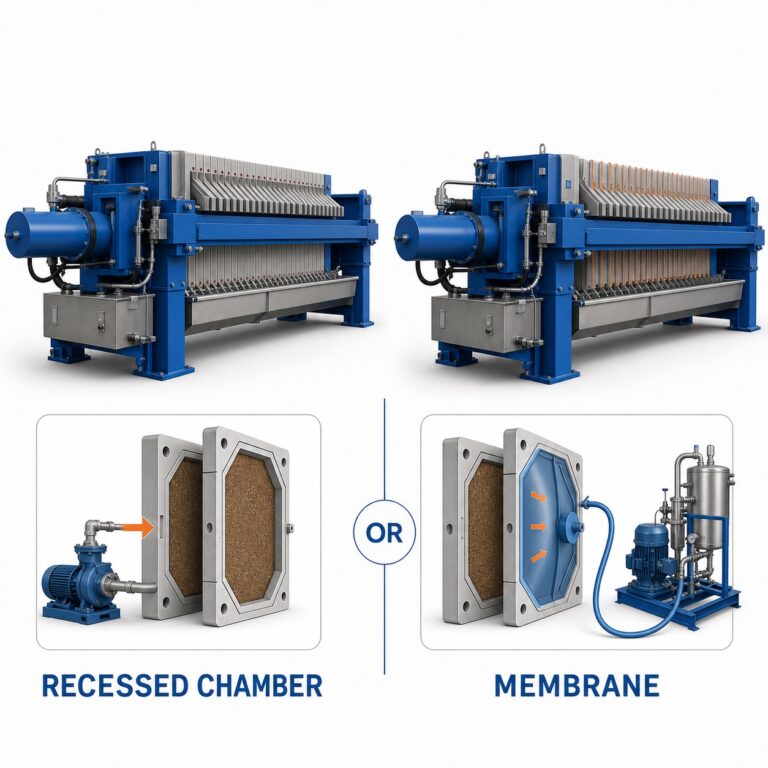
Stating the intended press family matters because different press configurations respond differently to the same feed — chamber volume, plate design, and membrane squeeze (where applicable) interact with particle behavior and solids loading in ways that a generic dewatering test cannot capture if the test apparatus does not resemble the equipment the plant is actually evaluating. Where the project has not yet settled on a press family, the test request should say so explicitly and ask the laboratory to test across more than one configuration rather than silently defaulting to one.
Seleção do tecido do filtro affects both filtrate clarity and cake release, and where the plant has specific cloth questions — permeability, blinding tendency, chemical compatibility with the slurry — these should be stated as explicit test questions rather than left to the laboratory’s default cloth choice. Cake-handling requirements matter because a cake destined for landfill disposal has a different acceptable moisture and handling characteristic than one destined for reuse or further processing, and the press configuration that satisfies one requirement may not satisfy the other. Filtrate destination similarly changes what “acceptable” filtrate quality means: filtrate returned to process has different clarity requirements than filtrate discharged to a sewer or surface water. Any plant constraints — available floor space, cycle time limits tied to upstream batch scheduling, or utility limitations — should also be stated as test questions, because a configuration that performs well in isolation may not fit the plant’s operating rhythm. This is the project information that, once declared, becomes the configuration basis a supplier such as Porvoo uses when reviewing a quotation request for filter press equipment, since equipment sizing depends on matching the proposed press to these same declared conditions rather than to feed data alone.
Results and Raw Records the Laboratory Must Return
| Return item | Minimum content | Review use |
|---|---|---|
| Raw run records | Recorded data for each test run | Check the conclusion against the underlying run record |
| Sample preparation | Preparation applied before testing | Distinguish the submitted sample from the condition actually tested |
| Equipment configuration | Test equipment and configuration used | Connect each result to the tested setup |
| Measurement bases | Basis used for each reported measurement | Compare reported values on their stated bases |
| Premissas de ampliação | Assumptions used to extend test results to the proposed equipment | Separate measured results from scale-up interpretation |
| Laboratory conclusion | The laboratory’s interpretation of the results | Read the conclusion alongside its records, configuration, and assumptions |
A laboratory’s summary conclusion — a stated cake dryness, a cycle time, a recommended configuration — is not sufficient on its own for the plant to act on. The underlying records are what let the plant’s engineers judge whether that conclusion applies to their actual feed and their actual press, rather than to a test condition that happened to be convenient.
Raw run records matter because a single averaged result can conceal run-to-run variability that is itself informative; if several runs produced meaningfully different outcomes, the average obscures a question the plant needs answered before committing to a configuration. Sample preparation records matter because a sample is rarely tested exactly as received — settling, decanting, dilution, or reconstitution between sampling and testing can change the feed condition, and the plant needs to know what was actually tested versus what was submitted. Equipment configuration records connect each reported result to the specific press size, plate type, cloth, and operating pressure used during the test, since a result obtained under one configuration does not transfer to a different one without re-examination.
Measurement bases matter for the same reason they mattered in the feed-data stage: a reported cake-solids percentage means different things depending on whether it reflects total solids or volatile solids, and a filtrate-quality figure means different things depending on the analytical method used. Scale-up assumptions deserve particular attention because they represent the laboratory’s interpretive step from measured bench or pilot results to a full-scale press recommendation — chamber volume, cycle time, and expected throughput at production scale are projections built on stated assumptions about how the tested behavior will extend to a different equipment size. Where those assumptions are not disclosed, the plant has no way to evaluate whether the scale-up is conservative or optimistic relative to its own operating variability. Reading the laboratory’s conclusion alongside these records, rather than as a standalone figure, is what allows the plant’s engineers to judge how much confidence the result deserves before it informs a purchasing decision.
Submission Format That Keeps Supplier Responses Comparable
Where a plant intends to send the same slurry data to more than one supplier for comparative testing or quotation, the format of the submission determines whether the responses can actually be compared. If each supplier receives a differently organized set of information — one missing the production context, another missing the chemistry data, a third receiving a different time window’s sample — their responses will differ for reasons that have nothing to do with their equipment’s actual suitability.
The practical approach is to compile the sample identity, feed condition, and configuration questions into a single, identically structured package sent to every supplier under consideration, so that any difference in their proposed configurations, test results, or sizing reflects a genuine difference in their equipment and judgment rather than a difference in what each supplier happened to be told. This is also where the connection to Porvoo’s filter press equipment becomes practical for the plant’s next step: once feed data, configuration questions, and plant constraints are documented in a consistent package, that same package supports both laboratory testing and the equipment interface planning — feed pump sizing, plate-and-frame or chamber arrangement, cake discharge, and filtrate routing — that follows once a press family is selected. A submission that keeps this information consistent across suppliers, and consistent between the laboratory testing stage and the equipment quotation stage, avoids the situation where a plant has to reconcile incompatible answers because each party was working from a different description of the same slurry.
Perguntas frequentes
Q: How can I tell whether a slurry sample is representative enough for filter press testing?
A: Tie the sample to a defined process source, sampling point, production state, and collection window. If the process varies, identify what changed and what operating condition the sample represents so the test result is not treated as evidence for unrepresented feed conditions.
Q: Should I estimate feed properties when measurements are unavailable?
A: No. Report the values you have with their measurement bases, and mark particle, pH, temperature, settling, or chemical-addition information that was not measured as an item to verify. Guessed inputs can make supplier conclusions appear more precise or comparable than the underlying evidence supports.
Q: What should every supplier test against to make proposals easier to compare?
A: Give each supplier the same intended press family, cloth questions, cake-handling need, filtrate destination, and plant constraints. Then compare whether each test configuration and conclusion addresses those declared project decisions rather than comparing conclusions in isolation.
Q: Can a successful test result be used directly as the final equipment basis?
A: Treat it as evidence tied to the tested sample, preparation, equipment configuration, and measurement bases. Review the laboratory’s scale-up assumptions separately before applying the result to proposed equipment or feed conditions beyond the test.
Q: What should I check before accepting a laboratory’s recommendation?
A: Confirm that the conclusion is accompanied by raw records for each run, the sample preparation, the tested equipment configuration, measurement bases, and scale-up assumptions. Any missing item leaves a specific gap between the recorded test and the recommendation that should be resolved before a purchasing decision.