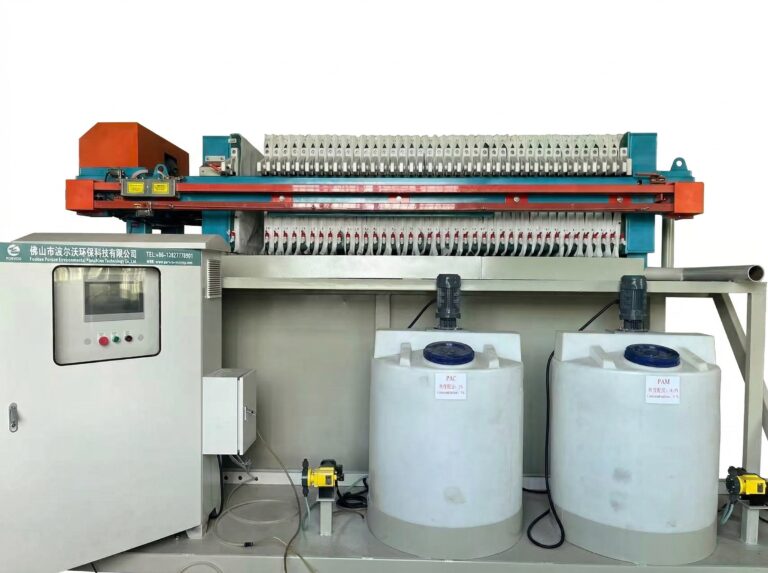
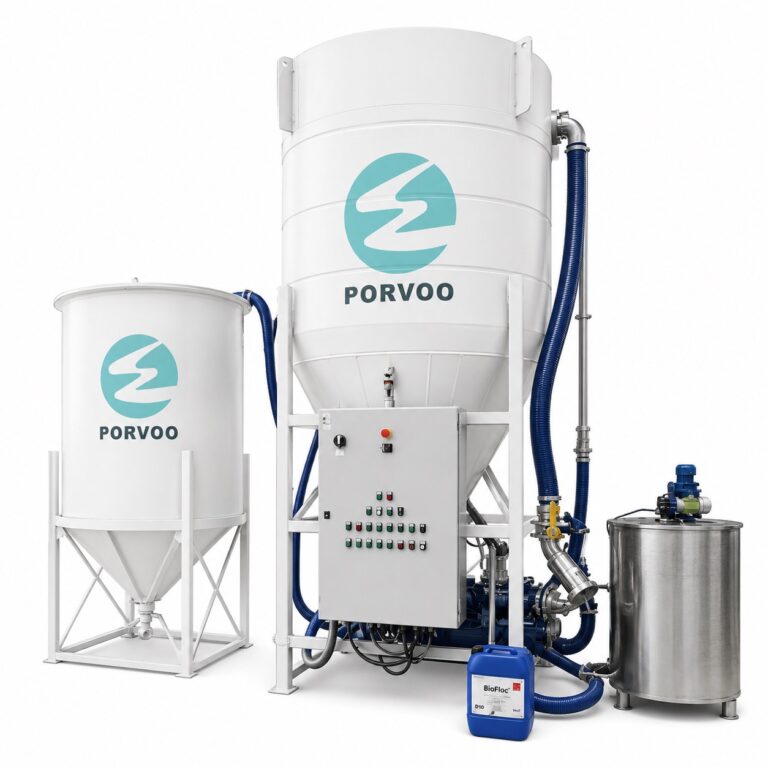
A filtro prensa that was sized and tuned against one feed description does not carry that performance forward automatically when the feed itself changes. The question for the plant is not whether the press still runs, but whether the cycle time, cake condition, and filtrate quality it was accepted on still apply to what is actually arriving at the feed pump today. Answering that requires knowing which changes matter enough to check, what the original baseline actually said, and how to gather new evidence that can be compared to it on fair terms.
Feed Changes That Trigger a Performance Review
A filter press is accepted against a feed description, not against the equipment alone. That description typically covers solids concentration, particle size distribution, chemistry, temperature, any upstream dosing, and the settling or handling behavior of the material before it reaches the press. When any of these moves outside the range the original acceptance was built on, the press is operating against a feed it was not characterized for, even if nothing on the equipment itself has changed.
The source process matters here because it is usually the root cause of a feed shift rather than the press itself. A change in an upstream unit operation, a different raw material lot, a modified dosing rate, or a shift in how material settles before transfer can all alter the slurry the press receives without any change to the press configuration. Where the source process has changed, the feed description needs re-examination even if no one has measured the slurry directly yet, because the original baseline may no longer describe what is being pumped into the chambers.
Solids concentration and particle size distribution change the mechanism most directly. A press builds cake through a filtration and compression sequence that depends on how solids pack against the cloth and how liquid moves through the forming cake. If the solids load rises or the particle sizes shift toward finer material, the cake permeability and compressibility the press was tuned for can no longer be assumed. Chemistry and temperature act differently: they influence flocculation behavior, cake cohesion, and filtrate clarity, so a change in pH, ionic content, or operating temperature can alter dewatering behavior even where solids concentration looks unchanged on paper.
The practical trigger is comparative, not absolute: the review starts when any of these parameters falls outside the feed description the press was last accepted against, not when a plant decides the change feels significant. Where the shift stays within the documented range, no review is implied. Where it falls outside that range, the original performance data no longer applies until the change is defined and tested, which is the starting point for everything that follows.
Baseline Data Needed to Define the Change
Before any new sample is taken, the original baseline needs to be stated in terms specific enough to compare against. A baseline that only records a pass or fail outcome cannot support a defensible comparison later; it needs the feed description that was in force, the measurement method used for each parameter, and the operating conditions the press was running under when that baseline was established.
This matters because a performance review is a comparison exercise, and a comparison is only as good as the weaker of its two sides. If the baseline recorded cake dryness without stating how it was measured, or recorded cycle time without stating the pressure profile it was tied to, then a new measurement cannot be judged against it with confidence, regardless of how carefully the new sample is taken. The measurement basis is part of the baseline, not an afterthought to it.
The baseline also needs to specify which feed parameters were actually controlled or characterized at the time, as distinct from parameters that were simply assumed stable. Where solids concentration was measured directly and particle distribution was inferred from the source process rather than tested, that distinction needs to carry forward, because it tells the project team which parts of the original baseline are strong evidence and which are working assumptions that a feed change could invalidate first.
Where the original baseline is incomplete, for instance where cloth behavior or pressure-flow response was never documented numerically, that gap does not disqualify the review; it does mean the new retest cannot be compared against that dimension with the same confidence as a dimension that was fully characterized. The project team should treat this as a known limit on the comparison rather than as a problem the retest itself can solve.
Once the baseline is stated in these terms, it becomes the fixed reference point against which the new sample and new test results are read, which is the structure the later comparison depends on directly.
Representative Resampling for the New Condition
| Sampling record item | What to document for the new sample |
|---|---|
| Localização | Where the sample was taken |
| Timing | When the sample was taken |
| Mixing state | The material’s mixing state at sampling |
| Handling route | How the sample was handled |
| Baseline relationship | How the sample relates to the prior baseline |
A sample taken casually after a suspected feed change cannot support a performance review, because the review depends on knowing exactly how that sample relates to the material the press is actually receiving and to the baseline it will be judged against. Representativeness is not a general quality; it is a specific, documented relationship between where, when, and how the sample was taken and the question being asked.
Location matters because slurry composition can vary across a holding tank, a transfer line, or a feed sump, particularly where settling or incomplete mixing is part of the process. A sample taken near a fill point behaves differently from one taken near a discharge, and a sample taken after a mixing event behaves differently from one taken before it. Where the source process includes variable settling behavior, as can occur with streams carrying grit or coarse fractions, the sampling location needs to reflect what actually enters the feed pump, not merely what is most convenient to access.
Timing interacts with this directly. A single grab sample describes one moment, while the feed condition driving a performance review may vary across a shift, a batch cycle, or a longer process change. Where the suspected shift is gradual rather than a step change, a single sample risks describing a moment that does not represent the operating condition the press actually sees over a full cycle.
Handling route and mixing state at the point of sampling determine whether the sample still resembles the feed by the time it is tested. Settling, temperature change, or chemical reaction between sampling and testing can alter particle distribution or chemistry readings in ways that have nothing to do with the actual feed change under review.
Finally, every sample needs a stated relationship to the prior baseline: what time interval separates it from the baseline conditions, what process state it was taken under, and what known differences in handling exist between the two. Without that linkage, a new sample is simply a new number, not evidence of a change.
Retest Scope Across Cake, Filtrate, Cycle, Pressure, and Flow
The retest does not need to repeat every original acceptance test; it needs the smallest set of measurements that can reveal whether the changed feed condition has actually altered press performance. This matters because over-testing wastes effort without adding confidence, while under-testing risks missing the dimension where the feed change actually shows up.
Cake formation is usually the first place a feed change becomes visible, because cake behavior reflects how solids pack and bind as the slurry dewaters. A change in particle size distribution or solids concentration changes how quickly cake builds and how it holds together, independent of anything else in the system. Filtrate quality responds to a different part of the mechanism: it reflects how well fine particles are retained as liquid passes through the forming cake, so a chemistry or dosing change that affects flocculation can alter filtrate clarity even where cake formation looks unaffected.
Cycle progression ties these together over time rather than at a single point: it shows whether the press reaches full cake formation in the pattern it did before, or whether the feed change has altered the rate at which chambers fill and compress. Pressure-flow response is the mechanical signature underneath cycle progression — how flow rate falls as pressure rises during the cycle — and a shift here can indicate a change in cake permeability that cycle time alone might not make obvious until later in the cycle.
Cloth behavior is the one area where a feed change can produce effects that are not immediately visible in the fluid-side measurements. Where chemistry, fine particle content, or dosing has changed, cloth blinding or fouling behavior can shift gradually, showing up first as a trend across cycles rather than a single discrepant reading. A retest that only measures one cycle may miss this entirely; where the suspected feed change relates to chemistry or fine solids, repeating the observation across more than one cycle becomes part of defining the smallest adequate test set rather than an optional extra.
The retest scope, in other words, is set by the specific feed parameter believed to have changed. A concentration change points toward cake and pressure-flow measurements first; a chemistry or dosing change points toward filtrate and cloth behavior first. Testing everything by default is not the same as testing what the suspected change would actually affect.
Trend Comparison Against the Original Operating Envelope
| Performance evidence | Original baseline | Changed-feed retest | Comparison to record |
|---|---|---|---|
| Formação de bolos | Baseline cake-formation evidence and measurement basis | Cake-formation evidence from the documented new sample | Whether cake formation changed |
| Filtrado | Baseline filtrate evidence and measurement basis | Filtrate evidence from the documented new sample | Whether the filtrate result changed |
| Progressão do ciclo | Baseline cycle-progression evidence and measurement basis | Cycle-progression evidence from the documented new sample | Whether cycle progression changed |
| Resposta pressão-vazão | Baseline pressure-flow evidence and measurement basis | Pressure-flow evidence from the documented new sample | Whether the pressure-flow response changed |
| Comportamento do tecido | Baseline cloth-behavior evidence and measurement basis | Cloth-behavior evidence from the documented new sample | Whether cloth behavior changed |
Collecting new retest data only becomes useful once it is set directly against the baseline it is meant to test. This is a comparison exercise, not a standalone measurement exercise: each performance dimension from the retest needs to be read against the matching baseline evidence, using the same measurement basis on both sides wherever possible.
Where the measurement method differs between the baseline and the retest, that difference needs to be noted before any conclusion is drawn, because an apparent change in performance may actually be a change in how the measurement was taken. This is one of the more common ways a review can mislead itself: treating a measurement-method artifact as if it were a real shift in press performance, or the reverse, treating a real shift as noise because the comparison basis was not actually consistent.
The comparison works dimension by dimension rather than as a single pass or fail judgment. Cake formation might remain consistent with baseline while filtrate quality has shifted, which would point toward a chemistry or dosing change rather than a solids-concentration change. Conversely, pressure-flow response and cycle progression might both shift together while filtrate stays within its prior range, which would point toward a particle-size or concentration effect rather than a chemistry effect. Reading the dimensions together, rather than in isolation, is what lets the comparison localize which feed parameter actually changed, even when the sampling only confirmed that something had shifted overall.
Where cloth behavior is part of the comparison, the relevant trend is often cross-cycle rather than single-point: a baseline that only captured one cycle’s cloth condition cannot be compared with full confidence against a retest that also only captures one cycle, particularly where the suspected feed change relates to fouling-prone chemistry or fine particle load. This is a case where the baseline’s documented limitations, carried forward from the data-definition stage, directly shape how much weight the new comparison can bear.
A comparison that shows every dimension within the prior range supports continuing under the existing operating envelope without changes. A comparison that shows one or more dimensions clearly outside the prior range, on a consistent measurement basis, is the evidence that an operating or acceptance envelope needs to be reconsidered — which is a distinct, following decision rather than something the comparison table itself resolves.
Updated Performance Boundary and Acceptance Decision
| Decision gate | Evidências a serem verificadas | Limite de decisão |
|---|---|---|
| Feed change | The changed condition is identified against the established feed description | Do not update the envelope if the change is not defined |
| New sample | Location, timing, mixing state, handling route, and relation to the prior baseline are documented | Do not update the envelope if the new sample cannot be related to the baseline |
| Retest scope | The test set reveals the effect on cake, filtrate, cycle progression, pressure-flow response, and cloth behavior | Do not update the envelope if the relevant performance effects are not covered |
| Evidence link | The retest evidence is linked to the identified changed feed condition | Do not update the envelope if that link is missing |
| Base de medição | The measurement basis for the new evidence is stated | Do not update the envelope if the basis is not documented |
| Update decision | The changed condition, sample record, retest evidence, and measurement basis are linked | Use the linked evidence to define the updated operating or acceptance envelope |
An updated operating or acceptance envelope is only as sound as the chain of evidence behind it. The decision to revise the envelope should rest on confirming that each link in that chain is actually in place, not on a general sense that the feed “seems different” or that performance “looks off.”
The first link is whether the feed change itself has been identified against the originally established feed description, in terms of the parameter that moved and the direction it moved in. A suspicion of change is not the same as an identified change, and an identified change is what makes the rest of the review meaningful rather than exploratory.
The second link is the new sample record: whether its location, timing, mixing state, handling route, and relationship to the prior baseline are documented well enough that the sample can be trusted to represent the changed condition rather than an artifact of how or when it was collected. The third link is retest scope: whether the measurements taken actually cover the performance dimensions that the identified feed change would be expected to affect, rather than a partial set that happens to have been convenient to collect.
The fourth and fifth links concern how the evidence is used rather than how it was collected: whether the retest evidence is explicitly linked to the identified feed change, and whether the measurement basis for that evidence is stated clearly enough to be compared against the baseline on equal terms. A retest result that is accurate in isolation but not clearly tied to the changed condition, or not clearly described in terms of how it was measured, cannot responsibly support a revised envelope, because the link between cause and evidence is what justifies changing an accepted operating boundary in the first place.
Where all of these links are in place — the changed condition identified, the sample properly recorded, the retest scope matched to the change, the evidence linked to the condition, and the measurement basis stated — the retest evidence becomes a legitimate basis for defining an updated operating or acceptance envelope specific to the new feed condition. Where any link is missing, the appropriate response is to complete that link rather than to revise the envelope on partial evidence; a press operating under an undefined or loosely evidenced envelope carries more uncertainty into daily operation than one still running under its original, better-documented baseline while the gap is closed. This is also the point at which project-specific information, such as the updated feed description, sample records, and retest results, becomes the basis for any subsequent equipment or configuration review, since a quotation or configuration check depends on the same documented feed condition rather than on the equipment specification alone.
Perguntas frequentes
Q: Does every feed variation require a complete filter press retest?
A: Start a performance review when the new feed falls outside the established description for solids concentration, particle distribution, chemistry, temperature, upstream dosing, settling, or source process. Then repeat the smallest test set that can show the effect on cake formation, filtrate, cycle progression, pressure-flow response, and cloth behavior.
Q: What makes a changed-feed sample comparable with the original baseline?
A: The sample must be traceable to its location, timing, mixing state, handling route, and relationship to the baseline sample. Apply any project-specific sampling, preservation, frequency, laboratory, or permit requirements before treating the comparison as representative.
Q: Can one acceptable retest result justify keeping the existing operating envelope?
A: A single result should not stand in for the relevant performance evidence. Compare the changed-feed results with the original measurement basis across cake, filtrate, cycle progression, pressure-flow response, and cloth behavior, using the dimensions needed to reveal the effect of the change.
Q: What should the project team prepare before changed-feed testing begins?
A: Prepare the prior feed description and performance baseline, identify the feed characteristic that changed, define the new sampling record, and document the measurement basis for each retest result. This creates the link needed to judge whether the operating or acceptance envelope can be updated.
Q: Can published filter press data replace testing on the changed industrial slurry?
A: No. Published guidance can help identify equipment and process interfaces to examine, but performance on the changed feed must be verified with a documented sample and project-specific evidence rather than transferred as a fixed value or guarantee.