Facilities that invest in a fully automatic filter press expecting an immediate headcount reduction often discover, six months after commissioning, that the press is idling between batches because flocculation upstream is inconsistent — and that the two operators they reassigned are now back at the machine, manually assisting with sticky cake discharge. The capital cost is sunk, the maintenance team lacks anyone who can troubleshoot the PLC and hydraulic seals simultaneously, and unplanned downtime has erased the throughput gain the project was sold on. Automation on a filter press is not a general upgrade; it is a targeted solution to specific operational bottlenecks, and its payback depends almost entirely on whether those bottlenecks are in labor, cycle frequency, operator safety exposure, or cake discharge consistency — not in the press hardware itself. What follows is a structured way to check whether your operation actually has those bottlenecks before committing capital.
Identify which labor tasks automation will actually remove
Three labor tasks dominate the operating cost of a manual or semi-automatic filter press: cake discharge, plate shifting, and filter cloth cleaning. Full automation eliminates the direct labor component of each, but the degree of elimination differs per task, and the residual supervision requirement is real enough to matter in a payback model.
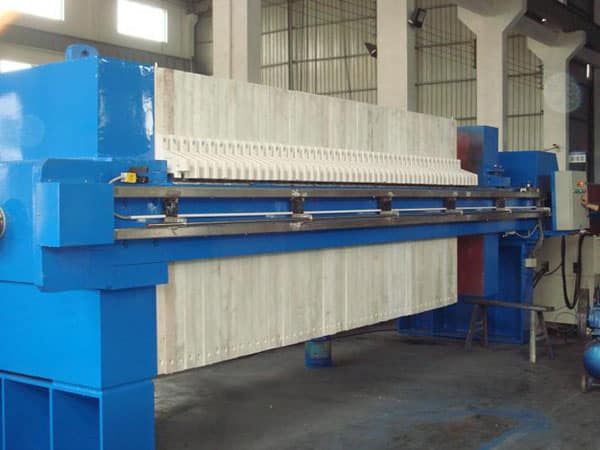
Cake discharge is the most physically demanding and safest to automate at scale. On a manual press, an operator scrapes cakes plate by plate using a tool, which on a large press with 60 or more chambers means repeated exposure to the press during each cycle. Automatic cake shaking removes the scraping task entirely and enables unattended discharge — but only when the cake releases cleanly. Sticky, high-viscosity, or incompletely dewatered cakes still require an operator to verify release and intervene, so the labor reduction is proportional to how reliably the sludge forms a self-releasing cake.
Filter cloth cleaning is where the hidden labor cost often surprises procurement teams. Manual cloth reconditioning — removing cloths, soaking them in roughly 5% HCl solution for upward of three days, then reinstalling them — takes the press fully offline and demands significant technician time. In-situ automatic acid cleaning replaces this cycle without disassembly, restoring cloth permeability between production runs. The downtime reduction is substantial for high-frequency installations. What remains is monitoring for progressive cloth blinding that the automated wash cannot fully reverse, and managing acid replenishment for the cleaning system itself.
The boundary between semi-automatic and fully automatic is often misunderstood at the RFQ stage. Semi-automatic presses motorize plate opening and closing but still require an operator to initiate each action. Full automation sequences the entire cycle — feed, filtration, membrane squeeze if equipped, plate shifting, discharge, and cloth wash — under PLC control with alarm handling. Clarifying this boundary early prevents specifying a semi-automatic system while expecting fully unattended operation.
| Labor Task | Without Full Automation | With Full Automation | What Still Requires Human Attention |
|---|---|---|---|
| Descarga de bolo | Manual scraping, highest labor | Automatic cake shaking/discharge | Ensuring complete release; handling sticky cakes |
| Deslocamento de placas | Operator presses button (semi-auto) or uses lever (manual) | Troca automática de placas | Monitoring for misalignment or jams |
| Cloth Cleaning | Disassembly, soaking in HCl 3 days, reinstallation | In-situ automatic cleaning | Checking for blinding; acid replenishment |
| Monitoramento do ciclo | Operator present for each step | PLC oversight with alarms | Detecting cloth blinding, poor cake release, process faults |
What the table makes clear is that automation converts direct physical labor into supervisory and diagnostic labor. The headcount implication is real, but it is not equivalent to removing operators from the process entirely. Cycle monitoring, cloth blinding detection, and acid replenishment still require trained personnel on shift.
Compare automatic plate shifting cake discharge and controls value
A manual filter press uses a lever to open and close the plate pack and a scraper for cake discharge. These two tasks define the labor floor: each cycle requires an operator present at the machine for both steps. Automatic plate shifting removes the opening and closing task; automatic cake discharge removes the scraping task. These are separate contributions to labor reduction, and conflating them leads to overestimating the value of either alone.
The plate-shifting mechanism — a hydraulic or mechanical puller that separates plates sequentially — primarily reduces per-cycle labor time and eliminates the need for the operator to manage plate alignment manually. Its value scales directly with cycle frequency: a press running six cycles per shift on mineral slurry gets far more value from automatic plate shifting than one running two cycles per day on a batch basis.
Cake discharge automation carries a different value proposition. Beyond labor reduction, consistent automatic discharge affects downstream material handling — uniform cake drop into a conveyor or skip reduces blockages and maintains throughput. On presses equipped with membrane squeeze capability, the discharge quality also reflects the additional dewatering step: membranes inflate after primary filtration to mechanically compress the cake, extracting moisture that gravity filtration alone cannot reach. This is a performance feature, not a labor feature. A filtro prensa de membrana with automated squeeze and discharge addresses both moisture content and discharge consistency in a single integrated cycle, which matters for sludge disposal cost calculations where cake moisture directly drives transport and disposal fees.
The PLC control layer adds a third dimension: process repeatability. Manual operation depends on the operator’s judgment of when a cycle is complete; PLC control uses feed pressure, flow decay, and timing to determine cycle end consistently. For variable sludge with changing filtration resistance, PLC-managed cycle end-point detection prevents both under-filtering (wet cake) and over-running (wasted energy), contributing to throughput stability that manual operation rarely achieves across shifts.
Check whether upstream feed stability supports automation
A filter press is more sensitive to feed variability than continuous dewatering equipment such as a centrifuge or belt press. When sludge consistency, solids concentration, or flocculation quality shifts between batches, the press responds with changes in filtration resistance, cake structure, and cloth fouling rate. On a manual press, an experienced operator adjusts feed pressure, extends filtration time, or calls for a cloth wash based on observation. On a fully automated press, the PLC sequences cycles based on programmed parameters, and a significant feed shift outside those parameters typically results in a wet cake, a blocked cloth, or a discharge failure before any alarm triggers corrective action.
The practical check before specifying automation is to assess how stable your sludge feed actually is over a full operating week. If solids loading fluctuates by more than 20–30% between batches, if flocculation is adjusted manually based on visual judgment, or if polymer dose is not yet optimized, the automated press will not operate reliably enough to deliver the cycle frequency and cake quality assumptions in any payback model. The press itself is not the problem — the upstream process is — and automation cannot substitute for feed conditioning discipline.
Oily or greasy sludge adds a specific complication. Grease coats filter cloth fibers, reducing permeability faster than clean mineral slurry, and can make cake release erratic regardless of how well the discharge mechanism is designed. Automatic cloth cleaning helps extend cloth life between offline interventions, but if grease loading is high and not managed upstream through dissolved air flotation, gravity separation, or thermal treatment, cloth blinding will set the practical cycle limit for the machine. Before specifying automation for oily sludge, define what pre-treatment is in place and how it affects the grease concentration reaching the press.
For facilities where sludge characteristics vary across production campaigns — different raw materials, batch chemical processes, or seasonal input changes — the stronger initial investment is often in upstream equalization and consistent chemical conditioning. Stabilizing the feed expands the range of configurations that can be automated reliably, and it ensures that whatever press configuration is selected performs consistently across operating conditions.
Calculate cycle frequency and operator exposure risk
Operator exposure to a filter press is not a single event per shift. A full batch cycle — press-up, feed filling, filtration, membrane squeeze where applicable, plate opening, cake discharge, and cloth wash — sequences through multiple steps, each requiring either active operator involvement or close proximity to the machine. On a high-frequency installation running five to eight cycles per shift, that exposure accumulates across the operating day in ways that are easy to underestimate at the procurement stage.
The cloth-washing interval is a useful planning anchor. Manual cloth washing is typically required every 15 to 30 cycles, depending on sludge type and cloth selection. At eight cycles per shift across two shifts, a 20-cycle interval means cloth washing occurs roughly every 30 operating hours — a regular, predictable labor demand that also exposes the operator to chemical handling. When multiplied across an annual operating schedule, the cumulative exposure time from cloth washing alone often exceeds the time spent on cake discharge, yet it rarely appears as a line item in headcount comparisons.
Sticky or high-viscosity cake changes the risk profile further. Discharge from a press running hydrated organic sludge, polymer-flocculated municipal biosolids, or high-fat food processing waste often requires manual assistance even when the press has mechanical shakers. The operator must reach into or adjacent to the open plate pack to clear discharge, which is the highest-exposure task on the machine. This is the scenario where the safety case for automation is strongest and most straightforward to justify — not by eliminating labor in aggregate, but by removing the specific intervention with the highest injury potential.
| Exposure Factor | Manual Operation Risk | Implication for Automation Decision |
|---|---|---|
| Batch cycle steps (press-off, filling, filtration, opening, discharge, wash) | Each step requires operator presence; exposure per cycle multiplies with frequency | High cycle frequency increases cumulative risk, strengthening the safety case for automated sequencing |
| Cloth washing frequency (every 15–30 cycles) | Adds regular manual intervention, often involving disassembly and chemical exposure | Frequent washing cycles magnify labor and exposure; automation of cloth cleaning provides larger gains |
| Sticky or high-viscosity cake | Requires manual assistance during discharge, raising physical exposure and injury risk | Automation reduces manual scraping; high stickiness justifies automated discharge and cake monitoring |
| Small, ergonomically designed presses (e.g., <40 plates, <1000×1000 mm) | Fewer pinch points; manual operation is faster, safer, and lower cost | Automation may not pay back; manual operation can be acceptable when exposure risk is inherently low |
The small-press threshold at the bottom of the table is worth treating as a genuine decision criterion rather than an edge case. For presses with fewer than 40 plates or a plate area below 1000×1000 mm, manual cake discharge is typically faster than automated discharge and the capital differential rarely recovers over the equipment’s operating life. Running an ROI model on automation for a small press typically produces a payback period that exceeds any realistic equipment replacement cycle.
Include maintenance skill and spare-parts availability
Automation redistributes maintenance burden; it does not reduce it. This distinction matters at the budget stage because the cost categories shift in ways that can be obscured by a per-cycle labor saving calculation.
Manual and semi-automatic presses concentrate maintenance effort in mechanical tasks: checking hydraulic seals, replacing worn plates, and managing cloth condition. All of these require skilled mechanical technicians, but most industrial maintenance teams in manufacturing and processing plants have the baseline capability to manage them. Spare-parts planning centers on cloths, gaskets, seal kits, and hydraulic hoses — items that are broadly available and straightforward to inventory.
A fully automatic press adds PLC controls, servo or hydraulic actuators for plate shifting, sensors for pressure and flow, and an automated acid cleaning system. These components require maintenance staff who can read ladder logic, diagnose sensor faults, and calibrate actuators — skills that are not uniformly available in the maintenance departments of mid-scale industrial facilities. The failure pattern that emerges most frequently after commissioning is that a hydraulic actuator fault or a sensor calibration drift triggers an alarm, the production team cannot resolve it internally, and an OEM service call is required. The downtime cost during that call-out window can easily exceed several weeks of the labor savings that justified the investment.
| Maintenance Area | Manual/Semi-Auto Press | Fully Automatic Press | Skill and Spare-Parts Shift |
|---|---|---|---|
| Cloth cleaning | Disassembly, 5% HCl soak ≥3 days, reinstallation; heavy labor and long downtime | In-situ automatic cleaning; lower labor, higher uptime | Reduced mechanical labor but need to manage acid cleaning system; spare cloths if blinding persists |
| Hydraulic components and plate seals | Regular checking and replacement; requires skilled maintenance personnel | Same maintenance need; may be more demanding due to more frequent cycling | No reduction in hydraulic skill requirement; seal kits remain critical spares |
| PLC and electronic controls | None or minimal | PLC, sensors, actuators require troubleshooting and update capability | Adds need for staff skilled in electronics and PLC diagnostics; stocking of sensors and controllers becomes essential |
The hydraulic maintenance row in the table confirms that automation does not reduce the mechanical skill requirement — it adds an electronic and controls skill requirement on top of it. Facilities planning an automatic press purchase should audit their maintenance team’s PLC troubleshooting capability before finalizing the specification, and confirm that the equipment supplier can provide training, remote diagnostics, and a committed response time for field service. Spare-parts planning should extend to sensors, actuator seals, and control cards, not just cloths and gaskets.
Avoid automation when the bottleneck is conditioning or thickening
The most common capital allocation error on filter press projects is commissioning a fully automatic press into a plant where conditioning is inadequate or thickening is unstable, then attributing poor dewatering performance to the press.
For hydrophilic organic sludge — biological treatment residuals, food processing waste, high-moisture anaerobic digestion outputs — inorganic conditioning with lime or ferric coagulant is often required to achieve a self-releasing cake structure. Without adequate conditioning, the cake remains sticky and incompletely formed, discharge fails or is inconsistent, and cloth blinding accelerates. No amount of automation on the press side recovers from this. The press sequences correctly; the process output is still poor.
Flocculation quality has a parallel effect. Insufficient polymer dose, incorrect polymer selection, or inadequate mixing contact time before the feed reaches the press results in weak floc that breaks under feed pump pressure, producing fine particles that penetrate the cloth and impair filtrate quality. Again, this is a process chemistry failure, not a press hardware failure, and automating the press does not address it. The filtrate returns to the wastewater system carrying solids that should have been retained, and the cake is wetter than expected because the fines have partially blinded the cloth rather than building a permeable cake layer.
| Upstream Bottleneck | Why Automation Doesn’t Fix It | What to Address First |
|---|---|---|
| Hydrophilic organic sludge | Inorganic conditioning (e.g., lime) is required for cake release; automation does not improve conditioning | Optimize conditioning chemistry and dosing before investing in automation |
| Inadequate flocculation | Leads to poor filtrate quality and inefficient dewatering; automation can’t compensate for poor floc formation | Review flocculant selection and mixing to stabilize cake structure |
| Highly variable sludge characteristics | Filter press is more sensitive to feed changes than continuous dewatering methods; unstable feed undermines reliable automated cycles | Stabilize upstream thickening and equalization to reduce feed variability before automation |
The sequencing principle is straightforward: prove the conditioning and thickening process on a manual or semi-automatic press first. Run consistent cycles, confirm cake moisture and filtrate clarity meet your downstream requirements, and establish a stable operating range for feed concentration and polymer dose. Once that stability is demonstrated, automation’s value — cycle repeatability, labor reduction, 24/7 operation — is achievable. Automating before that point means the press is sequencing a process that is not yet under control, and both the capital investment and any performance guarantees become difficult to defend.
Decide payback from labor safety and repeatability together
Payback from a filtro prensa totalmente automático is justified when at least two of the three primary drivers — labor cost, safety exposure, and process repeatability — are genuinely constraining operations. When only one is present, the capital differential over a semi-automatic configuration often does not recover within a reasonable operating horizon.
The dewatering performance data cited for automated membrane presses — approximately 55 to 60% dry solids and hazardous waste volume reduction exceeding 70% — illustrates what is achievable under favorable conditions: stable feed, effective conditioning, and a membrane squeeze cycle integrated into the automation sequence. These are documented practitioner results, not design guarantees, and they should be used as a benchmark for evaluating whether your sludge type and conditioning process can approach that range, not as a specification commitment. When they are achievable, the downstream cost implications are substantial: lower transport volume, reduced disposal fees, and in some cases filtrate quality that supports process water reuse. For facilities where waste disposal is invoiced by volume or weight, the payback arithmetic becomes straightforward.
The 24/7 operation capability is compelling only when actual production demand and sludge generation rate justify continuous cycling. A plant generating slurry for eight hours per day, five days per week, with two cycles per shift does not load the automation investment the same way a continuous process generating sludge around the clock does. Repeatability value is proportional to cycle frequency, and the labor saving per tonne of dry solids decreases as batch frequency drops.
| Payback Factor | Benefício da automação | Trade-off or Limitation | Payback Implication |
|---|---|---|---|
| Dewatering performance | Achieves 55–60% dry solids, >70% hazardous waste volume reduction, filtrate recyclability | Higher capital and energy cost than manual/screw presses | Strong payback when waste disposal costs and water reuse value are high |
| 24/7 operation and repeatability | Automatic cake shaking enables unattended cycles, consistent cake quality, higher uptime | Requires stable upstream feed; if feed varies, repeatability may drop | Boosts throughput and reduces labor per tonne; assess feed stability first |
| Cloth cleaning labor | In-situ acid cleaning reduces manual labor and downtime; increases equipment utilization | Acid handling and system maintenance remain; no labor elimination | Direct labor and availability improvements support payback in high-cycle operations |
| Capital/energy/maintenance vs screw presses | Automation cuts direct operator labor but increases capital cost, energy use, and maintenance frequency | Lifecycle cost may be higher if labor rates are low or energy expensive | Run total cost-of-ownership comparison; automation may not be best if labor is not the constraint |
| Small press threshold (<40 plates, <1000×1000 mm) | Manual discharge is faster and lower cost; automation does not yield benefit | None—manual operation is inherently safer and cheaper for small units | Automation does not pay back for small presses; reserve for larger, high-frequency installations |
The capital and energy trade-off row in the table reflects a constraint that matters most when labor rates are moderate and energy costs are high: automation may reduce headcount cost while increasing power consumption and maintenance spend, producing a net lifecycle cost that is higher than a screw press or semi-automatic configuration on a per-tonne basis. Running a total cost-of-ownership comparison — including energy, consumables, maintenance labor, and downtime cost — against the baseline configuration is worth doing before finalizing specification, particularly if the project is justifying the investment primarily on labor reduction rather than dewatering performance.
If you are at the sizing stage and have not yet validated filtration area requirements, the fully automatic filter press sizing and capacity calculator provides a structured method for translating daily slurry volume and solids concentration into press capacity requirements — which is a necessary input before automation scope and plate count can be meaningfully evaluated.
The decision to automate is ultimately a capacity and risk management decision, not a technology upgrade. The strongest cases share a common profile: high cycle frequency, sludge that resists clean manual discharge, a stable conditioning process already producing consistent cake, and an operating environment where labor availability or safety exposure is a genuine constraint. Where that profile holds, automation delivers compounding value — labor reduction, 24/7 throughput, repeatable cake quality, and reduced cloth maintenance downtime — and the payback is defensible on multiple input lines simultaneously.
Before finalizing an RFQ, confirm the 40-plate and 1000×1000 mm threshold against your plate count and size, assess whether your maintenance team can absorb PLC and hydraulic diagnostics without OEM dependency, and verify that feed conditioning is stable enough to sustain unattended cycling. Those three checks will tell you more about automation payback than any cost model built on theoretical headcount reduction.
Perguntas frequentes
Q: Our sludge characteristics shift significantly between production campaigns — is there a way to stage the investment rather than committing to full automation upfront?
A: Yes, and staging is often the lower-risk path. Commission a semi-automatic or manual press first to stabilize your conditioning and thickening process across the range of sludge types your campaigns produce. Once you have demonstrated consistent cake release, predictable filtration times, and stable filtrate quality across that variability, the automation scope and PLC parameters can be defined against real operating data rather than design assumptions. Automating before that stability is established means the press sequences a process that is not yet under control, and the payback model built during procurement becomes difficult to defend.
Q: If automation shifts maintenance from mechanical tasks to PLC and controls diagnostics, how should we assess whether our team can actually absorb that change?
A: Audit your maintenance team against two specific capabilities before signing the purchase order: the ability to read and interpret ladder logic for fault diagnosis, and experience calibrating hydraulic actuators and pressure sensors. These are the skills that determine whether an alarm condition is resolved internally or escalates to an OEM service call. If both capabilities are absent, factor the cost of training, a service contract with committed response times, and remote diagnostics access into the total cost of ownership — not just the capital line. The mechanical skill requirement for hydraulic seals and plate inspection does not disappear with automation; the controls layer is additive, not a replacement.
Q: At what point does high cycle frequency definitively tip the payback calculation in favor of full automation over semi-automatic?
A: The article establishes that automatic plate shifting value scales directly with cycle frequency, but no single threshold applies universally because labor rates, sludge type, and shift structure all affect the calculation. As a practical starting point, evaluate full automation seriously when you are running five or more cycles per shift across multiple shifts, particularly if each cycle requires operator presence at the machine for plate opening and cake discharge. Below that frequency — especially with two or fewer cycles per shift on a single shift — the capital differential over a semi-automatic configuration rarely recovers within a realistic equipment replacement cycle, and the lower-complexity option typically wins on lifecycle cost.
Q: How does the total cost of ownership for a fully automatic filter press compare to a screw press when dewatering performance is roughly equivalent?
A: When both technologies achieve acceptable cake moisture for your disposal requirements, the automatic filter press typically carries higher capital cost, higher energy consumption per cycle, and greater maintenance complexity from its PLC and hydraulic systems. A screw press offers lower capital outlay, simpler mechanical maintenance, and continuous rather than batch operation — which suits steady sludge generation profiles better. The filter press regains ground when cake dryness requirements are stringent, when sludge filterability is high, or when the 55–60% dry solids range achievable with membrane squeeze meaningfully reduces disposal volume and cost. Run a total cost-of-ownership comparison — including energy, consumables, maintenance labor, and unplanned downtime — before treating equivalent nominal dewatering performance as equivalent economics.
Q: After confirming that automation is justified, what is the immediate next step before issuing an RFQ?
A: Translate your daily slurry volume and sludge solids concentration into a filtration area requirement. Plate count and plate size determine whether you are above or below the 40-plate and 1000×1000 mm thresholds at which manual discharge becomes faster and cheaper than automated discharge — so these dimensions must be resolved before automation scope can be meaningfully specified. Without validated filtration area sizing, an RFQ may result in a press that is technically automated but sized into a range where the automation adds cost without adding value.