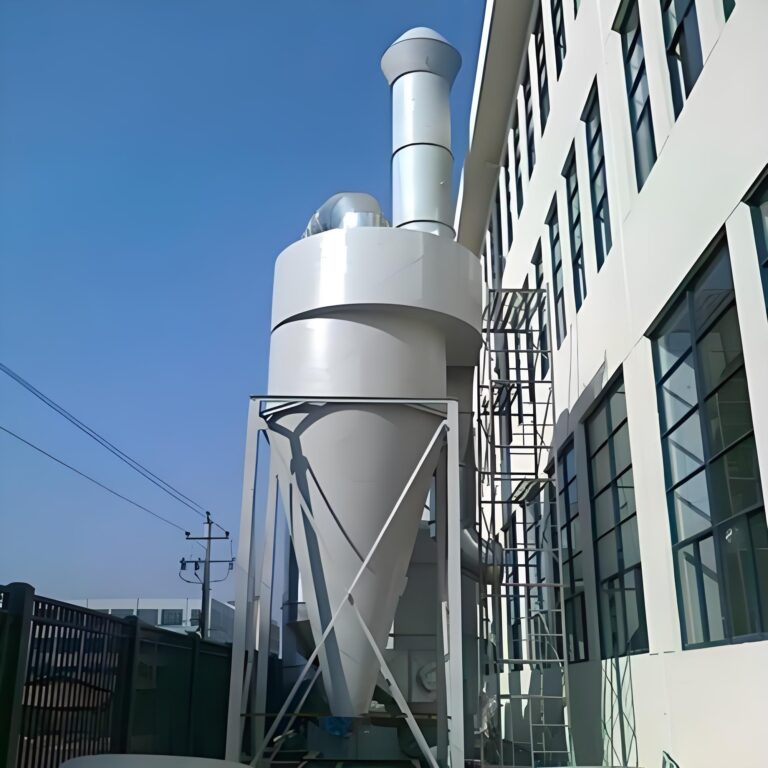
A dust collector that clears factory acceptance at the vendor’s facility can still fail the first week on your production floor—not because the specification was wrong, but because the test never reflected real operating load. Filter media that performs adequately against clean test air can behave like a fine-dust delivery system once grinding or cutting begins in earnest, and a pressure-drop swing that looks manageable in isolation can translate to 40% less airflow at the hood face after a single fill cycle in some single-stage collector designs. The signature on an acceptance document only means something if the test conditions actually represent the installation: production equipment running, operators at normal positions, cleaning pulses cycling, and the hopper discharging under the same constraints it will face every shift. What follows gives commissioning teams and procurement reviewers the specific checks—airflow, pressure, visible escape, sampling method, pulse behavior, discharge simulation, and result comparison—that separate a real acceptance from a documented assumption.
Test airflow at each pickup point
Nameplate fan capacity and measured airflow at each individual pickup point are different numbers, and accepting one as a proxy for the other is where many installations quietly go wrong. A collector sized correctly at the system level can still produce inadequate capture velocity at a remote hood if branch duct resistance, damper settings, or fitting losses were estimated rather than measured during design. Acceptance testing should verify actual velocity and volume flow at every pickup point under normal operating conditions, not aggregate system flow alone.
For velocity and volume flow measurement, ISO 10780 provides a recognized framework for traversing duct cross-sections and calculating volumetric flow from multiple-point velocity readings. This is not a mandatory regulatory requirement for every industrial installation, but where the project specification calls for traceable measurement or where local codes invoke a formal method, it gives the test a defensible technical basis. Using it as a testing framework—rather than treating it as a governing compliance standard—is the right framing for most acceptance scenarios.
The practical decision point is whether each pickup meets the design capture velocity at the source, not whether total system airflow matches the fan curve. An installation with adequate total flow but unbalanced branch distribution will show acceptable aggregate readings while leaving specific operations under-captured. Identify the most hydraulically remote pickup point before the test begins, and treat it as the critical acceptance criterion.
Record static pressure and filter pressure drop
Static pressure across the filter assembly is a proxy for filter condition, not a replacement for measured airflow, and using it as a standalone acceptance criterion overstates its resolution unless site-specific correlation between pressure drop and flow has been established. At acceptance, the right approach is to record baseline static pressure across the filter at the start of the test, verify it against the supplier’s design operating range, and confirm that airflow measurements taken simultaneously are consistent with what the design assumed at that pressure drop.
The more important acceptance question is how fast pressure drop rises under actual production load. In single-stage collector designs with rapid filter loading, documented observations show airflow can drop by roughly 40% after filling the bags just once—a failure mode that will not surface in a short clean-air bench test. This is not a universal design constant, but it is an indicative risk pattern that acceptance testing on single-stage collectors should deliberately provoke by running the test through at least one representative production cycle rather than stopping at initial commissioning conditions.
Recording both the starting and end-of-cycle pressure drop, together with the corresponding airflow measurements, gives the commissioning team a real-loading performance envelope. If the collector’s cleaning system is supposed to recover pressure drop between cycles, the test should confirm that recovery actually happens and that post-pulse airflow rebounds to within the design window before the next production cycle begins.
Check visible escape during normal grinding or cutting
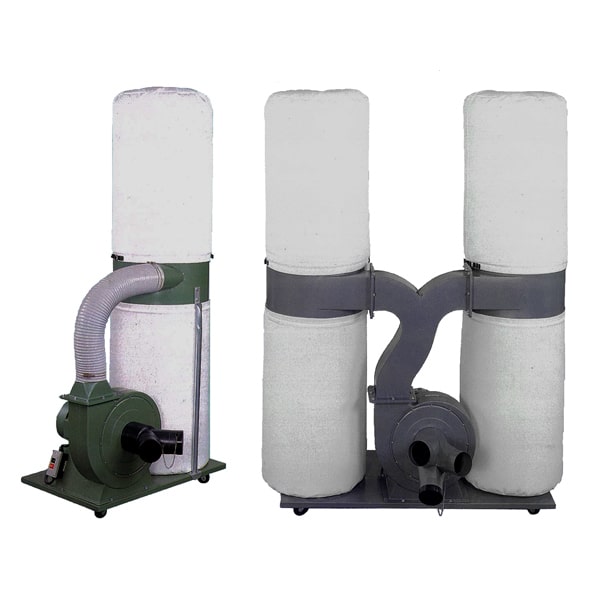
Visible dust escape at or near head height during production is one of the most direct failure signals an acceptance test can produce, and it is also one of the most commonly skipped because the collector appears to run without alarm. Low-efficiency filter media—particularly porous polyester bags in the 30-micron range—can allow fine particles to pass during normal operation, creating a visible dust cloud at operator breathing zone height that no static pressure reading will flag. When fine dust is present, this is a probable operational risk worth testing explicitly, not an edge case.
The check itself is straightforward: run the actual production operation—grinding, cutting, blending, whatever the design case is—at representative throughput, and observe the collector exhaust and the space around operator positions. Visible escape from the exhaust stack or recirculated air discharge should be treated as a filter media or system-sizing issue requiring resolution before acceptance closes. The distinction between visible escape and a specific regulatory non-compliance depends on the applicable local visible emission standard and the material involved, but regardless of whether a formal limit is triggered, visible escape at operator positions is a containment failure by any reasonable production standard.
For applications where fine or hazardous dust is present, a Dépoussiéreur à cartouche with appropriately rated media offers meaningfully tighter filtration than porous bag designs—a distinction that should be settled in the specification stage rather than discovered at acceptance.
Confirm particulate or dust sampling method if required
Not every dust collector acceptance test requires formal airborne particulate sampling, but when the application involves materials with defined occupational exposure limits, relying on visual observation and pressure-drop readings alone is not defensible. The acceptance protocol should specify in advance whether airborne sampling is required, who collects and analyzes the samples, and what the acceptance threshold is.
One approach used for contained systems handling hazardous or high-potency materials is surrogate testing: replacing the actual process material with a substitute compound—lactose at undiluted concentration is one documented example—that can be detected at very low airborne concentrations without the health exposure risk of the real material. Running 100% surrogate dust rather than the diluted concentrations typical of real process streams creates a worst-case challenge for the collector during acceptance, which is precisely the point. This is a manufacturer-specific and application-specific option, not an industry-wide norm, but where OELs are tight and the real material cannot be safely used during commissioning, it is a practically useful approach.
Where a regulatory sampling protocol is required—for stack emissions or formal environmental measurement—gravimetric methods such as those described in ISO 9096 or ASTM D6331 provide recognized frameworks for mass concentration determination, though the applicability of each depends on the specific local or permit requirement.
| Sampling Duration Type | Detection Limit (lactose) | Application typique |
|---|---|---|
| 8-hour TWA | 0.005 µg/m³ | Full-shift exposure assessment |
| 14-minute STEL | 0.17 µg/m³ | Short-term peak exposure check |
The detection limits in the table matter because they determine whether the sampling method can actually confirm performance at the OEL in question. A method that cannot resolve concentrations near the target limit will produce a passing result by default rather than by evidence—which is a different and much weaker kind of acceptance.
Watch cleaning pulse and hopper discharge behavior
A collector that achieves adequate airflow and acceptable filter pressure drop at the start of a test but degrades progressively because its cleaning system is not functioning correctly has passed a static snapshot, not an operational acceptance. The cleaning pulse check should confirm that timed or differential-pressure-triggered pulses are firing at the correct interval, that they are actually dislodging accumulated material from filter surfaces, and that the dislodged material falls into and accumulates in the hopper as designed rather than re-entraining into the airstream.
The hopper discharge check is where many acceptance tests stop short. For applications involving hazardous materials, the discharge operation—liner removal, valve cycling, bag sealing—is itself an exposure event that needs to be tested under representative conditions. In one documented contained-system case, operators performed three discharge cycles using a dual-butterfly valve system and then crimped and cut the liner; personal air samples during those operations confirmed concentrations well below the applicable OEL. The specific numbers from that case reflect one system design and one material and should not be treated as universal performance targets, but the test structure—simulating the discharge operation and taking personal samples at operator positions during the event—is sound practice for any application where the hopper discharge creates a credible exposure pathway.
| Opérateur | Sampling Duration (min) | Measured Concentration (µg/m³) |
|---|---|---|
| Operator 1 | 126 | 0.077 |
| Operator 2 | 126 | 0.045 |
The decision implication here is straightforward: if discharge operations were not tested, the acceptance test did not cover the full exposure cycle. For contained or hazardous-material applications, that gap is a risk that either needs to be closed before acceptance or explicitly carried forward as a known open item with agreed mitigations.
Compare results with quoted assumptions
The supplier’s performance claim—whether expressed as an OEL limit, a capture efficiency percentage, or a maximum exhaust concentration—is a design commitment, not a regulatory limit. Acceptance testing is the point at which that commitment is verified against installed, loaded-system performance. Comparing measured results to quoted assumptions only means something if the test conditions actually match, or deliberately exceed, the conditions the supplier assumed when making the claim.
When acceptance testing has been completed, three practical outcomes are possible depending on how measured concentrations compare to the supplier’s stated threshold.
| Résultats | When It Applies | Required Action |
|---|---|---|
| Accept as Designed | Measured concentrations are below the claimed limit | Proceed with acceptance |
| Modify and Retest | Results are close to the threshold but not fully compliant | Adjust system, then repeat test |
| Évaluation des risques | Performance falls short of the threshold | Conduct risk assessment and consider supplemental PPE |
The modify-and-retest path is often underfunded in project schedules, which is one reason acceptance tests conducted too early—before the system is fully balanced, before production load is representative, or before cleaning pulse timing has been tuned—tend to produce marginal rather than confident results. A result that passes only because the test was run under favorable conditions will create problems at the first production audit or the first process change that shifts dust loading. The risk-assessment path, where performance falls short, should be a deliberate decision with documented rationale, not the default outcome of an inconclusive test.
Close acceptance on installed system performance
Surrogate testing results, where collected, can provide strong evidence that a collector will meet required emission control performance under real operating conditions—in one documented case, a customer accepted surrogate test results at FAT as sufficient evidence before equipment was shipped. But containment performance data alone does not close acceptance; it closes the exposure-control portion of the review. Acceptance of the installed system also requires a practical review of whether the system is operationally sustainable.
Functional acceptability covers factors that do not appear in emissions data but drive total cost of ownership and operational reliability over time.
| Facteur | Acceptance Review Requirement |
|---|---|
| Ease of Service | Customer and manufacturer to review and agree |
| Utilisation de l'énergie | Customer and manufacturer to review and agree |
| Fiabilité | Customer and manufacturer to review and agree |
| Coût total de possession | Customer and manufacturer to review and agree |
Ease of filter service, energy draw under production load, cleaning pulse reliability, and hopper discharge reliability are the factors most likely to generate unplanned maintenance costs and downtime if they are not reviewed and agreed between the customer and the supplier before the acceptance document is signed. A collector that meets every containment number but requires two people and thirty minutes to change a filter cartridge in a confined space will accumulate deferred maintenance over its service life. These reviews are not a formal industry-wide standard checklist, but they represent the gap between what an acceptance test proves and what a production team actually needs to sustain the system.
For pulse-jet collector designs where filter loading and cleaning cycle management are critical to sustained airflow performance, the Dépoussiéreur à jet pulsé product design parameters should be reviewed specifically against the production dust type and loading rate as part of the functional review, not assumed to be covered by nameplate capacity alone.
The difference between a reliable acceptance and a documented assumption comes down to whether the test ran under conditions that could actually surface a problem. Airflow at each pickup point under production load, filter pressure drop through at least one representative fill cycle, visible escape at operator positions, cleaning pulse recovery, and hopper discharge behavior during an actual removal event—each of these is a potential failure mode that a nameplate or clean-air test will not catch. Before acceptance closes, the team should be able to confirm which of these checks were performed, what the test conditions were relative to the supplier’s quoted assumptions, and where any gap between tested conditions and real production conditions remains open. That confirmation is what gives an acceptance document its practical weight.
Questions fréquemment posées
Q: Our production process runs intermittently and never fills the hopper in one shift. Does the acceptance test still require a full fill cycle?
A: Yes, but you can simulate a worst-case loading by running the collector at peak generation rate for a representative period, even if the hopper does not reach capacity. The goal is to observe filter pressure-drop behavior under real dust loading and confirm cleaning pulse recovery. A partial fill cycle that captures the maximum dust load your process can produce in a single operating window still yields valid data, provided the test is not cut short before the cleaning system cycles at least once under load.
Q: After all checks pass, what documentation is needed to formally close acceptance?
A: As a minimum, you need a signed acceptance report that lists each test parameter (airflow at pickup points, start/end pressure drop, visible escape observations, sampling results if taken, and discharge-event records) alongside the corresponding design targets and measured values, and a clear statement confirming that the installed system meets the agreed functional and performance criteria. Any deviations, open items, or agreed risk assessments should be attached. This report becomes the baseline for future maintenance checks and warranty claims.
Q: At what point does visible dust escape cross from a performance issue to a regulatory violation?
A: The threshold is defined by your local air permit or visible emission standard—typically an opacity limit (e.g., 20% opacity for a continuous emission). If no numeric limit applies, visible escape at operator breathing zones is still a containment failure that should be resolved before acceptance, as it signals that filter media or system design is not capturing fine particulates. Always confirm the applicable regulation for your location and material; compliance is separate from the operational acceptance check but may dictate required fixes.
Q: Do cartridge and pulse-jet collectors demand different acceptance test procedures?
A: The core checks—airflow, pressure drop, visible escape, and discharge behavior—apply to both, but the cleaning-system evaluation differs. For cartridge collectors, you verify that reverse-pulse cleaning effectively dislodges fine dust from pleated media and that the pleats do not pack in. For pulse-jet baghouses, you focus on pulse-tube alignment, valve timing, and bag tension to confirm dust release. In both cases, the test must run under real production loading to prove cleaning recovery.
Q: Is the full acceptance test necessary for a small workshop with a single dust source and non-hazardous wood dust?
A: The scope of testing should scale with risk and regulatory requirements. At minimum, verify airflow at the single pickup point, check for visible dust escape during operation, and confirm that the cleaning pulse (if fitted) restores airflow after a typical loading period. Airborne sampling and formal OEL comparisons are generally unnecessary unless the dust has an established exposure limit or a permit demands stack testing. The article’s framework is a maximum-quality approach; for low-risk settings, you can tailor it down to the checks that directly affect worker safety and collector longevity.
Contenu connexe :
- Principaux fabricants de filtres à vide en céramique 2025
- Les 10 premiers fabricants de filtres à disques sous vide 2025
- Principaux fabricants de filtres à disques céramiques 2025
- Améliorer l'efficacité du système de filtration sous vide
- Les meilleurs équipements de séparation solide-liquide pour 2025
- Technologie de filtration à haut rendement énergétique : Guide 2025