Ceramic disc filter efficiency should be managed as a stable process, not as a universal percentage. The useful questions are practical: Is the feed within the expected range? Is cake forming and releasing consistently? Is the vacuum system stable? Does the filtrate meet the site’s criteria? Is cleaning restoring permeability?
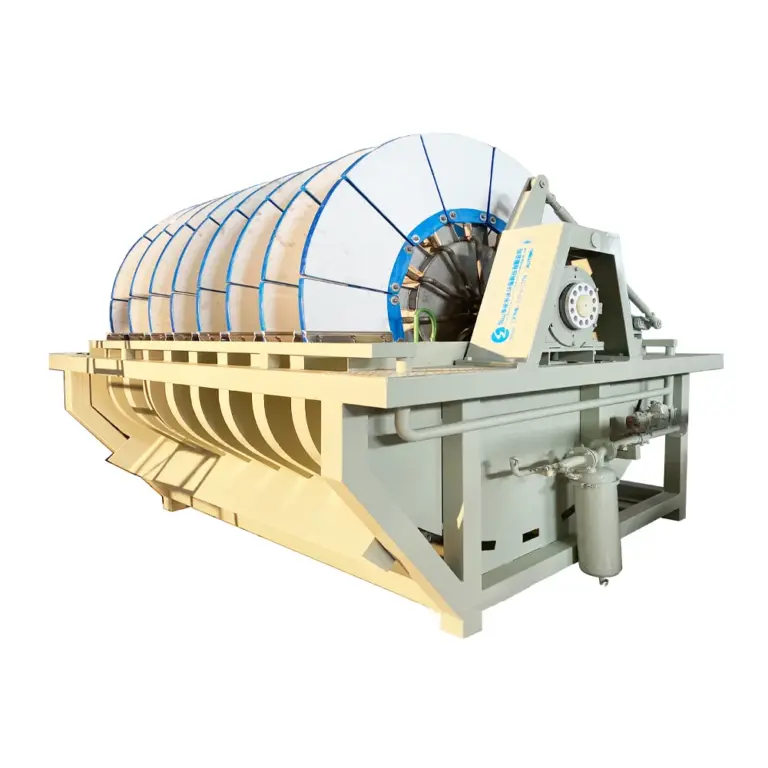
This guide is for operators and process teams working with an installed ceramic disc or disk filter. For the basic operating cycle, read what a vacuum ceramic disk filter is. For equipment-selection value and limitations, see ceramic disc filter advantages and purchase conditions.
Start with a controlled operating baseline
Optimization begins by recording a stable period rather than changing several settings at once. The baseline should bind the feed condition to the observed cake, filtrate, vacuum behavior, rotation, discharge, and cleaning response.
Useful baseline observations include solids concentration, particle distribution when available, slurry level, agitation condition, vacuum stability, disk speed, cake formation and release, filtrate appearance or measured quality, cleaning sequence, and any alarms or operator interventions. Use site-approved measurement methods so that later comparisons are meaningful.
Keep the feed condition visible
A filter cannot compensate indefinitely for an unstable feed. Changes in solids concentration, particle distribution, chemistry, temperature, or upstream conditioning can alter cake permeability, adhesion, liquid removal, and cleaning demand.
When performance changes, first compare the feed with the baseline. If the change follows a feed shift, coordinate with the upstream process before treating it only as a mechanical problem. If the feed is stable, continue through the equipment checks below.
Balance cake formation, dewatering, and discharge
Disk rotation determines how long each sector spends in the main cycle zones. A change can affect cake thickness, dewatering time, discharge behavior, and the amount of clean surface returned to the slurry. The useful setting is therefore application-specific.
Observe the cake around the disk rather than relying on one sample. Uneven formation may point to slurry distribution, agitation, vacuum distribution, blocked flow paths, or sector condition. Poor release may relate to cake character, scraper condition or alignment, rotation, or deposits on the ceramic surface.
Check the vacuum and filtrate path
Stable pressure difference is necessary for liquid to move through the cake and ceramic medium. Inspect the vacuum source, valves, seals, receivers, moisture management, and lines according to the equipment’s approved maintenance procedure. An unstable reading can be a system symptom rather than a reason to increase vacuum blindly.
Filtrate is also a diagnostic signal. A change in appearance or measured quality can indicate unstable cake formation, a damaged ceramic sector, a seal or internal connection problem, or a feed change. Isolate the affected condition and confirm the cause before returning to normal operation.
Use cleaning as a controlled regeneration step
Backwash and other installed cleaning methods are intended to recover permeability. Where the equipment includes ultrasonic assistance, its role is to support removal of deposits from the ceramic structure; it is not a substitute for confirming why deposits formed.
Track the response before and after cleaning. If permeability returns, review whether the cleaning trigger and sequence are appropriate. If it does not, investigate feed chemistry, fine-particle loading, scaling, organic deposits, ineffective cleaning delivery, or irreversible media damage. Use only cleaning methods and chemicals approved for the installed materials.
Inspect the discharge and wear points
Scrapers, seals, drive components, ceramic sectors, and slurry-contact parts should be inspected for condition and alignment. A scraper problem can leave cake on the sector or damage the surface. A seal or connection problem can reduce vacuum stability or affect filtrate. Drive irregularity can change the time spent in each cycle zone.
Maintenance frequency should be based on observed condition, duty, and the equipment’s approved instructions. The fixed local evidence does not support a universal interval or ceramic-sector service life.
A practical troubleshooting sequence
| Observed condition | Checks to prioritize |
|---|---|
| Cake becomes thinner or inconsistent | Feed solids, particle distribution, slurry level and agitation, vacuum stability, sector permeability, and rotation. |
| Cake does not release cleanly | Cake character, scraper condition and alignment, surface deposits, discharge timing, and feed changes. |
| Filtrate quality changes | Cake formation, ceramic-sector integrity, seals and internal connections, sampling method, and abnormal feed. |
| Permeability declines after cleaning | Cleaning delivery, deposit type, scaling or fine-particle blinding, media condition, and chemical compatibility. |
| Vacuum becomes unstable | Vacuum source, valves, leaks, receivers, moisture carryover, lines, seals, and changes in filtrate flow. |
Change one controlled variable at a time
Record the reason for each adjustment, the starting condition, the change made, and the observed result. Avoid changing feed conditioning, rotation, vacuum, discharge, and cleaning simultaneously; otherwise the evidence will not show which change helped or caused a new problem.
If the process cannot meet its agreed cake, filtrate, capacity, or stability criteria within the approved operating envelope, return to process-fit review. The Page consacrée aux équipements de filtration à disques céramiques sous vide lists the inputs needed to reassess the duty or configuration.