La ventilation générale échoue au niveau du poste de travail de manière prévisible : au moment où le flux d’air de la pièce commence à diluer les particules en suspension, la poussière a déjà quitté la zone de découpe et pénétré dans l’espace respiratoire de l’opérateur. C’est dans cet intervalle entre la génération et la dilution que l’exposition se produit, et le découvrir lors d’un contrôle post-installation revient cher — car la correction nécessite presque toujours un repositionnement, un remaniement de la tuyauterie ou le remplacement d’équipements qui, sur le papier, répondaient aux spécifications nominales. Les choix qui permettent d’éviter cette situation — géométrie de la hotte, compartimentage des zones, dimensionnement des conduits sur l’ensemble du parcours — ne coûtent presque rien à mettre en œuvre dès la phase de conception, mais leur correction après la mise en service s’avère nettement plus onéreuse. Vous trouverez ci-après une méthode structurée pour évaluer ces choix avant la construction du système.
Déterminer à quel moment la poussière s'échappe avant que la ventilation de la pièce ne puisse la diluer
La ventilation locale renouvelle l’air dans la pièce, mais elle n’intercepte pas les particules à leur point d’origine. Sur un poste de découpe, la poussière et les fumées se déplacent immédiatement après leur émission — vers le haut sous l’effet de la chaleur, vers l’extérieur dans le sens de la découpe — et la ventilation générale fonctionne à un rythme tout simplement trop lent pour capter les particules déjà en mouvement. Il ne s’agit pas d’une défaillance du système de ventilation, mais d’une inadéquation physique entre le problème et l’outil utilisé pour le résoudre.
Sur une table à aspiration descendante, le paramètre de conception qui fait la différence entre une captation efficace et un échec visible est la vitesse du flux d’air à la surface de la table. Les professionnels utilisent une plage de 150 à 250 ft/min comme objectif de fonctionnement pour contrer la portance des fumées générées par la chaleur ; en dessous de cette plage, les panaches ascendants issus de la découpe au plasma, au laser ou à la flamme peuvent échapper à l’aspiration de la table avant d’être entraînés dans la chambre de collecte. Il s’agit d’un paramètre de conception technique, et non d’un seuil réglementaire codifié, mais il fait office de limite pratique : si cette valeur n’est pas atteinte, le système peut sembler fonctionnel au niveau du collecteur alors que des fumées s’échappent visiblement au bord de la table.
Le deuxième facteur de défaillance est la surface exposée. Une table à aspiration descendante qui fonctionne sur toute sa surface mais dont le débit d'air n'est dimensionné que pour une découpe partielle présentera une vitesse insuffisante dans les zones non couvertes, créant ainsi des zones de basse pression d'où la poussière peut s'échapper. C'est le zonage — c'est-à-dire le partage de la table en sections contrôlées indépendamment — qui permet d'éviter cette situation, et non une capacité globale plus élevée du système d'aspiration.
| Point de défaillance | Pourquoi c'est important | Éléments à vérifier |
|---|---|---|
| Vitesse de courant descendant inférieure à 150–250 ft/min | Les fumées ascendantes ne sont pas neutralisées ; la poussière s'échappe vers le haut avant d'être captée | La vitesse du flux d'air au niveau de la surface de la table, et pas seulement la capacité nominale du collecteur |
| Débit d'air insuffisant dû à une surface de table dégagée ou à un mauvais zonage | La capture des poussières est inégale ; des particules s'échappent des zones non couvertes | Le zonage et la couverture de la table correspondent à la zone de découpe active |
Ces deux points de défaillance présentent une caractéristique commune : ils sont invisibles au niveau du collecteur, mais détectables à la surface de la table grâce à un simple contrôle à l'anémomètre. Si cette étape de vérification est omise, le système peut passer avec succès un audit au niveau de l'équipement tout en continuant à exposer les opérateurs à des risques.
Placez des hottes, des tables ou des bras de prélèvement à proximité de la source de découpe.
Le principe qui sous-tend le captage local est celui de la proximité : il s'agit de placer l'entrée suffisamment près du point de génération pour que la vitesse de captage soit suffisante avant que les particules ne se dispersent. Pour les opérations de découpe, cela signifie que le dispositif de captage — qu'il s'agisse d'une table à aspiration descendante, d'une hotte à aspiration arrière ou d'un bras de captage flexible — doit être positionné par rapport à l'endroit où le matériau est effectivement découpé, et non par rapport à l'emplacement nominal de la machine.
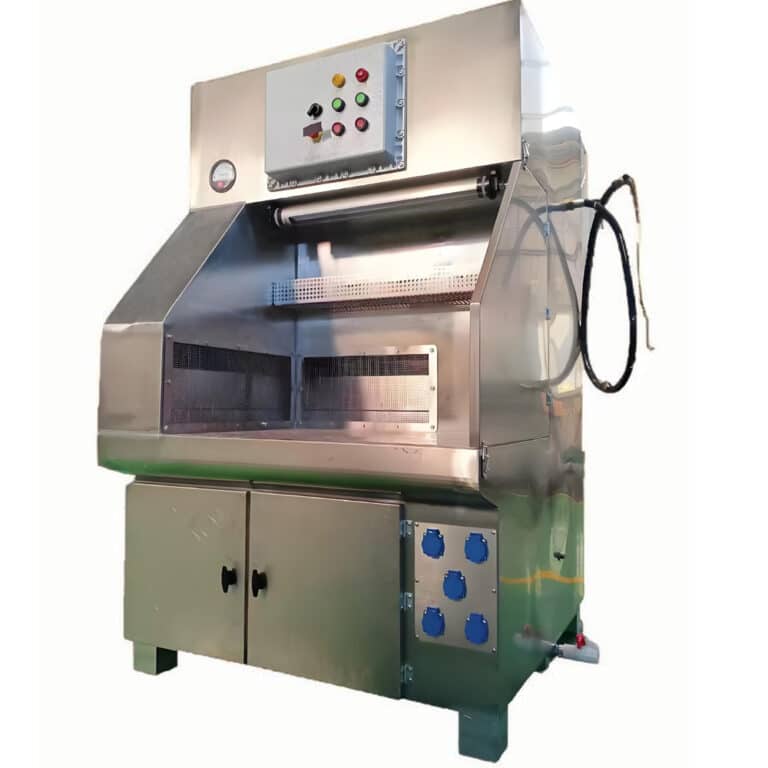
Pour un table de broyage à courant descendant, le zonage est le principal critère de conception qui permet d’assurer l’efficacité de la proximité à grande échelle. Sans zonage, l’aspirateur répartit le flux d’air sur toute la surface de la table, ce qui réduit la vitesse au niveau de la zone de découpe active. Avec le zonage, le flux d’air se concentre là où la découpe a lieu, et les zones inutilisées sont isolées — ce qui permet de maintenir une vitesse de captage efficace sans avoir besoin d’un collecteur surdimensionné. C’est important car surdimensionner la capacité du collecteur pour compenser un mauvais zonage constitue une véritable erreur d’achat : le système coûte plus cher, le réseau de conduits est plus lourd, et le problème de captage peut tout de même se poser, car c’est la vitesse à la surface, et non le débit total en CFM à l’entrée, qui détermine si les particules sont interceptées.
OSHA 1910.94 apporte un appui général, sous forme de référence technique, au principe selon lequel les entrées d'aspiration doivent être situées aussi près que possible de la source. Les implications en matière de conception sont claires : chaque pouce de distance entre le point de génération et l'entrée de captage réduit la vitesse effective atteignant ce point, et les configurations opérationnelles qui éloignent la zone de découpe de la hotte — même temporairement — peuvent faire sortir le système de sa plage de captage effective.
Les bras d'aspiration flexibles permettent de résoudre ce problème pour les postes de travail où l'emplacement de la découpe varie, mais ils introduisent une contrainte qui leur est propre : le trajet du tuyau entre le bras et le collecteur affecte le débit d'air fourni, et cette contrainte s'ajoute à la géométrie des conduits d'une manière que la plupart des fiches techniques des équipements ne mettent en évidence qu'au moment de l'installation.
Tenir compte du sens de coupe et de la position de l'opérateur
La poussière et les fumées ne se propagent pas de manière uniforme à partir d'une source de découpe. La direction de la découpe, le sens d'avance du matériau et la position de l'opérateur par rapport à la ligne de découpe influent tous sur la trajectoire suivie par les particules après leur formation. Une hotte ou une table correctement positionnée pour une orientation de découpe donnée peut s'avérer inefficace lorsque l'opérateur fait pivoter la pièce ou change le sens de découpe.
Il s’agit d’un critère de planification qui nécessite une intervention des concepteurs avant la finalisation de l’agencement. La partie de la table recouverte par la pièce à usiner à un moment donné détermine la surface libre non protégée, ce qui influe à son tour sur la répartition du flux d’air sur la table. Une pièce de grande taille recouvrant la majeure partie de la table concentre efficacement la vitesse au niveau de la ligne de coupe ; une petite pièce posée sur une grande table crée des zones ouvertes qui dispersent le flux d’air et réduisent la vitesse au niveau de la zone de coupe active. Aucune de ces deux situations ne constitue automatiquement un défaut de conception, mais elles nécessitent toutes deux une prise en compte délibérée dans la configuration des zones et le positionnement de l’opérateur par rapport au dispositif de captage.
La position de l’opérateur constitue un élément à prendre en compte séparément. Si l’opérateur se trouve entre la zone de découpe et l’entrée d’aspiration — ou si la direction de découpe propulse les particules vers l’opérateur avant que la hotte ne puisse les intercepter —, la captation locale peut ne pas protéger la zone respiratoire, même si elle protège la pièce. La vérification pratique consiste à tracer la trajectoire probable des particules à partir du point de découpe, compte tenu de la direction spécifique de la découpe, puis à confirmer que la hotte est positionnée de manière à intercepter cette trajectoire plutôt que le scénario inverse moyen ou le pire des cas. Il s’agit là d’un jugement de l’opérateur, et non d’une méthode de calcul normalisée, mais c’est le genre de jugement qui empêche un système d’être techniquement conforme tout en étant inadéquat dans la pratique.
Vérifiez si le système d'évacuation général provoque des courants d'air transversaux
La ventilation générale par extraction et la captation locale doivent être coordonnées, et non pas simplement installées au même endroit. Une installation qui installe une hotte à aspiration descendante à côté d'un système d'extraction de la pièce sans vérifier l'interaction entre les deux risque de nuire involontairement aux performances de captation locale sur lesquelles elle compte. Le Chapitre 32 du Manuel ASHRAE consacré à la ventilation industrielle est la référence pertinente pour ce principe de coordination : les systèmes généraux et locaux doivent être conçus conjointement afin d'éviter toute interférence croisée susceptible de nuire aux performances de la hotte.
Le mode de défaillance spécifique est le « courant d'air transversal » : une prise d'aspiration de la pièce située à proximité d'une hotte de captage local peut aspirer l'air latéralement à travers la zone de captage, éloignant ainsi les particules de l'entrée de la hotte et les dispersant dans la pièce au lieu de les acheminer vers le système local. La gravité de ce phénomène dépend des débits d'air relatifs et de la géométrie de la prise d'aspiration par rapport à la hotte. La présence d’une prise d’air de la pièce à haute vitesse située en amont d’une table à flux descendant est une situation qu’il convient de vérifier ; elle n’entraîne pas nécessairement une défaillance dans toutes les installations, mais elle contribue souvent aux insuffisances de captation inexpliquées constatées lors de la mise en service.
La vérification est simple : lors des essais de débit d’air, introduisez un traceur visible — un crayon fumigène ou équivalent — au niveau de la zone de coupure et observez si le panache se dirige vers l’entrée de captage ou s’il est dévié par les courants d’air transversaux de la pièce. En cas de déviation, la géométrie ou le débit d’évacuation de la pièce doit être ajusté avant de pouvoir se fier au système local. Ce contrôle ne coûte presque rien et permet d’éviter une discussion délicate visant à déterminer si l’équipement installé est adéquat ou si le problème réside dans la configuration de la pièce.
Vérifiez que la capture s'effectue bien sur le poste de travail, et pas seulement dans la pièce
Le débit nominal d'un collecteur indique le débit que le système est capable de fournir à l'entrée dans des conditions nominales. Il ne précise pas le débit qui parvient à l'outil. C'est précisément cette différence entre ces deux chiffres qui explique pourquoi de nombreuses installations, qui semblent adéquates sur le papier, s'avèrent défaillantes dans la pratique.
La géométrie des conduits est la variable principale. Chaque raccord, chaque transition et chaque tronçon de tuyau entre l'entrée du collecteur et le point de captage introduit une résistance qui réduit le débit d'air fourni. La perte de performance peut être suffisamment importante pour avoir un impact sur le fonctionnement, et elle est prévisible compte tenu de la configuration des conduits — ce qui signifie qu'elle peut également être évitée si l'ensemble du tracé des conduits est dimensionné et évalué avant l'installation.
| Démarrage du CFM (collecteur) | Obstruction d'un conduit | CFM chez Tool | Mesurer l'impact |
|---|---|---|---|
| 1314 | Pertes normales au niveau des tuyaux et des raccords | ~900 | Risque de capture insuffisante si l'outil nécessite une vitesse plus élevée |
| 1314 | Diamètre réduit de 6″ à 4″ avec un tuyau flexible de 15 pieds | <700 | Perte importante de débit d'air ; la capture locale risque d'échouer |
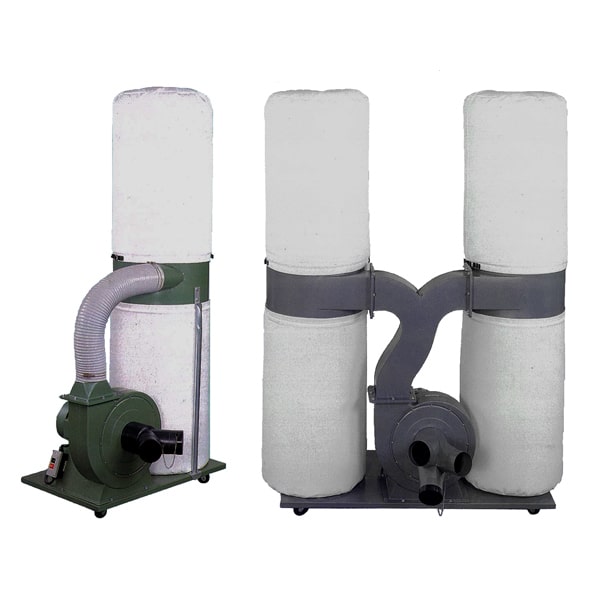
Le tableau illustre un phénomène qui se produit régulièrement dans les installations de dépoussiéreurs portables : un dépoussiéreur dimensionné pour fournir un débit d’air adéquat à l’entrée peut fournir un débit nettement inférieur au niveau de l’outil après une réduction du diamètre du conduit et l’utilisation d’un tronçon modeste de tuyau flexible. Le passage d’un diamètre de conduit de 6 pouces à 4 pouces, associé à 15 pieds de tuyau flexible, peut réduire le débit d’air fourni de près de moitié. Cette réduction n’est pas due à une défaillance du dépoussiéreur — celui-ci peut fonctionner exactement conformément à ses caractéristiques nominales. Il s’agit d’un problème de conception du réseau de conduits qu’un examen des spécifications au niveau du dépoussiéreur ne permettra pas de détecter.
Pour les systèmes portables où le tracé des flexibles varie en fonction de la tâche à effectuer, cela signifie qu’une installation offrant une captation adéquate dans une configuration donnée peut s’avérer insuffisante dans une autre si la longueur du flexible est plus importante ou si le diamètre est réduit au niveau d’un point de raccordement. Les recommandations de dimensionnement abordées dans un Calcul du débit en CFM d'un dépoussiéreur portable Il faut tenir compte de l'ensemble du tracé des conduits tel qu'il sera réellement utilisé, et non de la configuration la plus courte ou la plus avantageuse. La vérification au point de captage — et non à l'entrée du collecteur — est le seul moyen de s'assurer que le système fonctionne là où il doit fonctionner.
Pour les établissements utilisant un dépoussiéreur portable sur plusieurs postes de travail, cela signifie également que la validation doit être répétée lorsque le tracé des flexibles ou la géométrie des raccordements change d'un poste à l'autre, car une configuration qui est validée à un endroit peut ne pas l'être à un autre.
Intégrer les EPI dans un plan de contrôle plus global
La captation locale réduit l'exposition ; elle ne l'élimine pas. Même un système de hotte bien conçu et correctement validé ne parviendra pas à intercepter toutes les particules générées au niveau d'un poste de découpe. Certaines particules s'échappent par le pourtour de la hotte, d'autres sont générées lors du repositionnement ou de la manipulation des pièces en dehors de la zone de captage active, et d'autres encore constituent la fraction résiduelle que tout système réel laisse sans captage. Considérer le captage local comme le dernier niveau de contrôle dans un environnement de découpe présentant plusieurs risques n'est une position défendable que si l'on vérifie que la fraction d'exposition résiduelle se situe dans des limites acceptables — et cette vérification est rarement effectuée de manière systématique.
Concrètement, cela signifie qu’un masque respiratoire de classe P100, qui filtre 99,971 % des particules en suspension dans l’air, doit rester un élément prévu de la stratégie de contrôle plutôt qu’une solution de secours en cas de défaillance du système. Cette distinction est importante, car une solution de secours est ce vers quoi les travailleurs se tournent lorsqu'un problème survient ; un élément prévu est ce que les travailleurs portent dans le cadre de la procédure de travail standard. L'un assure une protection constante ; l'autre crée une lacune qui ne se comble que lorsqu'un problème est déjà survenu.
Ce cadre reflète la hiérarchie des mesures de contrôle : les mesures techniques, telles que la captation locale, constituent la première ligne de défense, mais elles s’inscrivent dans un système qui inclut des mesures administratives et des EPI en tant que niveaux complémentaires. Un plan de contrôle qui supprime les EPI une fois la captation locale mise en place réduit un système multicouche à un point de défaillance unique. L’approche appropriée consiste à mettre en place une captation locale afin de réduire l’exposition autant que le permettent les moyens techniques, puis à recourir aux EPI pour couvrir la fraction résiduelle que les mesures techniques ne peuvent pas traiter de manière fiable.
Prévoir une captation locale là où un risque d'exposition est généré
Le principe général selon lequel la captation locale doit être définie au point de génération s'appuie sur des exigences réglementaires spécifiques qui varient en fonction des matériaux et des juridictions. Ces exigences créent des obligations de conception documentées qui vont au-delà des bonnes pratiques générales, et elles s'appliquent à des procédés de découpe spécifiques d'une manière qui influe sur la configuration que doit adopter un système de captation.
Deux exemples illustrent comment les contraintes réglementaires se traduisent en exigences de conception :
| Matériau/Procédé | Règlement | Exigence |
|---|---|---|
| Découpe de l'acier inoxydable (chrome hexavalent) | Limite d'exposition admissible réduite par l'OSHA | Une captation locale est nécessaire ; l'air recyclé peut nécessiter un filtre de contrôle |
| Production de poussière de bois | Code de la Californie | Captage à la source ; le dispositif de protection doit faire partie intégrante de la hotte de collecte |
La découpe de l’acier inoxydable génère du chrome hexavalent, pour lequel l’OSHA a abaissé les limites d’exposition admissibles — ce qui constitue un impératif réglementaire spécifique et documenté justifiant une captation locale lors de cette opération. Si l’air capté est recyclé plutôt que rejeté à l’extérieur, un filtre de contrôle peut être nécessaire pour vérifier que l’air recyclé ne réintroduit pas de contaminants dans l’espace de travail. Il s’agit d’une exigence de conception du système qui découle du matériau découpé, et non de la catégorie générale des “ opérations de découpe ”. Pour la poussière de bois, conformément au Code californien, l’exigence est encore plus précise : la captation doit avoir lieu au point de génération, et le dispositif de protection doit faire partie intégrante de la hotte de captage. Il s’agit d’une exigence d’intégration dans la conception, et non d’une simple recommandation de proximité.
Le principe général que ces exemples viennent étayer est que c’est le risque d’exposition à la source — et non la concentration moyenne dans la pièce — qui doit servir de critère pour prescrire une captation locale. Lorsqu’un matériau ou un procédé spécifique présente un risque d’exposition avéré, le système de captation doit être conçu pour traiter ce risque à la source. Une ventilation générale peut satisfaire aux normes de qualité de l’air ambiant tout en laissant la zone de respiration de l’opérateur sans protection, et c’est dans cette lacune que convergent les risques réglementaires et sanitaires. Normes de l'OSHA relatives à la silice cristalline Appliquons cette même logique aux opérations générant de la silice : le risque d'exposition se situe au point de génération, et les mesures de contrôle s'imposent en conséquence.
Pour les installations traitant plusieurs matériaux ou procédés, cela signifie que les spécifications en matière de captage doivent être déterminées en fonction du matériau présentant le risque le plus élevé dans la zone de travail, et non en fonction d'une moyenne. Un système adapté à la découpe d'acier doux peut nécessiter un captage local supplémentaire ou une filtration renforcée lorsque de l'acier inoxydable ou des matériaux contenant de la silice sont introduits.
L'idée centrale défendue dans cet article est simple mais souvent négligée : la ventilation générale et la captation locale ne sont pas interchangeables, et cette différence se manifeste au niveau de la zone de respiration de l'opérateur plutôt qu'au niveau du collecteur ou du capteur de qualité de l'air ambiant. Avant de finaliser la conception d’un système, il convient de vérifier si la vitesse de captage à la surface de la table respecte l’objectif opérationnel de 150 à 250 ft/min dans les conditions réelles de zonage, si le débit d’air fourni au niveau de l’outil a été calculé sur l’ensemble du parcours des conduits plutôt que d’être simplement repris des spécifications du collecteur, et si le plan de contrôle inclut les EPI en tant qu’élément intégré à la conception plutôt que comme mesure d’urgence.
Les décisions qui déterminent si un système de dépoussiérage d'un poste de travail de découpe fonctionnera comme prévu sont prises lors de la conception, de la configuration des zones et du dimensionnement des conduits — des étapes où les modifications sont peu coûteuses. Vérifier ces paramètres avant l'installation constitue la mesure de vérification la plus rentable qui soit ; les vérifier après avoir reçu les données d'exposition des opérateurs ne l'est pas.
Questions fréquemment posées
Q : Cette approche s'applique-t-elle également si le poste de découpe se trouve à l'extérieur ou dans un grand hangar ouvert sur les côtés, où il n'y a pas de véritable ventilation de la pièce ?
R : La captation à la source revêt une importance encore plus grande dans les environnements ouverts ou semi-fermés, et non l’inverse. En l’absence de parois de confinement permettant de créer un quelconque effet de dilution, il n’existe aucun autre mécanisme que la captation à la source pour intercepter les particules avant qu’elles n’atteignent la zone respiratoire de l’opérateur. L’objectif de vitesse superficielle de 150 à 250 ft/min et le dimensionnement complet du réseau de conduits restent d’application — l’absence d’enveloppe de la pièce supprime totalement le recours à la dilution ; la capture à la source devient donc la seule mesure de contrôle que l’ingénierie peut garantir de manière fiable.
Q : Après avoir vérifié que la vitesse de captage et le débit d'air dans les conduits respectent les objectifs de conception, quels éléments faut-il encore vérifier avant de valider la mise en service du système pour son fonctionnement courant ?
R : L’étape suivante consiste à valider les performances dans des conditions de travail réelles, et pas seulement selon la configuration de mise en service. Cela implique de répéter le contrôle à l’anémomètre et le test à la fumée traceuse lorsque le poste de travail est configuré tel qu’il sera utilisé au quotidien — avec la taille et le positionnement de la pièce représentatifs d’une production normale, le cheminement des flexibles que les opérateurs utiliseront réellement, et tout système d’aspiration général adjacent fonctionnant à son débit normal. Un système qui passe avec succès un contrôle statique de mise en service mais qui n’est jamais validé dans des conditions de production peut tout de même présenter des défaillances dès qu’un tuyau plus long, une pièce à usiner pivotée ou un ventilateur d’extraction déplacé crée une situation qui n’existait pas lors de la validation initiale.
Q : À partir de quel moment est-il plus judicieux d'ajouter un deuxième dispositif de collecte local plutôt que de passer à un collecteur unique de plus grande capacité ?
R : Un deuxième dispositif de captage constitue généralement la meilleure solution lorsque la zone de découpe se déplace ou couvre une surface trop vaste pour qu’une seule hotte puisse la couvrir à une vitesse suffisante, ou lorsque deux opérations distinctes se déroulent simultanément à des emplacements différents. L'augmentation de la capacité du collecteur ne résout à elle seule qu'un problème lié au débit total (CFM) ; elle ne résout pas un problème de géométrie ou de proximité. Si la captation échoue parce que la hotte ne parvient pas à intercepter les particules s'éloignant de l'entrée — en raison de la direction de découpe, de la position de l'opérateur ou de la couverture de la pièce à usiner —, augmenter le débit d'air au niveau de cette même entrée ne résoudra pas le problème. Un deuxième dispositif repositionné au niveau du point de génération réel s'attaque à la cause plutôt qu'au symptôme.
Q : Une table à aspiration descendante est-elle toujours la solution de captage local la plus adaptée pour les opérations de découpe, ou existe-t-il des situations où une hotte à aspiration arrière ou un bras flexible sont préférables ?
R : Les tables à aspiration par le bas sont particulièrement adaptées lorsque la découpe est effectuée sur une pièce plate posée à plat sur la surface de la table et que le mouvement dominant des particules est ascendant sous l’effet de la chaleur — la découpe au plasma, au laser et à la flamme en sont les exemples les plus évidents. Les hottes à aspiration arrière ou les bras flexibles sont préférables lorsque la géométrie de la pièce empêche un contact à plat avec la surface de la table, lorsque la direction de la découpe propulse les particules horizontalement vers l’opérateur avant qu’un flux descendant ne puisse les intercepter, ou lorsque l’opération est intermittente et qu’un appareil portable doit se déplacer d’un poste à l’autre. Le critère déterminant est de savoir si le dispositif de captage peut être positionné de manière à ce que la trajectoire des particules depuis le point de découpe se dirige vers l’entrée plutôt que de la dépasser — et cela dépend de la géométrie spécifique de chaque opération, et non d’une préférence universelle pour un type d’appareil particulier.
Q : Si un établissement a déjà mis en place des équipements de protection respiratoire pour tous les opérateurs chargés de la découpe, y a-t-il tout de même des raisons liées à la conformité ou aux risques qui justifient d'investir dans des mesures techniques de captage local ?
R : Oui — selon la hiérarchie des mesures de protection appliquée par l’OSHA et qui sous-tend les normes, notamment la réglementation sur la silice cristalline, les mesures techniques sont obligatoires lorsque cela est possible et ne peuvent être contournées en se fiant uniquement aux EPI. Les masques respiratoires constituent une mesure complémentaire prévue pour couvrir l’exposition résiduelle une fois que les mesures techniques ont réduit l’exposition autant que possible ; ils ne remplacent pas ces mesures. Au-delà de la simple conformité, l’efficacité des EPI dépend entièrement d’une utilisation correcte et systématique (ajustement, procédure d’enfilage et entretien des filtres), tandis qu’un système de captage local correctement conçu réduit l’exposition indépendamment du comportement de l’opérateur. Se fier uniquement aux masques respiratoires revient à transformer un problème d’ingénierie structurelle en une exigence quotidienne de conformité comportementale, ce qui constitue un modèle de protection moins fiable pour l’ensemble du personnel et sur l’ensemble des horaires de travail.