A ceramic disk filter can fail a shift in two completely different ways that look similar from the outside: cake comes off the plates but it is too wet to handle downstream, or cake reaches the right dryness and still will not leave the discharge zone. Treating both as the same problem leads to the wrong corrective action and wastes the diagnostic window. The first judgment a plant engineer needs to make, before touching any valve or scraper, is which of these two patterns is actually occurring.
Separate a Filtration Problem from a Cake-Release Problem
| Observed pattern | Working classification | Next comparison | Limite |
|---|---|---|---|
| Cake leaves the filtration zone too wet | Filtration-side wet-cake pattern | Compare feed condition, vacuum trend, sector timing, plate condition, filtrate behavior, and recent process changes with the baseline duty | This comparison narrows the investigation; it does not identify one universal cause |
| Cake reaches discharge condition but does not release cleanly | Cake-release pattern | Trace the agreed discharge sequence, backblow or release functions, scraper or chute condition, cake buildup, and mechanical alignment | Equipment-specific alarm and intervention limits require manufacturer and site data |
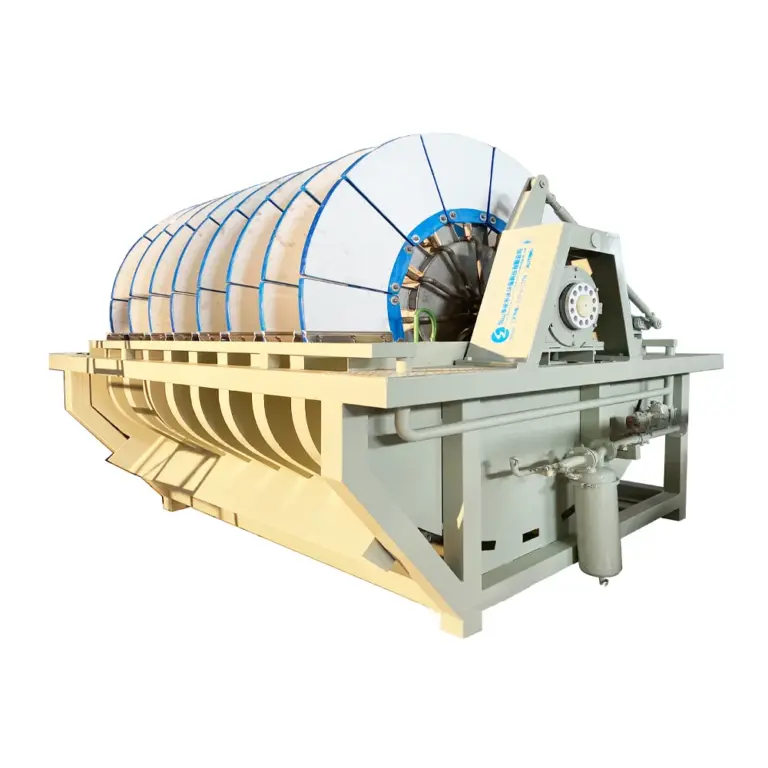
The filtration zone and the discharge zone do two different jobs, and a problem in one does not imply a problem in the other. In the filtration zone, vacuum draws liquid through the ceramic plate and the cake forms and dewaters while the disk rotates through the slurry and the drying sectors. In the discharge zone, the cake that has already reached its intended dryness is meant to separate cleanly from the plate face. A cake that leaves the filtration zone still carrying excess liquid is a filtration-side condition: something upstream of discharge prevented the plate from dewatering the solids as expected for that duty. A cake that reaches the discharge point in the expected condition but will not detach, flakes unevenly, or leaves residue on the plate is a release-side condition: the dewatering step did its job and the discharge mechanism did not complete its own.
This distinction matters because the corrective paths do not overlap. Where the investigation begins on the filtration side, the questions concern feed, vacuum, timing, and plate condition relative to the baseline duty the filter was set up for. Where the investigation begins on the release side, the questions concern the discharge sequence itself, the backblow or release function, and the mechanical condition of the scraper, chute, and alignment. Starting in the wrong zone means changing conditions that were never the cause, which obscures the real signal when a later check is run. If the symptom is ambiguous, for example a cake that appears acceptable at the plate face but arrives wet at the chute, both zones need an initial look before a single corrective change is attempted, because a release-side issue can trap moisture against the plate in a way that resembles incomplete dewatering.
The practical move is to classify the pattern first, using the condition of the cake at the point it leaves the filtration zone versus the point it fails to discharge, and only then choose which baseline comparisons or which discharge-path checks apply. GB/T 30177.2-2024, the vacuum filter performance testing standard, establishes the general basis for dewatering verification against a defined duty, which supports treating filtration-side dryness as something to be measured against a baseline rather than judged by appearance alone.
Compare Feed, Vacuum, Timing, and Filtrate with Baseline
| Item de comparação | Comparação da linha de base | What the comparison can establish | What it cannot establish |
|---|---|---|---|
| Feed condition | Current feed condition vs. baseline duty | Whether the wet-cake pattern coincides with a feed-condition change | A universal feed cause or numeric limit |
| Vacuum trend | Current vacuum trend vs. baseline trend | Whether wet cake coincides with changed vacuum behavior | An equipment-specific alarm or intervention limit |
| Sector timing | Current sector timing vs. baseline duty | Whether wet cake coincides with a timing difference | One universal timing correction |
| Comportamento do filtrado | Current filtrate behavior vs. baseline behavior | Whether filtrate changed alongside the cake condition | A cause based on filtrate observation alone |
| Recent process changes | Sequence of recent changes vs. the previous baseline duty | Which changed condition should be isolated in a controlled repeat | Causation without a one-condition-at-a-time check |
Once a wet-cake pattern is classified as filtration-side, the diagnostic task is to find which operating condition has drifted from the baseline duty the filter was configured for, because a filtro de disco de cerâmica a vácuo dewaters to a level that depends on several interacting conditions, not one. Feed condition is the starting point: if the slurry’s solids concentration, particle-size distribution, or temperature has shifted from what the baseline assumed, the cake that forms in the same vacuum and timing window will carry different residual liquid, independent of any fault in the equipment itself. Comparing current feed condition against the baseline duty establishes whether the wet-cake pattern coincides with a feed change, though it does not by itself prove the feed is the cause.
Vacuum trend is the second comparison. The vacuum level and its stability through the filtration and drying sectors determine how much liquid is drawn through the cake and plate before discharge; a vacuum trend that has drifted lower, become unstable, or shortened in effective duration relative to baseline will under-dewater the cake even when feed and timing are unchanged. Sector timing is distinct again: the proportion of the rotation allocated to filtration, drying, and discharge was set for a particular duty, and a timing change, whether from a control adjustment or a mechanical drift in the valve, changes how long the cake spends in each stage regardless of vacuum strength.
Filtrate behavior gives a different kind of evidence: a change in filtrate clarity, rate, or volume alongside the wet-cake pattern suggests the dewatering mechanism itself has shifted, while unchanged filtrate behavior points attention back toward feed or timing rather than the plate’s filtration performance. None of these four comparisons, taken alone, identifies the cause. Their value is in narrowing which condition changed at the same time the wet-cake pattern appeared, and recent process changes supply the sequence needed to decide which condition to isolate first. ISO 17359’s framework for condition monitoring and diagnostics supports using baseline comparison as the structure for this kind of investigation, while the specific alarm thresholds or intervention limits for a given filter remain a matter for the equipment manufacturer and the site’s own operating data.
Inspect Plate Condition and the Cake Formation Pattern
Where the baseline comparisons in feed, vacuum, and timing do not explain a wet-cake pattern on their own, the plate itself becomes the next thing to inspect, because the ceramic plate’s surface condition governs how evenly and how completely liquid is drawn through it regardless of how correctly the upstream conditions are set. A plate whose surface has become partially blinded, by fine solids lodging in the pore structure or by an uneven buildup of material, will dewater unevenly across its face even when feed, vacuum, and timing all match the baseline duty. This produces a cake that may look acceptable in overall average dryness but carries pockets of excess moisture corresponding to the blinded areas, which is a different signature from a uniformly wet cake caused by a feed or vacuum shift.
The cake formation pattern itself carries diagnostic information beyond its moisture content. A cake that forms unevenly across the disk face, thicker in some zones and thinner in others, points toward either an uneven feed distribution reaching the plate or a plate condition that is drawing vacuum unevenly; a cake that forms at a consistent thickness but dewaters poorly across the whole face points more toward a vacuum or timing condition applying uniformly to an otherwise sound plate. Distinguishing these two patterns, uneven thickness versus uniform thickness with poor dewatering, helps decide whether the next check belongs with the plate itself or back with the operating conditions already compared against baseline.
Plate condition is also where mechanical history intersects with process condition: a plate that has been in service through a number of cleaning cycles, chemical exposures, or mechanical contacts carries a different starting condition than a new or recently serviced plate, and a wet-cake pattern that appears without any corresponding change in feed, vacuum, or timing may be explained by a gradual change in plate condition that the other comparisons would not reveal. This does not mean plate condition is the default explanation whenever other comparisons are inconclusive; it means plate inspection is the next place to look once the upstream operating comparisons have been made, and the pattern the cake forms in is part of what that inspection should record alongside the plate’s physical surface condition.
Trace Backblow, Scraper, Chute, and Mechanical Discharge Functions
| Discharge-path check | Observation to compare | Diagnostic use | Limite |
|---|---|---|---|
| Agreed discharge sequence | Observed sequence vs. the agreed sequence | Locate the first step where observed discharge differs | A sequence difference narrows the investigation but does not prove root cause |
| Backblow or release functions | Observed function during release vs. the agreed operation | Determine whether poor release coincides with a release-function difference | Settings and intervention limits require manufacturer and site data |
| Scraper or chute condition | Physical condition and cake buildup at the scraper or chute | Determine whether the discharge path belongs in the release investigation | The observation does not establish one universal cause |
| Mechanical alignment | Observed alignment condition vs. the equipment and site reference | Determine whether alignment belongs in the release investigation | Acceptable limits require manufacturer and site data |
Once a problem is classified as a release pattern rather than a wet-cake pattern, the investigation moves to a different zone entirely, and the logic shifts from comparing operating conditions against a baseline to tracing a sequence of discrete functions against the sequence the equipment was configured to perform. The starting point is the agreed discharge sequence itself: the order and timing in which backblow or release assistance, scraper contact, and chute delivery are meant to occur for that filter. Observing where the actual discharge sequence first diverges from the agreed sequence locates the stage that needs closer inspection, without yet proving what caused the divergence at that stage.
Backblow or equivalent release functions assist cake detachment at the moment the plate reaches the discharge point, and a release function that is weak, mistimed, or inconsistent relative to its intended operation can leave cake adhering to the plate even though the cake itself reached an acceptable dryness in the filtration zone. This is a release-side explanation distinct from any filtration-side cause and should not be confused with a wet-cake pattern, since a cake can be dry enough to release and still fail to do so if the release function is not operating as agreed. The scraper or chute is the next function to trace: physical wear, misalignment, or buildup of accumulated material at the scraper edge or within the chute can prevent a cake that has already detached from the plate from clearing the discharge path, and cake buildup observed at this point is itself diagnostic of where in the path the problem sits.
Mechanical alignment closes the sequence. The plate, scraper, and chute are positioned relative to one another according to the equipment’s configuration, and a condition that has shifted that alignment, even slightly, changes the geometry the release function and scraper were set up to work with. Observed alignment compared against the equipment and site reference establishes whether alignment belongs in the investigation at all; the acceptable limits for that alignment are a matter the manufacturer and the site’s own reference data define, not something a general inspection can establish on its own. Reviewing these functions against documented operating practice, of the kind covered in material on operação do filtro de disco de cerâmica, supports tracing the sequence systematically rather than inspecting components in isolation.
Prove the Corrective Action with a Controlled Repeat Check
| Test stage | Condition under test | Cake observation | Filtrate observation | Vacuum observation | Discharge observation | Uso da decisão |
|---|---|---|---|---|---|---|
| Baseline duty | No corrective change; record the starting condition | Record baseline cake condition | Record baseline filtrate behavior | Record baseline vacuum trend | Record baseline discharge behavior | Establish the comparison point |
| Controlled repeat | Change one condition only | Record cake condition after the change | Record filtrate behavior after the change | Record vacuum trend after the change | Record discharge behavior after the change | Attribute the observed result to the single change and check that it repeats |
A diagnostic comparison that points toward a likely cause is not the same as a corrective action that has been proven to work, and the difference matters because more than one condition is often suspected by the time the filtration-side or release-side comparisons are complete. Changing several conditions at once, even with good intentions, makes it impossible to attribute an improved result to any single change, and it leaves open the possibility that the apparent fix will not repeat under normal operating variation. The controlled check exists to close that gap: record the cake, filtrate, vacuum, and discharge condition at the current baseline before making any change, change exactly one condition, and record the same four observations again under the new condition.
This discipline applies identically whether the suspected cause sits on the filtration side, such as a feed condition or vacuum setting, or on the release side, such as a backblow function or mechanical alignment; in either case, the single-change principle is what allows the result to be attributed rather than assumed. Where the project has already identified more than one candidate condition from the earlier comparisons, the order in which they are tested can be chosen by which is easiest to reverse or least disruptive to confirm, since the controlled check itself does not require prioritizing one suspected cause over another on technical grounds alone.
Repeatability is the second part of the proof. A single successful repeat under the new condition is consistent with that condition being the cause, but it does not rule out coincidence, particularly where the observed problem was already variable before the change. Running the controlled condition again, under the same recorded observations, and confirming the cake, filtrate, vacuum, and discharge behavior hold steady is what converts a plausible explanation into a documented corrective action. Where the project information gathered through this process, including the baseline duty, the comparisons made, and the controlled-check results, is the same information a supplier needs to review a configuration against its original design intent, keeping that record complete supports any later review of whether the filter’s configuration still matches the duty it was supplied for. Material on maximizing ceramic disc filter efficiency addresses the same baseline-and-condition framework from the operating side, which is consistent with using a controlled repeat rather than a single observation to confirm a corrective action.
Perguntas frequentes
Q: What observations should I collect before changing the ceramic disk filter?
A: Record the current cake condition, filtrate behavior, vacuum trend, discharge behavior, feed condition, sector timing, and any recent process changes. Compare them with the previous baseline duty so the first test starts from a documented difference rather than an assumed cause.
Q: What if the cake is both wet and difficult to discharge?
A: Identify where the first clear departure from baseline appears. Check whether the cake already leaves the filtration zone too wet or reaches the discharge stage in an expected condition and then fails to release; that distinction determines whether to start with filtration-side comparisons or the discharge sequence.
Q: Should several settings or components be adjusted during one troubleshooting run?
A: Change one condition at a time. Record cake, filtrate, vacuum, and discharge observations after each controlled repeat so any improvement or deterioration can be attributed to that change and checked for repeatability.
Q: Does a recent process change prove the cause of wet cake?
A: No. It identifies a condition worth isolating, but causation requires a controlled comparison with baseline duty. Recreate or reverse only the relevant condition where appropriate, then check whether the cake, filtrate, vacuum, and discharge observations change consistently.
Q: Which troubleshooting decisions require equipment-specific reference information?
A: Use manufacturer and site data when judging alarm or intervention limits, backblow or release settings, and acceptable mechanical alignment. The observed difference can narrow the investigation, but the supplied planning basis does not support a universal limit or correction.