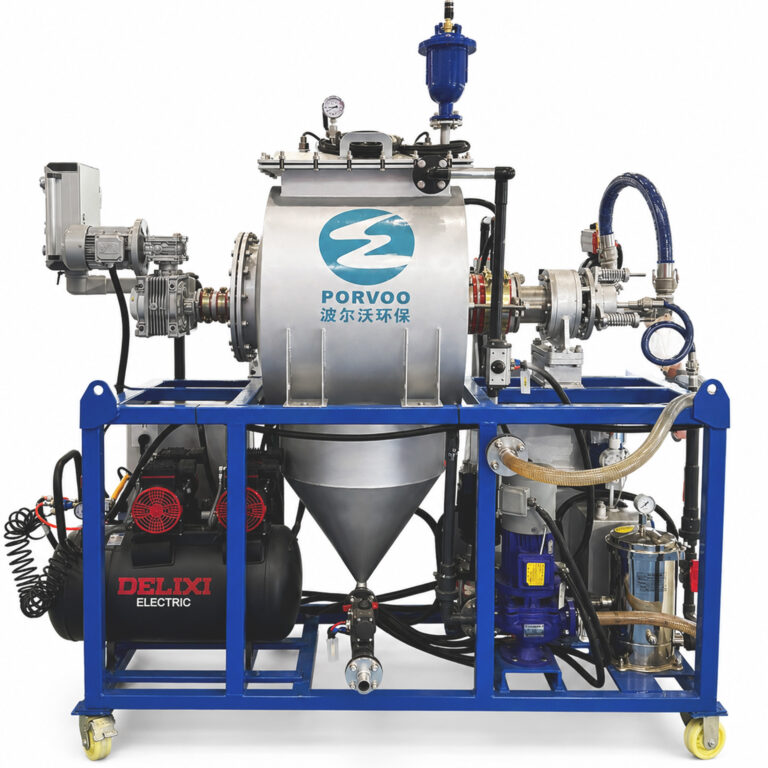
A filtro de disco de cerâmica a vácuo quotation is only as good as the data behind it. If an RFQ states a required capacity without defining the feed solids, chemistry, and variability that produced it, every bidder sizes against different assumptions, and the resulting quotes stop being comparable. Before a buyer can evaluate proposals, review supplier qualifications, or set an acceptance basis, the RFQ package itself has to carry the right information in the right form.
Describe the Process Duty and Feed Data Suppliers Must Receive
| Feed-data category | Details to include in the RFQ package |
|---|---|
| Sampling record | Sampling dates |
| Operating envelope | Operating range and temperature |
| Material definition | Solids characteristics and chemistry |
| Process variation | Variabilidade da ração |
| Upstream treatment | Any upstream conditioning |
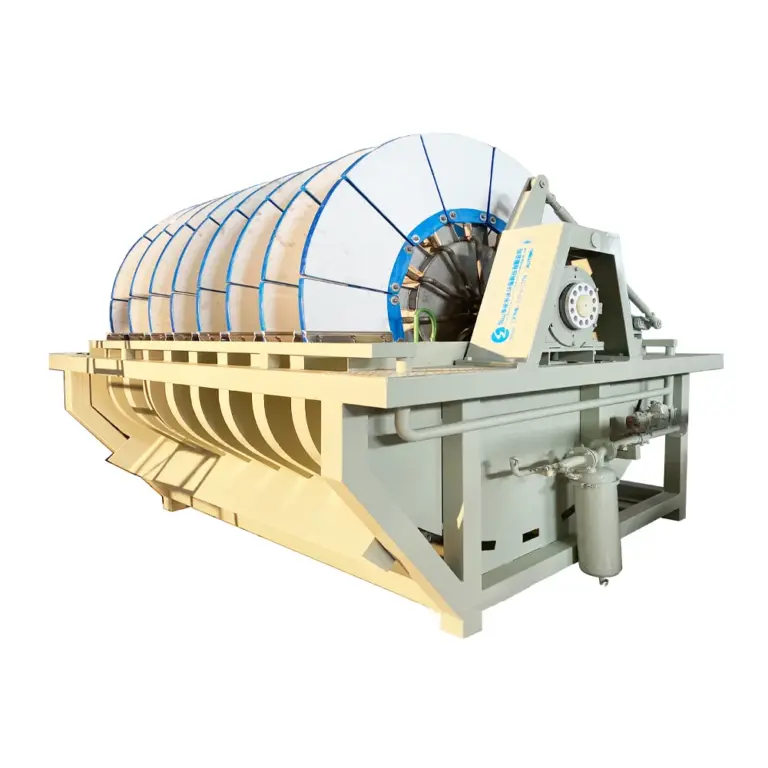
A ceramic disk filter separates solids from a slurry by drawing filtrate through a porous ceramic medium under vacuum, leaving a cake on the disk face. How well that mechanism performs on a given slurry depends entirely on the character of the feed, not on the filter alone. Two slurries with the same nominal solids content can behave completely differently across the disk depending on particle size distribution, particle shape, density, and the chemistry of the liquid phase. Where particles are fine or compressible, cake formation slows and the achievable throughput drops relative to a coarser, more rigid solid at the same solids loading. Where the liquid carries dissolved species that interact with the ceramic surface or with any flocculant used upstream, the resistance of the cake and the long-term permeability of the membrane can shift over time even if the solids themselves remain constant.
This is why a feed description based on a single analysis, taken on one day, under one operating condition, is not sufficient for a supplier to size or configure a vacuum ceramic disk filter responsibly. Slurry composition in an industrial process rarely holds constant; it moves with upstream operations, batch changes, seasonal effects, or shifts in raw material. A supplier quoting against a single data point has to assume that point is representative, and that assumption carries risk in either direction — oversizing against a worst case that rarely occurs, or undersizing against an average that understates the real variability the equipment must handle.
Upstream conditioning compounds this further. If a flocculant, coagulant, or pH adjustment is applied before the slurry reaches the filter, the feed the filter actually sees is a conditioned stream, not the raw process stream. A supplier evaluating filterability needs to know whether that conditioning is already assumed, already installed, or still to be defined, because the filter’s performance is tied to the conditioned feed’s settling and dewatering behavior, not to the untreated material’s.
Where the feed data is also time-stamped and scoped to a defined operating range, this allows the evaluation to specify a representative test substance rather than relying on the buyer’s prior equipment data or supplier averages from unrelated service experience. Decision rules for feed solids and chemistry.
State Required Outputs and Operating Conditions
| Decision area | Project input to state |
|---|---|
| Taxa de transferência | Required capacity |
| Dewatered product | Required cake condition |
| Liquid handling | Filtrate destination |
| Operating pattern | Operating schedule |
| Limpeza | Cleaning expectation |
| Test qualification | State that project targets remain subject to representative testing |
Describing the feed is only half the duty definition; the RFQ also has to state what the filter is expected to deliver, since the same feed can be processed toward different outcomes depending on what downstream handling and discharge requirements demand. A required capacity target means little on its own unless it is paired with a cake condition target, because capacity and cake dryness trade against each other in cycle time and vacuum level — pushing for a drier cake generally means a longer dwell time per cycle, which reduces throughput at a given disk area, while pushing for maximum throughput tends to leave a wetter cake. A buyer who states only one of these targets leaves the supplier to guess which side of that trade-off the project actually favors.
Filtrate destination matters for a related reason: where the filtrate returns to process, is discharged, or is further treated, its required clarity and allowable solids carryover differ, and that requirement feeds back into how the filter is configured and operated. A filtrate destined for reuse may demand a different operating point than one headed to a tolerant discharge, even on an identical feed.
Operating schedule changes the equation again. A filter running continuously across multiple shifts faces different wear, cleaning frequency, and redundancy considerations than one running intermittently or on a batch schedule tied to an upstream process. And cleaning expectation — how the ceramic membrane is restored between or during cycles — interacts with both cake condition and schedule, since a cleaning approach suited to a slurry with low fouling tendency may not hold up against a chemistry that scales or blinds the membrane faster.
None of these targets can be guaranteed from a feed description alone; they are project targets that remain subject to representative testing on the actual or a closely matched feed material. Stating them as targets, rather than as fixed performance commitments, keeps the RFQ honest about what still needs verification before an acceptance basis is set. Decision rules for stating output requirements.
Map Equipment, Utility, Control, and Site Interfaces
A vacuum ceramic disk filter does not operate in isolation; it sits inside a chain of feed buffering, vacuum generation, filtrate transfer, cake handling, controls, and the physical utilities and foundations that support all of it. Every one of these interfaces can be supplied, owned, or operated by either the equipment supplier or the buyer, and an RFQ that does not state which party covers which interface leaves each bidder free to assume differently — one bidder’s quote may include a vacuum system that another bidder’s quote excludes, and the two numbers will not be comparable even if the filter itself is identical.
Feed buffering illustrates why this matters beyond cost allocation. If the filter requires a steady, de-aerated feed at a controlled level, but the buyer’s process delivers a surging or intermittent flow, something has to absorb that difference — either a buffer tank in the supplier’s scope, one already existing in the buyer’s plant, or a control strategy that adapts the filter’s cycle to the incoming variation. Which of these applies changes the physical scope of the quotation and the control logic the filter’s automation must execute.
Vacuum services work the same way. The filter’s separation mechanism depends on the vacuum source’s capacity and reliability; if that source is shared with other equipment, or if its performance degrades under conditions the RFQ does not describe, the filter’s achievable throughput and cake dryness will not match a dedicated, well-controlled vacuum supply. Filtrate transfer and cake handling raise parallel questions: where filtrate must be pumped onward or cake must be conveyed, crushed, or bagged, the interface point between the filter’s discharge and the next piece of equipment has to be defined physically — elevation, connection type, expected consistency of material — or the downstream equipment may not be able to accept what the filter delivers.
Controls, installation, commissioning, and the utilities and foundations that support the unit all follow the same logic: each is either in supplier scope or owner scope, and stating that allocation for every interface — not just the major ones — is what lets a bid evaluation treat competing quotations as describing the same project rather than different ones.
Request Comparable Documentation, Spares, and Commercial Exclusions
| Quotation section | Disclosure needed for bid normalization |
|---|---|
| Sizing basis | Sizing assumptions |
| Scope limits | Exclusions |
| Operating items | Consumíveis |
| Support items | Spares |
| Project records | Documentação |
| Verificação | Test plan |
| Acceptance | Proposed acceptance method |
Once the feed, the targets, and the interfaces are defined, the quotations that come back still need to be read against each other rather than taken individually at face value. A quotation that states a capacity and a price without disclosing the sizing assumptions behind that capacity is not directly comparable to one that does, even if the stated numbers look similar, because the first may be sized against a favorable feed assumption and the second against a conservative one.
Exclusions work the same way in reverse: a lower quoted price can reflect narrower scope rather than better value, and the only way to tell the difference is if each bid states explicitly what it excludes — whether that is a utility connection, a control component, installation labor, or a service the buyer assumed was included. Consumables and spares deserve equally explicit treatment, since a ceramic disk filter’s ongoing operating cost and availability depend on what wears, what requires periodic replacement, and what the supplier recommends keeping on hand; a quotation silent on these items transfers that discovery cost to the buyer after award rather than before it.
Documentation and test plan disclosures matter for a related but distinct reason: they describe how the supplier intends to demonstrate that the delivered equipment meets the stated targets, and a proposed acceptance method that is vague or absent leaves the buyer with no agreed basis for resolving a dispute if field performance falls short of what was quoted. Asking each bidder to state its proposed acceptance method up front, alongside its test plan, puts that negotiation before contract award rather than after commissioning, when the buyer’s leverage is lower.
Where the inputs describing the filter’s technology and selection approach are reviewed earlier in the process, that groundwork supports interpreting what a given sizing assumption or exclusion actually implies for the project — but the quotation stage still requires each bidder to state its own assumptions in writing, because two technically sound approaches to the same duty can still differ in scope and basis in ways that only a side-by-side, itemized comparison will reveal.
Define the Test Basis, Responsibilities, and Bid Evaluation Record
| Reference | Relevant use in the RFQ | Limite da evidência |
|---|---|---|
| GB/T 30177.2-2024, Methods of Performance Testing for Filters — Part 2: Vacuum Filter | Vacuum-filter performance testing and equipment comparison | Identifies the source and its broad scope; RFQ values and acceptance obligations remain project-specific |
| ISO 10005:2018, Guidelines for Quality Plans | Quality plans, responsibilities, and verification records | Identifies the source and its broad relevance; it does not establish product performance or PORVOO certification |
The final piece of the RFQ package is the record that ties everything else together: what test basis will be used to judge performance, who is responsible for each part of that test, and how the resulting evidence feeds into the bid evaluation and eventual acceptance. GB/T 30177.2-2024, the national standard covering performance testing methods for vacuum filters, provides a reference basis for how vacuum-filter performance testing and equipment comparison can be structured; it establishes the source and its broad scope for this kind of testing, but the specific values, test conditions, and acceptance obligations for a given project remain matters the buyer and supplier must agree on directly, not something the standard itself fixes for every installation.
Separately, ISO 10005:2018, covering guidelines for quality plans, is relevant to how a project documents responsibilities and verification records — it supports structuring who does what, when, and how that work is evidenced, without itself certifying any product’s performance or establishing that a given supplier holds any particular certification. Citing a quality-plan framework in an RFQ tells bidders how their documentation should be organized; it does not substitute for the project-specific test plan each bidder must still propose.
Where responsibility for testing is split between buyer and supplier — for instance, the buyer supplying representative feed material and operating conditions, and the supplier executing the test and proposing the acceptance criteria — stating that split explicitly in the RFQ avoids a late-stage dispute over whose data counts as the basis for acceptance. Where a single party controls both the test execution and the interpretation of its results, the other party loses visibility into whether the test was representative of real operating conditions or run under a more favorable condition than the project will actually see.
The bid evaluation record itself should bring together the feed data, the stated targets, the interface allocations, the quotation disclosures, and the proposed test and acceptance basis from each bidder into one comparison. At that point, the relevant configuration details for the vacuum ceramic disk filter under evaluation — its scope, its documented sizing assumptions, and its proposed acceptance method — can be checked against the buyer’s own project requirements rather than against a generic specification sheet, which is what allows the evaluation to distinguish a bid that fits the project from one that simply quotes a lower number against a narrower or less certain scope.
Perguntas frequentes
Q: Is one feed sample enough for a vacuum ceramic disk filter quotation?
A: A single sample may not represent the full duty. Provide sampling dates, the expected operating range, solids characteristics, chemistry, temperature, feed variability, and any upstream conditioning so each supplier can state what its sizing assumes.
Q: When are capacity and cake-condition offers genuinely comparable?
A: They are comparable when suppliers price against the same required capacity, cake condition, filtrate destination, operating schedule, and cleaning expectation. Keep these as project targets subject to representative testing, and require every bidder to disclose its sizing and test assumptions.
Q: Which interface responsibilities should be settled before quotations are evaluated?
A: Assign supplier and owner responsibility for feed buffering, vacuum services, filtrate transfer, cake handling, controls, foundations, utilities, installation, and commissioning. Any unassigned interface should be clarified before price and scope comparisons are finalized.
Q: How should buyers handle exclusions that differ between bids?
A: Normalize them in one evaluation record alongside sizing assumptions, consumables, spares, documentation, test plans, and proposed acceptance methods. This shows whether a lower price reflects a true commercial difference or a narrower scope.
Q: Do the cited filter-testing and quality-plan standards define the final acceptance requirements?
A: No. They provide relevant frameworks for performance testing, responsibilities, and verification records, but the RFQ must still define the project-specific test basis, acceptance method, and obligations for each party.