How centrifugal separation works
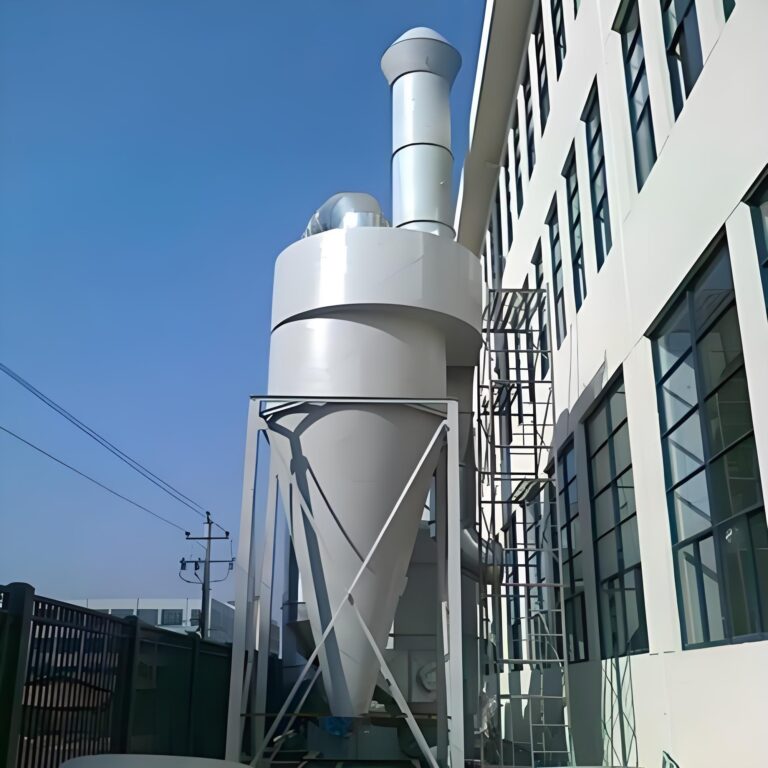
A cyclone creates a rotating gas stream. Particles with sufficient inertia move toward the wall and discharge below, while gas exits through the outlet. A cyclone is often used before a final filter to reduce coarse material loading.
Put the cyclone where it solves a defined problem
For woodworking, check coarse chips and the tendency of material to bridge at the discharge. For abrasive processes, quote inspection access and wear components. For powders that stick or must be kept separate, check whether a cyclone and its discharge arrangement can be serviced and cleaned for the duty.
Read efficiency by particle size
Request a grade-efficiency curve, which shows capture by particle size, alongside pressure drop at the stated gas flow. Specify particle distribution, concentration, density and operating conditions. A high mass efficiency on coarse dust can coexist with fine material passing downstream.
Check the equipment interfaces
Verify inlet and outlet orientation, fan pressure margin, dust discharge seal, bin access and downstream filter capacity. Confirm where the supplier measures pressure and airflow. Include duct loss and any final filter when selecting the fan.
Plan inspections around likely wear and buildup
Trend differential pressure at comparable flow and operating material. Look for changes in dust discharge as well as wear at inlet and wall surfaces with appropriate isolation. Verify process changes before adjusting maintenance intervals.
Keep collection metrics separate
Define whether acceptance concerns inlet-to-outlet removal, downstream filter loading, workplace exposure or a permitted discharge. Arrange the corresponding test for the installed train and its operating conditions.
Validate a proposed geometry change
Ask for a comparison at the same feed and pressure-loss boundary. If a supplier starts with a calculation or simulation, identify what a pilot or factory test will verify before installation.
Measure the benefit of pre-separation
For an upstream retrofit, record final filter pressure and service interval at matched duty before and after. Include the cyclone’s added fan load and the added handling required at its discharge.
Prepare a useful request for quotation
Send representative dust information, normal and peak flow, site layout, temperature and the expected downstream result. Ask the supplier to separate calculated design estimates from measured data.