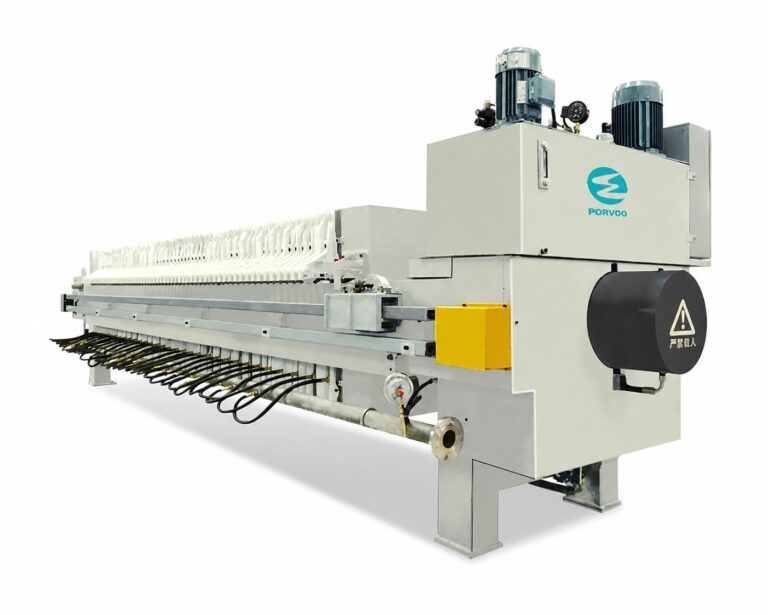
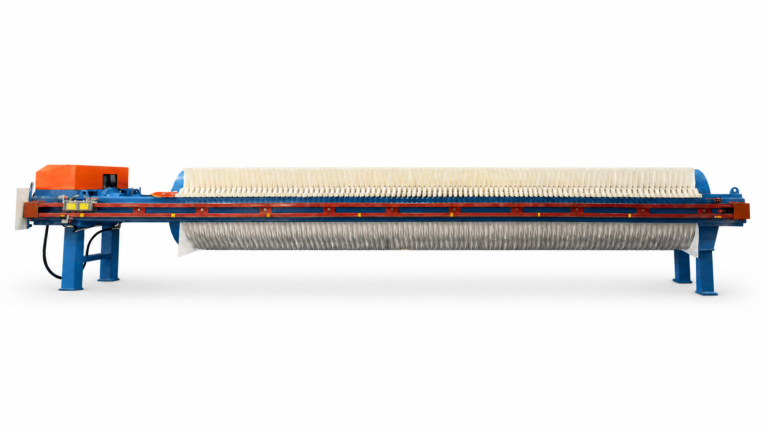
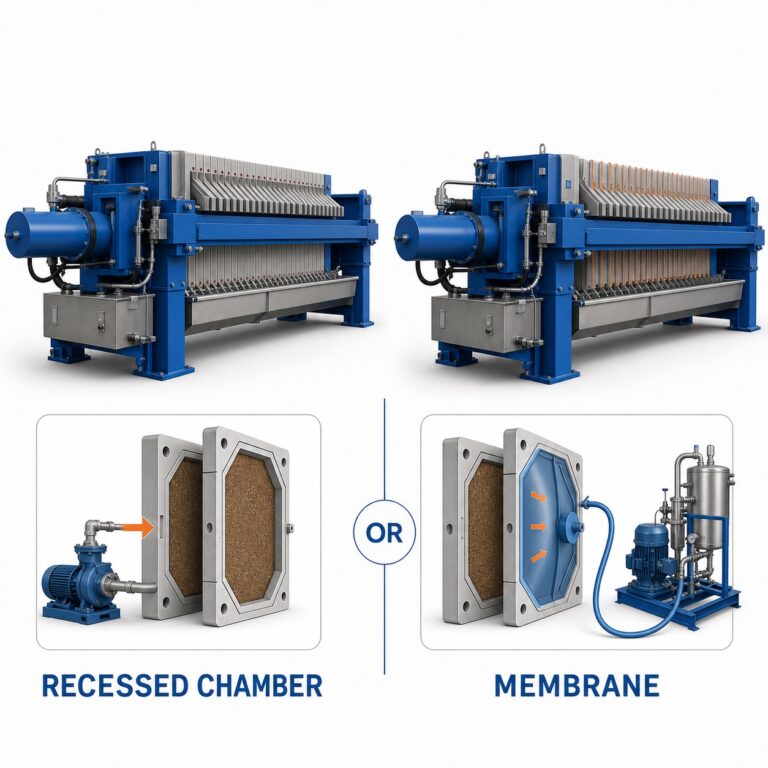
Should a filter press unload its plates by hand or through a powered shifter? The answer depends less on preference than on how much repetitive handling the duty actually creates, what the site can support in access and maintenance, and how a fault in the handling system would be recovered. Framing the decision around cake discharge and turnaround, rather than around filtration performance, keeps the comparison grounded in what plate handling is actually for.
Plate handling workload behind the automation decision
Plate handling sits at the end of the filtration cycle: once the chambers are full and the cake has formed, the plates must be separated, the cake released, and the pack closed again before the next cycle starts. This step does not change how filtration occurs inside the press. The medium, the chamber design, and the pressure cycle determine separation performance; plate handling only determines how discharge and turnaround are carried out once that cycle ends. Treating it this way keeps the automation question in its proper place, as a materials-handling and workflow decision layered onto an unchanged filtration mechanism.
The workload behind this decision comes from how the fill-and-discharge cycle repeats. Where a press runs through frequent cycles, the plate-handling step recurs at the same frequency, and whatever time, attention, and physical effort it requires is multiplied across the operating period. Where a press holds a larger number of plates, each discharge event involves moving, inspecting, and recovering a correspondingly larger sequence, even if the cycle itself happens less often. These two factors, cycle frequency and plate count, interact: a press with many plates on an infrequent cycle can present a different handling burden than a press with few plates cycling often, and the comparison has to account for both together rather than either alone.
Cake release characteristics also feed into this workload. Where cake separates cleanly from the plate surface with minimal manual assistance, the handling step is largely about moving plates and managing the released material. Where cake release requires closer attention, the handling step extends to include that intervention, regardless of whether the plate movement itself is manual or mechanized. This is one reason plate handling cannot be evaluated purely as a mechanical movement problem; it includes whatever attention the cake itself demands at each opening.
O Ficha técnica da EPA sobre tecnologia de biossólidos: prensas de filtro com placas recuadas identifies batch operation, cake discharge, and regular fill-and-unload attention as comparison dimensions for this equipment category, consistent with treating discharge as a recurring operational demand rather than an incidental step. This framing supports workload comparison; it does not establish any specific cycle time, labor figure, or discharge duration for a given project, each of which depends on the material, press configuration, and operating pattern in question.
Manual operation conditions that remain practical
Manual plate handling remains a legitimate operating choice for many duties, and the decision to keep it should rest on whether the site’s specific combination of cycle frequency, plate count, access, and staffing keeps the handling task within what operators can reasonably sustain. There is no general rule that manual handling becomes impractical past a fixed point; the practicality depends on how those factors combine at a given site.
Where cycles are infrequent and the plate count is moderate, manual unloading can be completed within the attention the site already allocates to the press, without the handling step becoming the limiting factor in the production or treatment schedule. Where cake release is clean and consistent, manual plate separation proceeds without extended intervention at each chamber, which keeps the per-cycle handling time predictable. Access matters as well: where the press location and surrounding layout allow operators to reach each plate safely and without obstruction, manual handling can proceed without added material-handling equipment or structural change to the installation.
Staffing availability is a separate condition from workload itself. A site can have a cycle frequency and plate count that are individually manageable, but if suitable staff are not available at the times discharge needs to happen, manual handling becomes harder to sustain even though the physical task itself is not unusually demanding. Conversely, a site with consistent staffing can absorb a higher handling workload than one where attention to the press competes with other duties.
Operator exposure is the condition that most directly affects whether manual handling remains acceptable independent of throughput. Repetitive manual handling of plates and cake material represents a sustained physical task, and whether that exposure is acceptable depends on the site’s own staffing model, rotation, and safety practice, not on a general industry threshold. Where exposure is judged acceptable for the duty, manual handling can remain the straightforward and lower-complexity choice, since it avoids the mechanisms, controls, and maintenance obligations that come with powered plate shifting. Where exposure, staffing, or access conditions shift, the same duty can move from one where manual handling is practical to one where it is not, without any change to the filtration process itself.
Automated shifter scope, controls and recovery provisions
| Scope item | Definition required for the offered configuration | Limite de decisão |
|---|---|---|
| Shifter sequence | The exact plate-handling sequence and how it fits cake discharge and turnaround | Shows which handling steps are automated; filtration itself is unchanged |
| Mechanisms, controls and sensors | The mechanisms, controls and sensors included in the offered shifter | Prevents an assumed automatic feature from being treated as included scope |
| Guarding | The exact guarding associated with the moving plate-handling system | Supports machinery risk review but does not by itself establish conformity |
| Intertravamentos | The exact interlocks included and the conditions they address | Defines the offered control boundary rather than an assumed protection package |
| Maintenance access | How the added mechanisms, controls and sensors can be reached for maintenance | Tests whether the site can support the automatic system through its lifecycle |
| Manual recovery | The exact manual recovery path when the shifter or its controls cannot complete the sequence | Shows how a fault can be recovered and how that recovery affects downtime |
Um câmbio automático de placas addresses the handling step itself; it does not change the filtration mechanism, and it does not remove the need for cake discharge and turnaround to happen correctly at each cycle. What it changes is who or what performs the repetitive movement, and that shift introduces a new set of elements that must be defined precisely for the offered configuration rather than assumed from the word “automatic.”
The starting point is the shifter sequence: the exact order in which plates are separated, moved, and returned, and how that sequence integrates with cake discharge and the turnaround between cycles. This sequence determines which parts of the handling task are mechanized and which, if any, remain manual within an otherwise automated system. A configuration described as automatic can still include manual steps at specific points in the sequence, and the buyer needs the sequence defined rather than inferred.
Behind that sequence are the mechanisms, controls, and sensors that carry it out. These are the physical and control elements that replace manual effort, and their scope is specific to the offered configuration rather than standard across all automatic presses. Assuming a feature is included because it is common in the category, rather than confirming it for the specific offer, is the kind of gap that creates mismatch between what the buyer expects and what is actually supplied.
Guarding and interlocks follow from the fact that a shifter introduces moving machinery where manual handling previously involved only the operator’s own actions. ISO 12100 provides a general methodology for identifying machinery hazards, evaluating risk, and documenting risk reduction; it supports the kind of risk review a guarding and interlock package should be able to withstand, but it does not, by itself, establish that a named machine or supplier configuration conforms to it. The buyer still needs the exact guarding and interlocks defined for the offered equipment, and the conditions under which each interlock acts, rather than treating a general safety framework as a substitute for that definition.
Maintenance access and manual recovery close the scope question. Added mechanisms, controls, and sensors require their own access for inspection and service, and the site needs to confirm it can support that access over the system’s working life, not only at commissioning. Equally, every automated sequence has conditions under which it cannot complete as designed, and the manual recovery path for that situation, how the plates and cake are handled when the shifter or its controls do not finish the sequence, determines how a fault translates into downtime. A shifter without a defined recovery path converts a mechanical fault into an unplanned handling problem at the worst possible moment in the cycle.
Access, guarding and maintenance implications
The implications of adding a plate shifter extend beyond the device itself into how the press area is arranged and maintained. Introducing powered handling equipment changes the space around the press: guarding has to occupy physical area without blocking the access operators need for other press-related tasks, and the layout has to accommodate both the shifter’s working envelope and the clearance needed to reach it for maintenance.
This creates a layout condition that manual handling does not impose in the same way. Where handling is manual, the access requirement is largely about operator reach and safe working space around the plate pack. Where handling is automated, the access requirement doubles: the shifter needs its own working space to move plates, and the maintenance team needs separate access to the mechanisms, controls, and sensors that make that movement possible. A site with layout constraints that comfortably accommodate manual access may not, without modification, accommodate the added envelope a shifter and its guarding require.
Guarding, in turn, interacts with maintenance access rather than existing independently of it. Guarding that fully encloses the moving plate-handling system protects against contact with that machinery, but it also restricts how maintenance staff reach the same mechanisms when service is needed. A configuration with guarding defined only for operational conditions, and not also for maintenance conditions, can leave maintenance staff working around or through guarding in ways that were not part of its original risk reduction intent. This is a specification question, not a general objection to guarding: the buyer needs to confirm that guarding and maintenance access were considered together for the offered system.
Interlocks extend this same logic into the control domain. An interlock that prevents operation under defined conditions is only as useful as the precision with which those conditions are specified, and the same interlock set that protects normal operation may or may not address the conditions that arise during maintenance or fault recovery. Where interlocks are defined broadly, they may halt the system under maintenance conditions in ways that complicate service rather than supporting it; where they are defined narrowly, they may fail to address a condition the maintenance team encounters. Either outcome depends on documentation the buyer has to obtain rather than infer, since the appropriate balance differs by site and by how maintenance work is organized there.
A duty-based choice to record in the specification
| Duty factor | When manual handling can remain practical | What to establish before selecting an automatic shifter |
|---|---|---|
| Frequência do ciclo | The expected frequency keeps regular fill-and-unload attention acceptable for the site | Whether repetitive plate handling is a material turnaround or workload issue |
| Plate count | The offered plate count remains manageable with the site’s staffing and access | Whether the offered plate count makes repetitive handling a material operating burden |
| Cake release and turnaround | Cake release and the resulting manual turnaround are acceptable for the duty | Whether mechanized plate movement improves the handling step while recognizing that it does not change filtration |
| Staffing and operator exposure | Suitable staffing is available and the expected handling exposure is acceptable | Whether reduced repetitive handling provides enough operating value for the duty |
| Access and maintenance support | The site can provide the access and attention needed for manual unloading | Whether the site can support the added mechanisms, controls, sensors and maintenance access |
| Fault recovery and downtime | The manual route fits the site’s downtime consequences and operating arrangements | Whether the defined manual recovery path and lifecycle support fit the site’s downtime consequences |
The choice between manual and automatic plate handling is a duty-based judgment, not a default setting tied to press size or industry sector. The conditions that keep manual handling practical, cycle frequency, plate count, cake release behavior, staffing, access, and acceptable operator exposure, can combine differently across sites that otherwise look similar on paper, and the same set of conditions can shift over the life of an installation as production volumes or staffing arrangements change.
Where cycle frequency is low, plate count is moderate, cake release is consistent, and staffing and access support manual unloading without strain, manual handling remains a reasonable specification choice, carrying lower mechanical complexity and fewer maintenance obligations than a powered alternative. Where cycle frequency or plate count make repetitive handling a material turnaround issue, where operator exposure to that repetition is judged unacceptable for the site, or where the site can support the added mechanisms, controls, sensors, and maintenance access that automation requires, evaluating an automatic shifter becomes the appropriate next step. The evaluation itself should not assume that mechanized plate movement resolves the handling question on its own; it only addresses the movement step, and its value still depends on how well the rest of the sequence, guarding, interlocks, and recovery path are defined for the offered configuration.
Fault recovery and downtime consequences belong in this same judgment. A site that cannot tolerate extended downtime from a stalled handling sequence needs the manual recovery path and the lifecycle support behind the automatic system confirmed before selection, not after installation. A site with more flexible downtime tolerance may weigh that risk differently against the handling relief that automation offers.
This is the specification point where the project information the buyer supplies, duty details, staffing patterns, site layout, and downtime tolerance, enters Porvoo’s configuration and quotation review, since the appropriate plate-and-frame ou fully automatic configuration follows from those conditions rather than from the press category alone. Recording the duty factors explicitly in the specification, rather than defaulting to automatic because the feature exists or to manual because it is simpler, keeps the choice traceable to the operating conditions that justified it, and gives the buyer a basis for revisiting that choice if those conditions change.
Perguntas frequentes
Q: Will automatic plate handling improve filtration performance?
A: Do not select it on that assumption. An automatic shifter changes the plate-handling step during cake discharge and turnaround; it does not change the filtration mechanism. Evaluate its value through workload, operator exposure, turnaround demands, and downtime consequences.
Q: What operating information should be prepared before requesting a plate-handling proposal?
A: Record the expected cycle frequency, offered plate count, cake-release behavior, staffing arrangement, available access, and consequences of delayed unloading. These facts let the supplier define the handling sequence and let the buyer judge whether reduced repetitive handling offsets the added mechanisms and support needs.
Q: Can a manual press be upgraded with an automatic plate shifter later?
A: Treat future upgradeability as a configuration-specific question rather than an assumed option. Before choosing a manual route, verify whether the offered press can accept the required shifter, controls, sensors, guarding, interlocks, maintenance access, and recovery provisions later.
Q: What should the project define for an automatic-shifter fault?
A: Define the exact manual recovery path before purchase. The proposal should state how an incomplete sequence is recognized, which parts of the offered system are involved, what access the recovery needs, and how the resulting delay fits the site’s downtime consequences.
Q: Does automatic plate handling make a filter press inherently safer?
A: It can reduce repetitive manual handling, but the added moving mechanisms create their own risk-review needs. Compare operator exposure for both routes and assess the offered guarding, interlocks, access, and recovery arrangement; the presence of automation alone does not establish machinery conformity.