A seleção da mesa correta para o downdraft é uma decisão crítica de engenharia, não uma simples compra. O erro mais comum e caro é presumir que o tamanho de uma mesa determina seu desempenho. Para uma mesa 3×4, o fluxo de ar necessário (CFM) pode variar em mais de 300%, dependendo inteiramente do processo de trabalho. Um sistema de baixa potência cria uma perigosa ilusão de segurança, deixando partículas perigosas na zona de respiração do operador.
Essa variação não é arbitrária; ela é ditada pela física fundamental dos contaminantes. As faíscas quentes e de alta velocidade da retificação de metais se comportam de maneira totalmente diferente da poeira densa e fria do polimento de pedras. Entender essa distinção é o primeiro passo para especificar um sistema que forneça uma captura genuína da fonte, proteja a saúde do trabalhador e garanta a conformidade regulamentar. O cálculo incorreto do CFM compromete todo o investimento.
Lixamento de metais vs. polimento de pedras: diferenças no fluxo de ar do núcleo
Definição do desafio dos contaminantes
O CFM necessário não tem a ver com a mesa - tem a ver com o que você coloca nela. A principal distinção está na energia e no comportamento dos poluentes gerados. O esmerilhamento de metais com rebolos abrasivos produz faíscas quentes e partículas finas ejetadas com força significativa, muitas vezes acompanhadas de plumas térmicas flutuantes. A captura desses perigos de movimento rápido exige uma força de tração para baixo poderosa e agressiva. Por outro lado, o polimento de pedras gera uma poeira mais densa e fria com menos energia inicial de projétil; as partículas são mais pesadas e tendem a se depositar mais prontamente.
Impacto no aplicativo e no desempenho
Essa diferença física determina uma enorme divergência nos requisitos do sistema. Um sistema projetado para pó de pedra falhará catastroficamente em uma aplicação de moagem de metal, permitindo a saída de fumaça e faíscas perigosas. Os especialistas do setor observam constantemente que a especificação principal deve ser o CFM necessário para capturar com segurança o particulado específico, pois a seleção baseada apenas nas dimensões da tabela é um erro fundamental de engenharia. Isso afeta diretamente os protocolos de segurança e a responsabilidade.
A comparação direta
A variação no comportamento dos contaminantes se traduz diretamente em uma ampla gama de desempenho necessário. Esta tabela resume as diferenças de fluxo de ar central para uma mesa 3×4 padrão:
| Processo | Contaminante principal | Faixa de CFM necessária (tabela 3×4) |
|---|---|---|
| Retificação de metais | Faíscas quentes, poeira fina | 2.400 - 4.800 CFM |
| Polimento de pedras | Poeira fria e densa | 1.200 - 2.400 CFM |
| Trabalho agressivo com metais | Partículas de alta velocidade | Até 5.000+ CFM |
| Acabamento com pedras claras | Assentamento de poeira | ~1.200 CFM |
Fonte: Documentação técnica e especificações do setor.
Cálculo principal: Fórmula CFM para uma mesa de tiragem baixa 3×4
A fórmula universal de engenharia
O fluxo de ar necessário é determinado por uma fórmula simples: CFM = Área da mesa (pés quadrados) × Velocidade da face (pés/min). Para uma mesa de 3 pés por 4 pés, a área de sucção ativa é de 12 pés quadrados. Esse cálculo não é negociável para o projeto adequado do sistema. A variável Velocidade da face (FPM) - a velocidade com que o ar é puxado para baixo através da superfície perfurada - é a verdadeira referência de desempenho, e não apenas o CFM. A captação eficaz depende da obtenção de velocidade suficiente em toda a superfície de trabalho.
Aplicação das variáveis
A etapa crítica é selecionar a velocidade facial correta com base em seu processo de trabalho. A poeira geral pode exigir um mínimo, mas os materiais perigosos exigem taxas significativamente mais altas. De acordo com diretrizes fundamentais como a Ventilação industrial da ACGIH: Um Manual de Práticas Recomendadas, A velocidade de captura deve ser escolhida para superar a energia do poluente gerado. Os compradores devem, portanto, calcular ou verificar a velocidade de face que um sistema fornece para o tamanho específico de sua mesa.
A estrutura de cálculo
Os componentes da fórmula se dividem da seguinte forma. Em minha experiência, ignorar a variável de velocidade de face é onde ocorre a maioria dos erros de especificação, levando a instalações de baixo desempenho.
| Variável | Valor / Faixa | Unidade |
|---|---|---|
| Área da tabela | 12 | pés quadrados |
| Velocidade da face (poeira geral) | Mínimo de 100 | FPM |
| Velocidade de face (perigosa) | >100 | FPM |
| Fórmula CFM | Área × Velocidade | CFM |
Fonte: Ventilação industrial da ACGIH: Um Manual de Práticas Recomendadas. Este manual fornece os princípios básicos de engenharia para o cálculo das taxas de fluxo de ar necessárias (CFM) com base na área da mesa e na velocidade de captura necessária para o controle de contaminantes.
Comparação da velocidade da face: Captura de faíscas pesadas versus captura de poeira fina
Requisitos de velocidade por processo
A natureza do trabalho determina a velocidade de face necessária. Para esmerilhamento e soldagem de metais, a corrente de ar descendente deve neutralizar a forte elevação térmica ascendente e a velocidade lateral das partículas. Isso normalmente requer uma faixa de velocidade de face de 150-400 FPM. A extremidade mais alta (300-400 FPM) é essencial para a captura de poeira metálica fina e fumaça de soldagem, que são particularmente perigosas. Para polimento de pedras e acabamentos semelhantes, o desafio de captura é menos intenso. Uma faixa de velocidade moderada de 100-200 FPM geralmente é suficiente.
Definição do desafio de captura
Essa divergência destaca a bifurcação do mercado. Os sistemas projetados para a captura geral de materiais benignos são fundamentalmente diferentes dos sistemas projetados para aplicações em processos industriais perigosos. A tentativa de usar um sistema de baixa velocidade projetado para pó de pedra na moagem de metais acarreta uma responsabilidade regulamentar e de segurança significativa, pois ele não consegue superar a energia das faíscas e da fumaça.
Um guia para as velocidades necessárias
A velocidade de face necessária é a base de um projeto eficaz. Essa comparação esclarece os padrões para diferentes aplicações:
| Aplicativo | Velocidade de face necessária | Desafio de captura |
|---|---|---|
| Esmerilhamento/soldagem de metais | 150 - 400 FPM | Elevação térmica, velocidade da partícula |
| Poeira metálica fina/fumaça de solda | 300 - 400 FPM | Partículas perigosas submicrônicas |
| Polimento de pedras (Powered) | 100 - 200 FPM | Poeira fria e mais pesada |
| Acabamento manual leve | ~100 FPM | Energia mínima do projétil |
Fonte: Documentação técnica e especificações do setor.
Requisitos de CFM: Comparação direta para metal e pedra
Cálculo dos intervalos
A aplicação da fórmula com os diferentes requisitos de velocidade revela a diferença substancial de desempenho. Para Retificação de metais, Se a velocidade de ponta for de 400 FPM, o requisito será de 4.800 CFM (12 pés quadrados × 400 FPM). Uma velocidade de faixa inferior de 200 FPM ainda requer 2.400 CFM. Para Polimento de pedras, Para o polimento elétrico a 200 FPM, são necessários 2.400 CFM, enquanto o acabamento leve a 100 FPM requer apenas 1.200 CFM.
Implicações para a seleção do sistema
Em resumo, a retificação de metais exige 2.400 - 4.800 CFM, enquanto o polimento de pedras normalmente requer 1.200 - 2.400 CFM. Essas faixas calculadas se alinham às especificações de produtos industriais e ressaltam que as operações devem se autoclassificar com base no perfil de risco. Além disso, para poeiras explosivas, como alumínio ou titânio, a filtragem seca padrão é insuficiente. Isso exige uma tecnologia especializada de coleta úmida para atender aos códigos da NFPA e eliminar o risco catastrófico de incêndio, uma consideração crítica que muitas vezes é revelada tarde demais no processo de aquisição.
Necessidades de CFM lado a lado
Essa comparação direta quantifica a decisão. A seleção da coluna correta é o primeiro passo em direção a um espaço de trabalho seguro e em conformidade.
| Processo | Velocidade da face (FPM) | CFM necessário (12 pés quadrados) |
|---|---|---|
| Retificação de metais (alta) | 400 | 4,800 |
| Esmerilhamento de metais (baixo) | 200 | 2,400 |
| Polimento de pedras (Powered) | 200 | 2,400 |
| Polimento de pedras (leve) | 100 | 1,200 |
Fonte: Documentação técnica e especificações do setor.
Custo do sistema e implicações de dimensionamento de diferentes necessidades de CFM
A principal desvantagem: integrado vs. com duto
O requisito de CFM determina diretamente a escala, o tipo e o custo do sistema de extração. Isso representa uma troca essencial entre dois projetos principais. As mesas autônomas com sopradores integrados geralmente são classificadas para 2.000 a 5.000 CFM, oferecendo mobilidade plug-and-play a um custo inicial mais alto. As mesas passivas com dutos dependem de um coletor externo, exigindo mais de 1.200 a 1.500 CFM de um sistema central, o que aproveita a infraestrutura existente da loja, mas aumenta a complexidade dos dutos.
A realidade “Personalizado é padrão
A tendência de suprimentos industriais mostra que as mesas prontas para uso frequentemente não atendem às necessidades específicas do mundo real. Isso faz com que a personalização - como grelhas resistentes a faíscas, cortinas de ventilação lateral ou filtragem especializada - deixe de ser uma exceção e passe a ser uma expectativa comum. A aquisição deve, portanto, incluir uma avaliação das necessidades de acessórios; a mesa básica geralmente é apenas o ponto de partida para uma solução completa de estação de trabalho.
Mapeamento do CFM para a arquitetura do sistema
Sua meta de CFM o direcionará para uma arquitetura de sistema específica. Compreender essas implicações antecipadamente evita redesenhos dispendiosos.
| Tipo de sistema | Faixa típica de CFM | Principais considerações |
|---|---|---|
| Mesa autônoma | 2.000 - 5.000 CFM | Custo inicial mais alto |
| Mesa com dutos (passiva) | 1.200 - 1.500+ CFM | Requer coletor externo |
| Soluções personalizadas | Varia muito | Acessórios geralmente essenciais |
| Alavancagem do sistema central | Depende da infraestrutura | Complexidade da tubulação |
Fonte: Documentação técnica e especificações do setor.
Fatores técnicos: Pressão estática e impacto da filtragem
A realidade da curva de desempenho
O CFM calculado representa o fluxo de ar necessário na superfície da mesa. O coletor de pó ou o soprador deve produzir esse CFM contra a pressão estática (SP) do sistema - a resistência dos filtros, do duto e da geometria interna da mesa. Um soprador classificado para 3.000 CFM em ar livre fornecerá uma quantidade significativamente menor quando conectado a uma mesa filtrada. Você deve consultar a curva de desempenho do fabricante para garantir que o soprador possa fornecer o CFM necessário na pressão estática operacional esperada.
O vínculo da manutenção com o desempenho
Filtros muito carregados aumentam a resistência, o que reduz a CFM efetiva e a velocidade de captura. Portanto, a manutenção regular do filtro não é apenas uma tarefa de limpeza; ela é essencial para manter o desempenho de segurança para o qual o sistema foi projetado. Essa realidade técnica sustenta o custo total de propriedade, que se estende muito além da compra inicial.
Fatores de custo do ciclo de vida
Os principais custos operacionais estão diretamente ligados a esses fatores técnicos. Uma análise do custo do ciclo de vida é essencial para um orçamento preciso de longo prazo.
| Fator | Impacto no desempenho | Link de manutenção |
|---|---|---|
| Carregamento do filtro | Aumenta a pressão estática | Reduz o CFM efetivo |
| Alta pressão estática | Diminui a saída CFM do soprador | Limpeza regular é fundamental |
| Filtros de sistema seco | Gerador de custo de reposição | Fator de custo do ciclo de vida |
| Sistema úmido (poeira explosiva) | Elimina o risco de incêndio | Tratamento de água necessário |
Fonte: Ventilação industrial da ACGIH: Um Manual de Práticas Recomendadas. O manual aborda fatores de projeto do sistema, como pressão estática e filtragem, que afetam diretamente o CFM fornecido e o custo total de propriedade dos sistemas de ventilação.
Otimização do desempenho: Obstruções e manutenção da peça de trabalho
O problema da obstrução
Para atingir a velocidade de face projetada, é necessário manter uma superfície de trabalho limpa e perfurada. Peças de trabalho grandes podem obstruir o fluxo de ar, criando zonas mortas onde a captura falha. Alguns projetos avançados de mesas apresentam fundos em V internos ou defletores estratégicos para direcionar o fluxo de ar com mais eficiência ao redor dessas obstruções, um detalhe que separa as mesas básicas das soluções projetadas.
Integração da segurança ao fluxo de trabalho
Esse foco em manter o desempenho no mundo real reflete uma tendência mais ampla em que o equipamento de segurança é integrado à ergonomia do fluxo de trabalho. Recursos como alturas ajustáveis, áreas de trabalho contidas e controles convenientes transformam as mesas de aspiração descendente de simples aspiradores em estações de trabalho preferidas. Isso melhora o ROI de segurança a longo prazo, tornando o sistema uma parte conveniente do processo, e não um obstáculo incômodo a ser contornado.
O Protocolo de Manutenção Crítica
A limpeza ou substituição consistente do filtro é a tarefa de manutenção mais importante para controlar a pressão estática e preservar a CFM. Observamos que as instalações com protocolos de manutenção programados e documentados têm uma eficiência de captura consistentemente mais alta e custos operacionais de longo prazo mais baixos em comparação com aquelas que usam limpeza reativa e conforme a necessidade.
Escolhendo o sistema certo: Uma estrutura de decisão para compradores
Um processo de seleção estruturado
A seleção do sistema correto requer uma abordagem estruturada e baseada em riscos. Primeiro, identifique o contaminante primário (faíscas quentes, poeira fina, pó explosivo) para determinar a faixa de velocidade facial necessária. Em segundo lugar, calcule o CFM necessário para o tamanho de sua mesa. Terceiro, decida entre um sistema autônomo ou com dutos com base nas necessidades de mobilidade e na infraestrutura existente. Isso reflete os princípios descritos em padrões como ANSI/ASSP Z9.5-2022 Ventilação de laboratório, que enfatizam os requisitos de fluxo de ar calculados com base no controle de riscos.
Verificação de desempenho e conformidade
Quarto, verifique se a curva de desempenho do soprador pode fornecer o CFM necessário na pressão estática esperada do sistema. Em quinto lugar, especifique a mídia de filtragem - resistente a fagulhas para metais, HEPA para sílica fina - com base no risco. Por fim, trate a conformidade com a OSHA e a NFPA não como uma reflexão tardia, mas como um fator primordial. Para os compradores industriais, a tabela é um ativo de conformidade, tornando os dados de desempenho certificados e os recursos de segurança inegociáveis.
A estrutura de decisão em ação
Seguir uma estrutura comprovada reduz os riscos. Este guia passo a passo garante que todos os fatores críticos sejam considerados.
| Etapa | Pergunta principal | Entrada/Saída de chave |
|---|---|---|
| 1. Identificar o contaminante | Faíscas quentes ou poeira fria? | Faixa de velocidade da face |
| 2. Calcular a necessidade | Área da mesa × velocidade? | CFM necessário |
| 3. Selecione o tipo de sistema | Móvel ou com duto central? | Autônomo vs. passivo |
| 4. Verificar o desempenho do soprador | CFM na pressão do sistema? | Curva de desempenho do fabricante |
| 5. Especifique a filtragem | Resistente a faíscas ou HEPA? | Mídia para tipo de perigo |
Fonte: ANSI/ASSP Z9.5-2022 Ventilação de laboratório. Essa norma exemplifica a abordagem estruturada e baseada em riscos para a seleção do sistema de ventilação, enfatizando os requisitos de fluxo de ar calculados e a tecnologia de controle apropriada, princípios diretamente aplicáveis à aquisição de mesas de downdraft.
Sua especificação deve começar com o contaminante, não com o equipamento. Calcule o CFM necessário com base na velocidade da face e na área da mesa e, em seguida, selecione um sistema cujo desempenho verificado atenda a essa meta na pressão estática de sua oficina. Considere os custos totais do ciclo de vida, incluindo filtragem e energia. Essa abordagem disciplinada garante que o seu investimento realmente controle o perigo.
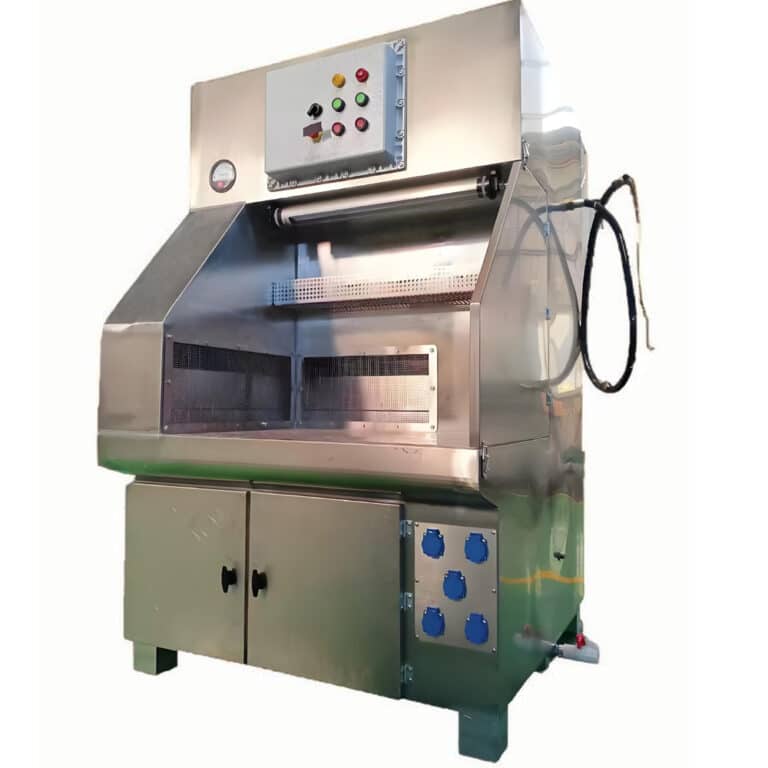
Precisa de uma solução profissional projetada para sua aplicação específica de retificação de metais ou polimento de pedras? PORVOO oferece mesas de fluxo descendente específicas para cada aplicação, projetadas para atender aos requisitos de CFM e velocidade de face calculados para uma captura de fonte segura e em conformidade. Consulte as especificações técnicas de nossas mesas de esmerilhamento industrial downdraft para informar sua próxima especificação. Para uma consulta detalhada, você também pode Entre em contato conosco.
Perguntas frequentes
P: Como você calcula o CFM necessário para uma mesa de tiragem baixa 3×4?
R: Você calcula o CFM necessário multiplicando a área da superfície da mesa pela velocidade da face necessária (CFM = Área (pés quadrados) x Velocidade da face (FPM)). Para uma mesa padrão de 3’x4′ (12 pés quadrados), a velocidade da face é a variável crítica. Essa velocidade deve ser alta o suficiente para superar a energia do contaminante específico, como faíscas ou poeira. Isso significa que você deve primeiro determinar a velocidade de face correta para o seu processo antes de dimensionar o soprador ou o coletor do seu sistema.
P: Qual é a velocidade de face necessária para capturar faíscas de esmerilhamento de metal versus poeira de polimento de pedra?
R: O esmerilhamento de metais requer uma velocidade de face entre 150 e 400 pés por minuto para neutralizar a forte elevação térmica e a alta velocidade das partículas. Para o polimento de pedras, em que a poeira é mais pesada e menos energética, uma velocidade moderada de 100 a 200 FPM é normalmente suficiente. Essa grande diferença no desempenho do fluxo de ar exigido determina que os sistemas não sejam intercambiáveis entre essas aplicações. Se a sua oficina realiza os dois processos, provavelmente precisará de soluções de captura separadas e específicas para cada aplicação para atender aos padrões de segurança.
P: Por que o esmerilhamento de metais exige um CFM muito maior do que o trabalho com pedras em uma mesa do mesmo tamanho?
R: O requisito de CFM é diretamente determinado pela maior velocidade de face necessária para capturar contaminantes de metal. Para uma mesa de 12 pés quadrados, o esmerilhamento agressivo de metais a 400 FPM exige 4.800 CFM, enquanto o polimento de pedras leves a 100 FPM exige apenas 1.200 CFM. Essa variação substancial decorre do comportamento físico das faíscas quentes e de movimento rápido em comparação com a poeira mais fria e sedimentada. Isso significa que a escolha de uma mesa de sucção descendente com base apenas em suas dimensões físicas provavelmente resultará em um sistema de baixa potência e inseguro para tarefas de metalurgia.
P: Como a pressão estática e a filtragem afetam o desempenho real de um sistema de tiragem descendente?
R: O CFM nominal de um soprador é medido em ar livre; a resistência do sistema de filtros e dutos reduz o fluxo de ar fornecido. À medida que os filtros são carregados com partículas, a pressão estática aumenta, o que pode reduzir drasticamente a velocidade de face na superfície da mesa abaixo do limite de captura. Portanto, a manutenção regular é um requisito de desempenho, não apenas uma tarefa de limpeza. Para operações com cargas pesadas de particulados, é preciso planejar custos de energia mais altos e trocas de filtro mais frequentes para manter a captura efetiva durante o ciclo de vida do sistema.
P: Quais são as principais diferenças entre uma mesa de fluxo descendente autônoma e uma mesa passiva com duto?
R: Uma unidade autônoma tem um soprador integrado, oferecendo mobilidade plug-and-play a um custo inicial mais alto, normalmente classificado para 2.000 a 5.000 CFM. Uma mesa passiva com dutos depende de um coletor externo, exigindo que você dimensione seu sistema central para fornecer mais de 1.200 a 1.500 CFM a essa estação. A escolha depende do equilíbrio entre as necessidades de mobilidade e a capacidade de aproveitar a infraestrutura de ar da loja existente. Isso significa que as instalações com estações de trabalho fixas e coleta central podem otimizar o custo com mesas com dutos, enquanto as oficinas de trabalho se beneficiam de unidades móveis e autônomas.
P: Quais fatores de conformidade e segurança devem orientar a seleção de uma mesa downdraft para uso industrial?
R: A seleção deve ser orientada pelo risco específico: use componentes resistentes a faíscas para metais, filtragem HEPA para pó de sílica e coleta úmida para pós explosivos, como o alumínio, para atender a Códigos NFPA. Trate os limites de exposição da OSHA e os padrões de consenso relevantes, como o Manual de Ventilação Industrial da ACGIH como critérios primários de projeto, e não verificações secundárias. Essa abordagem garante que a mesa funcione como um ativo de conformidade verificado, tornando os dados de desempenho certificados do fabricante um requisito inegociável para sua compra.
P: Como peças de trabalho grandes ou manutenção deficiente podem criar lacunas de segurança em um sistema de tiragem descendente dimensionado corretamente?
R: Itens grandes colocados na grade da mesa podem obstruir o fluxo de ar, criando zonas mortas em que a velocidade de captura cai para zero. Além disso, a manutenção negligenciada do filtro aumenta a pressão estática do sistema, o que reduz a CFM efetiva e a velocidade da face em toda a superfície. O desempenho depende da manutenção de uma área de trabalho desobstruída e perfurada e de um caminho de filtragem limpo. Isso significa que é necessário integrar os protocolos de uso e manutenção da mesa aos procedimentos operacionais padrão para garantir que os controles de segurança projetados funcionem diariamente como previsto.