A grinding operation rarely produces dust from one fixed point in one fixed direction. The wheel or belt moves, the operator repositions the workpiece, and the contact point shifts through the task — which means a capture layout chosen from a single snapshot of the process can miss the source entirely once real work resumes. Before a plant engineer discusses a downdraft table, side hood, or any alternative arrangement with a supplier, the task itself has to be documented as it actually runs, not as it is assumed to run.
Start With the Real Grinding Motion
Hood selection depends on matching the capture arrangement to the process, the source, the production pattern, and how the operator actually performs the work — this is the basis Orientação da HSE sobre ventilação por exaustão local (HSG258) sets out, alongside the need to understand the contaminant cloud’s size, speed, and direction before any layout is proposed. That means the audit cannot start from a hood catalog or an airflow figure. It starts from watching the tool.
Tool type sets the general character of the source: a wheel produces a different contact geometry than a belt, and a fixed bench operation differs from a handheld one. But type alone does not fix the layout question. What matters is where the working stroke travels, how far that stroke ranges across the workpiece, and whether the contact point stays in one place or migrates as material is removed. A task that holds a single contact point for its duration presents a different capture problem than one where the operator repositions the workpiece repeatedly to reach different faces or edges.
Workpiece orientation compounds this. If the same task is performed with the workpiece held flat, angled, or rotated depending on what is being ground, the source path changes shape each time the orientation changes, even though the tool and operator remain the same. A layout that suits one orientation may leave another orientation’s contact point outside the intended capture zone.
Operator position has to be recorded alongside the tool motion, not separately from it, because the stance and reach the task requires will later determine whether any proposed hood placement keeps the operator’s breathing zone outside the contaminated path. None of this produces an airflow value or a hood recommendation at this stage — it produces the record a supplier needs to interpret before either can be discussed.
| Audit item | What to document | Why it changes the layout question |
|---|---|---|
| Tool movement | Direction and range of the working stroke | Shows whether the source path is fixed or moving |
| Contact point | Where the tool meets the workpiece through the task | Defines the changing working zone |
| Dust or swarf travel | Observed direction at representative positions | Shows whether a receiving direction is stable |
| Workpiece orientation | Orientations actually used | Reveals whether the source path changes with handling |
| Operator position | Normal stance and necessary reach | Checks whether contaminated air could cross the breathing zone |
Trace the Dust Stream Before Choosing the Hood Direction
Once the motion is documented, the next judgment is whether the dust stream itself has a stable direction. HSE distinguishes receiving hoods, which rely on a process-generated direction the contaminant already travels in, from capturing hoods, which must generate their own airflow to draw the contaminant toward them because no reliable natural direction exists. CCOHS adds that natural contaminant movement and the grinding wheel’s own motion affect where a hood should be placed. This distinction is the hinge the whole layout decision turns on, and it cannot be resolved from the motion record alone — it requires watching where the dust or swarf actually goes at representative points in the task, not just where the tool is.
If the stream consistently moves toward a surface or direction as a consequence of wheel rotation or process energy, a receiving arrangement becomes a reasonable concept to raise, because the capture layout can be positioned to intercept a path the process already creates rather than fight against it. If the stream instead settles near the work surface with no dominant direction, or reverses direction as the contact point or workpiece orientation changes, a receiving concept loses its basis, and the layout question shifts toward whether airflow can be generated close enough to the source to draw the contaminant in before it disperses.
The harder case is a stream that moves in a broadly consistent direction under one working condition but changes character under another — for instance when the same task is performed at different contact angles or with different tool pressure through its stroke. Where the stream’s direction is stable enough to support a fixed open hood, that becomes one line of inquiry; where it changes too much for any single fixed opening to stay in its path, an arrangement that can adapt to the source, or one built around a smaller working zone, becomes the more relevant question to bring to a supplier. This determination has to be made by observing the actual stream, at the actual task positions, not inferred from the tool motion record on its own.
Compare Capture Layouts Against Operator Position and Reach
With the motion and stream behavior documented, layout concepts can be compared — but only as options to weigh, not as a conclusion the audit itself can reach. HSE’s guidance is that the hood arrangement should follow the source’s own direction where one exists, keep contaminated air away from the operator’s breathing zone, and remain consistent with how the work is actually done; CCOHS adds the specific condition that the operator should not stand between the source and the hood. Both conditions apply directly to grinding tasks where the operator’s stance changes as the workpiece is repositioned.
A downdraft surface depends on the working zone staying near an open, extracted surface throughout the task. Where the tool motion record shows the contact point ranging widely across a large or oddly shaped workpiece, the working zone may move outside the effective surface at some points in the stroke, which is a fit question the motion record — not the hood specification — has to answer. Side or back capture depends on the stream direction traced in the previous step holding reliably toward that side; if the observed stream reverses or diffuses depending on orientation, side capture risks placing the operator between the source and the hood, which is the condition CCOHS flags directly. A partial enclosure can contain more of the source, but only if the openings needed for access and visibility do not reopen the same escape path the enclosure was meant to close, and only if the task’s required movements still fit inside it. A movable or on-tool concept becomes relevant specifically where the source itself moves beyond what any fixed capture zone can cover — but such a concept still has to preserve the reach and positioning the task demands, or the operator will work around it in practice.
None of these comparisons determines a suitable layout by itself. What they do is convert the motion and stream observations into a short list of concepts worth raising with a supplier, each with the specific fit question that the plant’s own observations — not a general hood description — will have to answer.
| Layout concept to discuss | Observable fit question | Boundary before proceeding |
|---|---|---|
| Superfície de corrente descendente | Does the working zone remain near an open extracted surface? | Confirm obstruction, source energy, and required access |
| Captura lateral ou traseira | Does the process-generated stream move reliably toward that side? | Confirm the operator is not placed in the contaminated path |
| Cercamento parcial | Can more of the source be contained without preventing the task? | Confirm openings, handling, visibility, and access |
| Captura móvel ou diretamente na ferramenta | Does the source move beyond a fixed capture zone? | Confirm usability and task compatibility through project review |
Test the Proposed Layout Under Actual Disturbances
A layout that appears to fit the tool motion and dust-stream observations still has to be checked against the room the task actually happens in. Both HSE and CCOHS identify room air currents, machine motion, operator movement, fans, doors, windows, and other drafts as influences that can alter how a capture arrangement performs, independent of how well the arrangement matches the source itself. A hood positioned correctly relative to a stable dust stream can still lose that stream to a crossing draft, a door cycling open, or air disturbed by adjacent equipment or foot traffic.
This is why the audit cannot conclude with a desk-based layout comparison. It requires arranging qualified observation, or airflow visualization, with the actual grinding task running under its normal operating conditions — not an idealized or isolated test — and recording how the capture behavior changes across the plant’s different operating states. A workshop that runs a door open during one shift and closed during another, or that operates adjacent machinery intermittently, presents a different disturbance profile at different times, and a layout validated under one state does not carry that validation into the other automatically.
Where the observed disturbances are minor and the layout’s fit already looked strong under the earlier motion and stream analysis, this step confirms rather than overturns the direction taken. Where the disturbances are significant enough to redirect or dilute the stream the earlier steps traced, the layout question has to be reopened — not by discarding the earlier observations, but by adding the disturbance conditions to what the supplier is told the layout has to withstand. This observation stage is a design-validation input for the project team to gather and interpret; it does not by itself constitute an acceptance result or a performance guarantee for any capture arrangement.
Package the Audit Findings for the Supplier
The audit’s output is a documented set of conditions, not a specification. What the supplier needs is the process and material being ground, the tool and its motion through the task, the range of workpiece envelopes and orientations actually used, the operator positions the task requires, the dust direction observed at representative points, the disturbance sources identified nearby, the access the task demands, the operating pattern across shifts or states, the space available for equipment, and a clear statement of which validation steps remain the plant’s responsibility rather than the supplier’s.
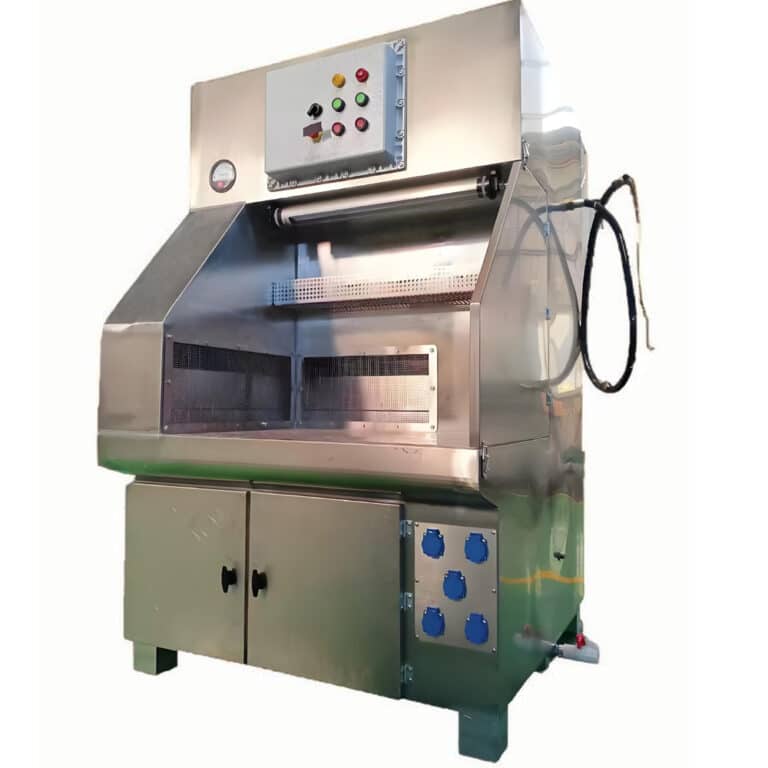
This is the information PORVOO can review against a project-specific grinding-table or dust-capture configuration, comparable to the arrangement described for an mesa de esmerilhamento com exaustão descendente para estação industrial de usinagem a seco/a úmido — but the review depends entirely on what the audit actually documents. A motion record without observed stream direction, or a stream observation without disturbance testing, leaves gaps a supplier cannot close by assumption. Equipment type, airflow, filtration, safety controls, and final performance remain subject to engineering confirmation against the specific inputs supplied, not against a general description of “grinding dust.”
Where the audit findings point toward a stable, process-generated stream direction with limited disturbance exposure, the packaged brief can support a more direct layout discussion. Where the findings show a shifting contact point, workpiece orientation changes, or disturbance sensitivity, the brief should say so explicitly rather than presenting a single preferred layout — because the layout comparison already showed that these are the conditions under which a fixed, simple arrangement stops matching the task. Documenting sources before sizing any collector follows the same logic: the equipment decision is only as good as the site and task information behind it.
Perguntas frequentes
Q: When should we compare a downdraft table with side or back capture for grinding?
A: Compare them using the real working zone and process-generated dust direction. A downdraft concept needs the task near an open extracted surface, while side or back capture needs a reliably directed stream and an operator position outside that contaminated path; both require project review of access and task fit.
Q: What if the dust direction changes as the operator rotates the workpiece?
A: Record the different orientations, contact points, tool strokes, dust paths, and operator positions instead of using one observation as the whole task. Discuss whether a fixed hood can cover that range or whether enclosure, movable, or on-tool concepts merit review.
Q: Can a layout observed with the workshop quiet be relied on during production?
A: Actual production disturbances still need observation. Arrange qualified assessment or airflow visualization with the task running, recording the effects of nearby fans, doors, windows, machine motion, and operator movement by operating state.
Q: What should we provide before asking for a grinding-table capture proposal?
A: Provide the material and process, tool motion, workpiece envelope and orientations, operator positions, observed dust direction, disturbance sources, access needs, operating pattern, and available space. Those inputs support a project-specific layout discussion before airflow, filtration, and performance are confirmed.