Choosing a ceramic filter plate by pore rating alone leaves the two outcomes that actually matter unanswered: what the filtrate will carry downstream, and how much work the cleaning cycle will demand to keep that performance intact. A plate grade that looks correct on a datasheet can still fail one of those tests once it meets the real slurry. Getting the selection right means starting from what the feed and the filtrate destination require, not from the plate specification sheet.
Start with Feed Particles and the Required Filtrate Destination
| Selection input | Project evidence to establish | How it guides the comparison |
|---|---|---|
| Feed particle distribution | Particle distribution for the intended slurry | Provides the basis for comparing particle retention across candidate plate grades |
| Filtrate destination and permitted solids carryover | Intended filtrate destination and the solids carryover permitted for that destination | Defines the filtrate outcome against which each candidate grade is assessed |
Plate porosity is a filtration boundary, not a fixed property of the equipment. A given pore structure will pass or retain particles differently depending on the distribution of particle sizes in the feed, how those particles are shaped, and how they tend to pack or bridge against the plate surface during cake formation. This is why selection has to begin with the feed particle distribution for the intended slurry rather than with a target pore size in isolation. Two slurries with the same average particle size can behave very differently against the same plate if their fine-particle fractions differ, because it is often the fine end of the distribution that determines whether a plate’s surface structure forms an effective retention layer or allows early breakthrough.
The second starting input is where the filtrate goes next. A filtrate returned to an internal process loop, one sent to a downstream treatment step, and one discharged under a compliance obligation can each carry a different permitted level of solids carryover. The same plate grade might be entirely adequate for one destination and inadequate for another, even though the feed slurry is identical. This means the acceptable carryover is not a property of the plate or the slurry alone — it is defined by what happens to the filtrate afterward, and that destination has to be established before any plate grade can be judged suitable or unsuitable.
Treating these two inputs as fixed before comparing plate grades avoids a common framing error: judging a plate by how clean the filtrate looks rather than by whether it meets the carryover the destination actually permits. A plate that produces a visually clear filtrate may still exceed a tight carryover limit for a sensitive downstream step, while a plate that looks less polished may be entirely acceptable where the filtrate returns to a tolerant internal loop. Establishing the particle distribution and the destination requirement first turns the plate comparison that follows into a defined technical question rather than a subjective one. Where the feed stream varies across production batches or campaigns, this first step also has to account for that variability, since a plate selected against one feed condition may not hold the same relationship to the carryover limit under a different feed condition.
Relate Candidate Plate Grades to Retention and Throughput
| Dimensão de comparação | Evidence from each candidate grade under the same slurry and operating conditions | Uso da decisão |
|---|---|---|
| Particle retention and filtrate outcome | Observed particle retention, solids carryover, or filtrate clarity | Compare the result with the permitted solids carryover for the intended filtrate destination |
| Taxa de transferência | Observed throughput | Show the throughput side of the grade-selection trade-off |
| Cleaning burden | Observed cleaning burden for the tested grade | Check whether a clarity gain is accompanied by a different cleaning burden |
Once the feed distribution and the filtrate requirement are established, candidate plate grades can be compared directly — but only if the comparison holds the slurry and operating conditions constant across candidates. Changing the slurry concentration, temperature, or vacuum level between tests on different grades makes the retention and throughput results incomparable, because those conditions influence cake formation and pore blinding independently of the plate itself. A matched comparison is what allows an observed difference in filtrate clarity or solids carryover to be attributed to the plate grade rather than to a shift in test conditions.
The central trade-off in this comparison is that a plate grade offering tighter retention does not automatically carry the same throughput as a more open grade. A finer pore structure can produce a cleaner filtrate by retaining more of the fine particle fraction, but that same structure can also increase resistance to flow through the forming cake, which shows up as reduced throughput under the same vacuum and cycle time. Where the filtrate destination permits moderate carryover, a more open grade may deliver adequate clarity while sustaining higher throughput, which can matter where production rate is the binding constraint. Where the destination requires tighter carryover, the finer grade may be the only one that qualifies, even if its throughput is lower, and the project then has to accept that trade or address it through other means such as cycle adjustment.
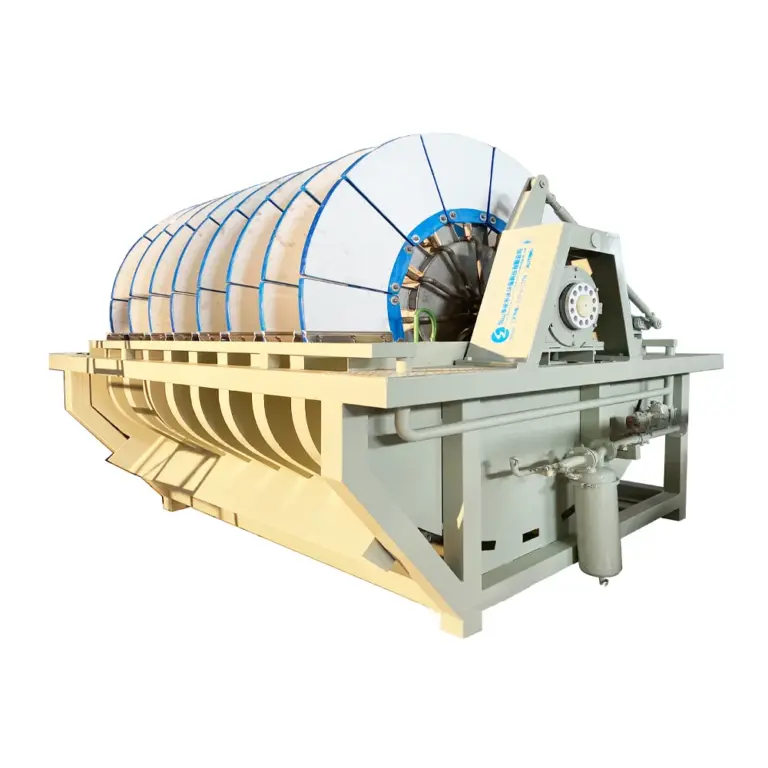
Cleaning burden is the third variable in this same comparison and cannot be assessed separately from retention and throughput. A plate grade that achieves strong initial retention can also be more prone to cake particles lodging within its surface structure, which raises the frequency or intensity of cleaning needed to sustain that retention over repeated cycles. A grade that trades some retention for a more open structure may clean more readily, recovering its throughput with less cleaning effort. This means the grade that looks best on a single clarity measurement is not necessarily the grade that performs best across a full operating cycle, and the comparison has to weigh retention, throughput, and cleaning burden together rather than selecting on the first result alone. Reviewing these interactions against the principles of vacuum ceramic disk filtration helps frame why pore structure, cake formation, and cleaning response are linked rather than independent variables.
Test Cleaning Recovery Under the Intended Slurry Conditions
| Comparison point | Evidence to record under the intended slurry conditions | Limite de interpretação |
|---|---|---|
| Clean baseline | Performance of the clean candidate plate under the intended operating conditions | Establishes the reference for later recovery checks |
| Loss before cleaning | Difference from the clean baseline | Establishes the extent of the loss but does not identify its cause |
| Result after repeatable cleaning | Recovery relative to the same clean baseline | Helps distinguish a cleanable loss from possible damage or end-of-life deterioration; it does not by itself prove the cause |
A plate grade’s retention and throughput figures from a single test cycle describe only its starting condition. What determines whether that grade remains suitable over time is how fully its performance recovers after cleaning, and that can only be judged against a defined clean baseline established under the plate’s intended operating conditions. Without that baseline, there is no fixed reference point against which later performance can be compared, and any observed change becomes difficult to interpret.
The logic of this check has three stages. First, the clean baseline is recorded for the candidate plate under the conditions it will actually run under — the same slurry chemistry, temperature, and cycle parameters it will see in service, since recovery behavior measured under different conditions does not necessarily predict recovery under the actual operating conditions. Second, performance is measured again before cleaning, and the difference from the baseline establishes how much the plate has lost over the preceding cycles. This loss figure on its own does not say why the loss occurred — it could reflect reversible fouling, structural change in the plate, or some combination of the two. Third, a repeatable cleaning step is applied and performance is measured again against the same baseline. Where the plate recovers close to its original baseline, the preceding loss is consistent with a cleanable condition. Where it does not recover, that gap points toward possible damage or progressive deterioration in the plate rather than a condition the cleaning step can reverse.
This sequence does not by itself identify the cause of an incomplete recovery; it only narrows where the explanation has to be sought. A plate that fails to recover after a properly applied cleaning step warrants a closer look at wear, chemical attack, or another form of deterioration, while a plate that recovers consistently across repeated cycles supports continued use of that grade under the tested conditions. Because this is a repeatable check rather than a one-time test, it also gives the operating team a basis for comparing performance over the plate’s working life, not just at the point of initial selection. Guidance on sustaining this kind of recovery over time is part of what ceramic vacuum filter maintenance practices are intended to address, since the cleaning step itself has to be applied consistently for the comparison to remain valid.
Confirm Chemical, Temperature, and Wear Boundaries with the Supplier
The retention, throughput, and cleaning recovery findings established so far all describe how a plate grade behaves under the conditions already tested. They do not establish the boundaries within which that behavior can be expected to continue, and those boundaries depend on factors the supplier is positioned to confirm for the specific plate material and grade under review.
Slurry chemistry is one such boundary. A plate material that performs well against one slurry composition may respond differently to a slurry with different chemical characteristics, particularly where the cleaning-agent chemistry used to restore the plate between cycles also interacts with the plate material itself. Confirming compatibility between the slurry, the plate material, and the cleaning agent avoids a situation where the cleaning step intended to recover performance instead contributes to gradual deterioration of the plate.
Temperature is a second boundary, since a plate’s structural and filtration behavior under one operating temperature does not necessarily hold at a different temperature, and slurries that vary in temperature across a process cycle may expose the plate to conditions beyond what a given grade was evaluated against.
Abrasive character of the slurry is a third factor, independent of chemistry and temperature. A slurry with abrasive particles can wear a plate’s surface structure progressively, changing its retention behavior over time even where the chemical and thermal conditions remain within bounds. This wear mechanism is distinct from the fouling and recovery behavior addressed through the cleaning baseline, and it changes the plate’s working life rather than its cycle-to-cycle performance.
Because these boundaries are specific to the plate material and configuration, confirming them is a matter for direct review with the supplier rather than something the project’s own test data alone can establish. This is also where the project information gathered through feed characterization, destination requirements, and matched test results becomes useful beyond the immediate selection decision — it gives the supplier the basis needed to evaluate the grade against its documented chemical, thermal, and wear boundaries as part of configuration and quotation review, rather than leaving that review to assumptions about typical conditions.
Approve the Plate Grade with a Baseline and Change-Control Record
| Approval record element | Project-specific record | Limite de decisão |
|---|---|---|
| Selected plate grade | [Plate grade] | Approval applies to the recorded grade |
| Feed and filtrate basis | [Feed particle distribution], [filtrate destination], and [permitted solids carryover] | Reassess the selection when this basis changes |
| Matched test basis | [Slurry and operating conditions used for the comparison] | Test results apply to the recorded conditions |
| Grade comparison findings | [Retention or filtrate result], [throughput result], and [cleaning recovery result] | Records the evidence used to balance the grade-selection trade-offs |
| Supplier-confirmed boundaries | [Slurry chemistry], [temperature], [abrasive character], and [cleaning-agent compatibility] | Use the grade within the confirmed boundaries |
| Clean baseline and recovery check | [Clean baseline] and [repeatable recovery check] | Supports later distinction between cleanable loss and possible damage or end-of-life deterioration |
| Change-control entry | [Changed condition and affected evidence] | Reassess the affected evidence before continuing the approval |
The selection work completed to this point produces a defined set of evidence: the feed and filtrate basis that set the initial requirement, the matched test conditions used to compare candidate grades, the retention, throughput, and cleaning recovery findings from that comparison, and the chemical, temperature, and wear boundaries confirmed with the supplier. Approving a plate grade means recording that evidence against the specific grade selected, so that the approval is traceable to the conditions under which it was established rather than treated as a general conclusion about the grade.
This record also has to specify what would require the approval to be reassessed. A plate grade approved against one feed particle distribution does not carry the same validity if the feed distribution shifts meaningfully, since the retention and throughput comparison was built on that original distribution. Similarly, a change to the filtrate destination, or a change to the permitted solids carryover for that destination, affects whether the previously approved grade continues to meet the requirement it was selected against. A change in slurry chemistry, operating temperature, or the cleaning agent used also falls within the supplier-confirmed boundaries, and operating outside those boundaries removes the basis for the earlier approval.
The clean baseline and its repeatable recovery check remain relevant after approval rather than only during the initial selection phase. As the plate continues in service, the operating team can apply the same recovery check against the recorded baseline to distinguish a cleanable loss from the kind of gap that points toward wear or deterioration, using the same logic established during the initial comparison. This gives the approval record an ongoing function: it is not only a record of why the grade was chosen, but also the reference against which later performance is judged.
Where any of these conditions change — the feed distribution, the filtrate destination, the slurry chemistry or temperature, or the plate’s recovery behavior relative to its baseline — the affected evidence should be reassessed before continuing to rely on the existing approval. A change in one input does not necessarily invalidate the entire record; a shift in filtrate destination, for example, affects the carryover requirement without necessarily changing the matched test basis, while a shift in slurry abrasiveness affects the wear boundary without changing the original retention comparison. Keeping the record structured by these distinct elements allows the project team to identify precisely which part of the approval needs to be revisited rather than repeating the full selection process whenever one operating condition shifts. The vacuum ceramic disk filter configuration ultimately selected, and its interface with the plate grade approved through this record, becomes the reference point for subsequent maintenance planning and any future reassessment the operating conditions require.
Perguntas frequentes
Q: Is the finest ceramic filter plate grade always the safest choice?
A: No. A finer grade should be judged by whether it meets the permitted solids carryover for the intended filtrate destination while providing an acceptable balance of throughput and cleaning burden. Compare candidate grades with the same slurry and operating conditions rather than selecting by porosity alone.
Q: What project information should be prepared before candidate plate grades are tested?
A: Prepare the feed particle distribution, intended filtrate destination, permitted solids carryover, and the operating conditions for the comparison. Also document slurry chemistry, temperature, abrasive character, and the intended cleaning agent so compatibility boundaries can be confirmed for the same proposed grade.
Q: When can test results for one candidate plate grade be applied to the project?
A: Apply them only to the slurry and operating conditions recorded for that comparison. If the feed, filtrate requirement, or test conditions differ from the actual project, repeat or extend the comparison before using those results as the approval basis.
Q: How can an operating team tell whether a performance loss is recoverable through cleaning?
A: Compare performance before and after a repeatable cleaning check against the same clean baseline. Recovery toward the baseline supports treating the loss as cleanable; incomplete recovery can indicate damage or end-of-life deterioration, but the check alone does not prove the cause, so the plate condition still needs to be evaluated.
Q: What changes should trigger a review of an approved plate grade?
A: Reopen the approval when the feed particle distribution, filtrate destination, permitted solids carryover, slurry chemistry, temperature, abrasive character, cleaning agent, or relevant operating conditions change. Record the changed condition and reassess the affected selection evidence before continuing under the existing approval.