Selecting the wrong clarifier geometry before civil work begins is one of the more expensive mistakes an industrial plant can make—not because the equipment itself is ruinously costly, but because short-circuiting and uneven feed distribution are nearly impossible to correct once concrete is poured. A center-feed circular tank that performs acceptably under steady municipal flow can lose sludge blanket stability quickly when industrial solids peaks or return streams from centrate or digester supernatant reach the inlet, and at that point the remediation options are limited to operational workarounds that rarely recover the full design capacity. The decision that prevents this is matching clarifier geometry to four specific operating facts—solids loading pattern, available footprint, sludge withdrawal style, and whether production expansion is planned within the same utility area—before any layout is committed to civil drawings. Working through those four factors in sequence is what allows a plant team to judge which layout genuinely fits, rather than defaulting to a form they have used before.
What changes when a clarifier is selected for industrial rather than municipal duty
Most secondary clarifiers in conventional municipal plants are sized for MLSS in the range of 1,800 to 4,000 mg/L. Industrial sites routinely exceed 10,000 mg/L, which means equipment specified against municipal loading figures is structurally mismatched before it processes a single batch. That gap is not a fine-tuning issue—it is a categorical difference in solids handling demand that changes which geometries remain viable and which ones will require compensating measures just to meet baseline effluent targets.
Two additional effects compound that loading discontinuity in ways that are largely absent from municipal design assumptions. Higher wastewater temperatures and longer transit times promote septicity: gas bubbles form, attach to settling solids, and keep those particles buoyant in the water column. The result is a reduced effective settling rate that a clarifier sized on standard hydraulic loading will not account for. Separately, recycle streams—digester supernatant, dewatering centrate, and waste activated sludge returns—feed fine particles and slow-settling solids back into the clarifier inlet, increasing the effective solids load beyond what the primary influent alone would suggest. Neither effect is universal; severity depends on specific plant configuration and how well return flows are managed. But both are plausible operational conditions that should appear on the design checklist for any industrial clarifier selection, not as edge cases but as expected contributors to peak load.
| Factor de proiectare | Municipal Typical | Industrial Challenge | Impact on Clarifier Selection |
|---|---|---|---|
| MLSS (Mixed Liquor Suspended Solids) | 1,800–4,000 mg/L | Often exceeds 10,000 mg/L | Overloads secondary clarifiers sized for municipal loads; requires higher solids handling capacity |
| Septicity Risk | Low; steady flows and cooler temperatures | Elevated temperature, long transit time promote septicity; gas bubbles attach to solids, reducing settling rate | Clarifier must account for potential floating solids and reduced settling efficiency |
| Recycle Streams | Minimal or well‑managed return flows | Digester supernatant, dewatering centrate, waste activated sludge loads return fine particles and slow‑settling solids | Increases effective solids loading; clarifier must handle compounded load from side streams |
The practical implication is that specifying a clarifier by referencing a municipal installation—even a recent, well-documented one—offers limited protection when the industrial site carries solids loads three to five times higher. The clarifier geometry, the sludge withdrawal mechanism, and the feed distribution arrangement all need to be re-evaluated against industrial operating conditions rather than borrowed from a different duty class.
How circular, rectangular, and lamella layouts behave under different loads
Circular clarifiers span a wide dimensional range—10 to 300 feet in diameter, up to 16 feet deep—and can handle large hydraulic flows within conventional detention times. Rectangular clarifiers are narrower, rarely exceeding 10 feet wide though reaching up to 20 feet deep, and their modular geometry makes it easier to add length incrementally. Lamella and tube settler configurations work differently: rather than providing large tank volume, they multiply the effective settling surface area within a compact footprint, enabling residence times under 10 minutes and settling capacities two to four times higher than a conventional open basin of comparable plan area. That multiplier is a design reference for application boundary decisions, not a guaranteed outcome independent of influent characteristics and floc quality, but it signals clearly where lamella becomes preferable—specifically in footprint-constrained sites and where the influent contains colloidal or difficult-to-treat solids.
The operating ranges for primary clarifiers are reasonably well established as practitioner sizing references: detention time should fall between one and two hours, and surface loading rate should stay within 300 to 1,200 GPD per square foot. Operating below the detention minimum produces solids carryover to downstream processes. Operating above it—particularly in cold weather—can increase septicity and strip heat from the liquid, degrading settling performance in a different direction. Cold-weather operations typically respond by placing additional clarifiers in service to keep the loading rate within range, which means the number of units in a plant’s design has seasonal as well as hydraulic implications. Secondary clarifiers carry a distinct parameter: a solids loading rate target of 12 to 30 pounds per day per square foot. This is the figure most likely to be exceeded when industrial MLSS values push above 10,000 mg/L, and it is the value that should be recalculated first when an industrial plant is evaluating whether a municipal-reference design will hold up.
| Layout | Dimensiuni tipice | Loading Capacity & Behaviour | Footprint & Suitability |
|---|---|---|---|
| Circular | 10–300 ft diameter, up to 16 ft deep | Conventional detention (1–2 h for primary); handles large hydraulic flows | Large footprint; suitable where space is not constrained |
| Rectangular | ≤10 ft wide, up to 20 ft deep | Conventional detention (1–2 h for primary); modular, easier to extend length | Efficient use of narrow sites; lends itself to phased expansion through incremental additions |
| Lamella/Tube Settlers | Add‑on to rectangular or circular basins; small footprint | Residence time under 10 min; increases settling capacity 2–4×; handles difficult‑to‑treat colloidal waters | Extremely compact; ideal for footprint‑constrained retrofits and high‑rate treatment |
Each layout’s behavior outside those ranges has a different downstream consequence. A circular clarifier operating with short detention under high solids load will pass suspended material forward to secondary treatment or filtration, increasing load on those units. A lamella pack operating on influent that has not been adequately coagulated may experience uneven floc distribution across the inclined surfaces, partially negating the capacity advantage. The layout choice and the upstream process design cannot be evaluated independently.
Where footprint and retrofit constraints should override preference
Layout preference should give way to site geometry when the available footprint is fixed or when production already occupies the area surrounding the existing clarifier basin. At that point, the relevant question shifts from which layout is theoretically optimal to which layout can physically fit and which retrofit path avoids new tank construction.
Tube settlers can be installed inside an existing rectangular clarifier to increase settling capacity without expanding the tank envelope. The inclined surfaces multiply the effective settling area within the existing plan area, converting a conventionally loaded clarifier into a higher-rate unit at relatively low civil cost. For existing rectangular basins with widths between 12 and 30 meters, a travelling bridge clarifier can typically be retrofitted with limited modification, preserving the basin structure while updating the sludge collection mechanism. These are not universally preferred solutions—they depend on the condition of the existing basin, the influent characteristics, and whether the basin geometry is compatible with the retrofit hardware. But when footprint expansion is genuinely not an option, these paths allow meaningful capacity increases without committing to a new-tank greenfield construction program.
The mistake pattern here is that footprint and phased expansion constraints tend to enter the design conversation late, after a layout has already been discussed with a vendor or sketched into a site plan. By the time site limitations are formally acknowledged, the project team has often already developed some attachment to a particular geometry. Introducing the tube-settler or travelling-bridge option at that stage feels like a compromise rather than the lower-cost, lower-civil-risk path it actually represents. The better sequence is to put footprint constraints and five-year expansion projections on the table before any layout discussion begins, so that retrofit-compatible geometries are evaluated on equal terms with new-tank options from the start.
For sites where space is genuinely at a premium and the vertical dimension is more available than the horizontal, a Turn vertical de sedimentare pentru reciclarea apelor reziduale offers a compact alternative that consolidates the settling function within a small plan footprint—a configuration explored in more detail in The Complete Vertical Sedimentation Tower Guide for Industrial Wastewater Recycling.
Why sludge blanket control matters as much as tank geometry
A clarifier can be correctly sized, correctly fed, and still produce poor effluent if the sludge blanket is not actively managed. The failure sequence is consistent: an unmonitored blanket accumulates, solids at the base transition into anaerobic conditions, gas is generated, and bubbles attach to settled particles and lift them back into the water column. What the discharge meter then records as a clarifier performance failure is actually an operational neglect problem—one that is invisible until effluent quality degrades and that is difficult to reverse quickly once the blanket becomes deeply anaerobic and begins generating gas at volume.
Feed geometry affects how reliably the blanket can be controlled in the first place. Center-feed clarifiers present a higher short-circuiting tendency: flow moves radially outward from the inlet toward the effluent weir, and any hydraulic perturbation—a solids peak, a recycle stream pulse, a change in influent temperature—can disrupt that radial pattern and create preferential flow paths that destabilize the blanket. Comparative testing of peripheral-feed spiral clarifiers has found settling performance two to four times better than center-feed configurations. That figure reflects a design benchmark from comparative evaluation, not a certified standard, but the underlying mechanism is sound: a spiral flow path distributes the feed more evenly across the basin, reduces the tendency to short-circuit to the outlet, and keeps the blanket more stable under variable loading conditions.
| Feed Geometry | Short‑Circuiting Tendency | Stabilitatea păturii de nămol | Relative Settling Performance |
|---|---|---|---|
| Center‑feed | Higher; flow short‑circuits to outlet more easily | Less stable, prone to disturbance | Baseline reference |
| Peripheral‑feed spiral | Lower; spiral flow path improves distribution | More stable, resists short‑circuiting | 2–4 times better (testing confirms) |
The operational implication is that blanket monitoring should be treated as a required process control step, not an optional maintenance check. Plants that rely on periodic visual inspections—or worse, on effluent TSS as a lagging indicator—are giving the blanket permission to deteriorate before corrective action is triggered. At industrial sites with variable production schedules and solids loads that can shift within a single shift, that lag time can be long enough to allow a recoverable blanket situation to become a serious carryover event.
How dosing strategy and clarifier choice must be reviewed together
Coagulation and flocculation dosing are usually treated as upstream process steps that precede the clarifier. The more useful framing is that dosing strategy and clarifier geometry together determine the effective treatment capacity of the system—and that selecting them independently introduces risk that neither the equipment supplier nor the chemical supplier will necessarily flag.
Coagulant and flocculant dosing causes fine particles to aggregate into denser, faster-settling flocs. When done correctly, this directly expands the effective solids handling capacity of the clarifier—particularly relevant for industrial sites where MLSS and recycle stream loads can push beyond the clarifier’s nominal design range. Chemically enhanced primary treatment using a metal salt combined with an anionic polymer can push BOD and TSS removal beyond conventional primary clarifier rates, which in principle allows either a smaller clarifier layout or an existing clarifier to handle a higher effective load. But this only holds if the internal hydraulics of the clarifier allow uniform floc contact throughout the basin. A clarifier selected without reviewing the dosing plan may require higher chemical spend, produce inconsistent effluent quality under variable loads, or both—despite appearing to meet its nominal sizing criteria on paper.
The internal design of the clarifier also affects how efficiently the dosing works. An intermediate diffused wall improves flocculant concentration uniformity across the basin cross-section, which reduces the dosage required to achieve equivalent floc formation and helps prevent zones of excess or deficit chemical concentration that produce uneven settling. This is an implementation-level detail, but it illustrates the broader point: the clarifier is not a passive vessel that receives whatever the upstream dosing system delivers. Its internal geometry actively shapes how well the chemistry performs.
| Interplay Point | How It Affects Clarifier Performance | Clarifier Design Implication |
|---|---|---|
| Coagulation/flocculation dosing | Forms denser flocs that settle faster; determines whether clarifier can handle peak solids loads | Clarifier hydraulic and solids capacity must align with expected dosed floc characteristics |
| Chemically enhanced primary treatment (metal salt + polymer) | Boosts BOD and TSS removal beyond conventional primary rates, effectively raising throughput | May allow use of a smaller clarifier layout or enable existing unit to handle higher loads |
| Intermediate diffused wall | Improves concentration uniformity of flocculant, reducing dosage needed and preventing excess regional density | Internal clarifier design feature that lowers chemical cost and enhances settling consistency |
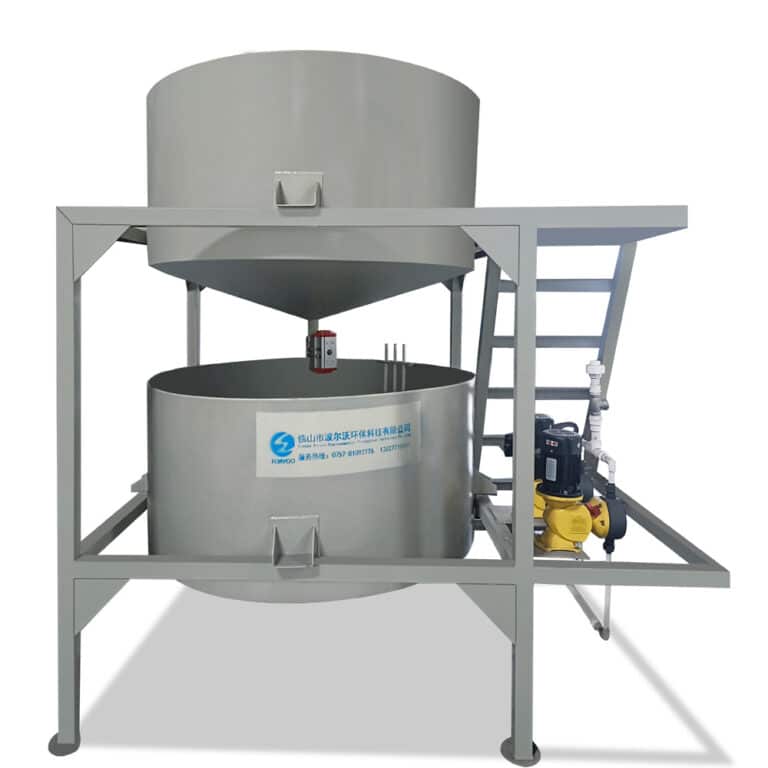
A practical review check before finalizing clarifier selection is to ask whether the dosing strategy has been defined at the level of reagent type, dosing point, and expected floc characteristics—and whether those characteristics have been factored into the hydraulic loading assumptions for the clarifier. If the answer to either question is no, the clarifier selection is resting on incomplete assumptions. An Intelligent Chemical Dosing System that adjusts reagent delivery in response to real-time flow and load conditions reduces the risk that a dosing mismatch undermines clarifier performance after commissioning.
Which clarifier path best fits staged factory expansion
Phased expansion creates a specific planning constraint that standard clarifier selection criteria do not address well: the system must be right-sized for current production, but also capable of being extended or upgraded without rebuilding foundational civil infrastructure. A circular clarifier is difficult to expand—its geometry is fixed at pour, and adding capacity means adding a separate new unit. Rectangular clarifiers are structurally more amenable to staged growth: length can be added incrementally, and travelling bridge designs can be retrofitted into any existing rectangular basin in the 12 to 30 meter width range with limited modification. Neither approach requires committing to full build-out capacity at the start of the project.
The tube settler retrofit path offers the clearest low-civil-work upgrade option for plants that already have a clarifier in service and need more throughput without new-tank construction. Installing lamella packs inside an existing clarifier can increase settling capacity two to four times—again, a design reference figure rather than a guaranteed multiplier, and one that depends on the condition of the existing basin and the influent characteristics. But for a plant facing a production expansion within the same site footprint, the option to avoid new-tank construction while achieving a meaningful throughput increase is a significant lifecycle cost advantage that should be formally compared against greenfield options rather than dismissed as a secondary choice.
Package treatment plants that integrate coagulation, flocculation, and clarification in a compact single unit offer a third path suited to new factory additions where the expansion area is limited and the timeline requires a modular, plug-and-play approach rather than a phased construction program. These units add discrete capacity increments without disrupting the existing treatment train during installation.
| Expansion Path | How It Works | Creștere tipică a debitului | Civil‑Works Requirements | Best‑Fit Situation |
|---|---|---|---|---|
| Incremental rectangular / travelling bridge | Add length to existing rectangular basins or retrofit travelling bridge into any rectangular basin 12–30 m wide | Scalable by length (no fixed multiplier) | Low; uses existing basin footprint, phased construction | Plants with existing rectangular clarifiers and available length extension space |
| Package treatment plant | Compact unit integrating coagulation, flocculation, and clarification | Modular capacity addition; suited for phased factory expansions | Minimal footprint; modular, plug‑and‑play addition | New factory expansions where space is tight and staged growth is planned |
| Tube settler retrofit to existing clarifier | Install lamella packs inside an existing clarifier to increase settling surface | 2–4 times settling capacity increase | Low civil works; no new tank required | Any existing clarifier where additional hydraulic or solids capacity is needed without expanding footprint |
The site condition and expansion priority that most clearly distinguishes between these paths is whether the existing basin and its geometry are assets or constraints. If the existing rectangular clarifier can accept length extension or a tube settler retrofit, it is an asset that substantially reduces the civil cost of expansion. If the existing geometry is incompatible with either approach, or if the site has no existing clarifier basin, then a package unit or a new circular tank should be evaluated on equivalent terms.
The core judgment this selection process requires is distinguishing between what a clarifier layout can do under ideal conditions and what it will reliably do under the actual operating profile of the plant—including solids peaks, recycle stream pulses, chemical dosing variability, and seasonal temperature effects. Those factors should be quantified, or at minimum bounded, before a geometry is committed to civil drawings, because the cost of correcting feed distribution or blanket management problems after concrete is poured is rarely proportional to what it would have cost to address them in the design phase.
Before finalizing any clarifier selection, confirm three things: that the solids loading figures used in sizing account for recycle stream contributions and not just primary influent; that the dosing strategy has been defined to the point where expected floc characteristics can be cross-checked against the clarifier’s hydraulic assumptions; and that footprint constraints and five-year production projections have been formally evaluated against retrofit-compatible layouts before a new-tank option is adopted by default. That sequence does not guarantee an optimal outcome, but it closes the gaps where the most common and most expensive clarifier selection errors tend to enter.
Întrebări frecvente
Q: What happens if the influent solids characteristics change significantly after the clarifier is commissioned—can the geometry be adapted?
A: Adaptation options are limited once concrete is fixed, which is precisely why the design phase must account for realistic operating ranges rather than steady-state averages. If solids load increases beyond the original design envelope, the most practical retrofit paths are adding tube settlers inside an existing rectangular basin to multiply settling area, or adjusting dosing strategy to improve floc density and settling rate—neither of which requires new tank construction. Circular tanks offer fewer retrofit options because their geometry does not easily accommodate internal packing or length extension, making them a higher-risk choice on sites where influent characteristics are expected to shift.
Q: At what point does a lamella layout stop outperforming a conventional circular or rectangular clarifier?
A: Lamella’s capacity advantage depends on adequate upstream coagulation producing well-formed, dense flocs. When influent contains high concentrations of poorly conditioned solids—stringy fibrous material, oils, or solids that resist flocculation—floc distribution across the inclined surfaces becomes uneven and the 2–4× settling multiplier can erode significantly. Lamella also becomes less practical when detention time requirements exceed what the compact volume can provide, or when sludge withdrawal from inclined pack geometry conflicts with the plant’s existing dewatering equipment and maintenance capability.
Q: Is it worth paying for peripheral-feed spiral clarifier geometry over a standard center-feed design if the plant already has strong blanket monitoring in place?
A: Yes, for variable industrial loads. Active blanket monitoring reduces the lag time before corrective action, but it does not eliminate the short-circuiting tendency that center-feed geometry creates under hydraulic perturbations such as solids peaks or recycle stream pulses. Peripheral-feed design distributes influent more evenly across the basin cross-section, which keeps blanket stability less dependent on continuous operator intervention. On a plant with highly variable production schedules or frequent recycle stream contributions, the geometry advantage is structural rather than operational—monitoring compensates for blanket drift but cannot compensate for flow paths that are biased toward the outlet from the start.
Q: Should clarifier sizing be recalculated from scratch if the plant adds a dewatering centrate or digester supernatant return stream after the original design is complete?
A: Yes, recalculation is warranted. Return streams introduce fine, slow-settling particles that increase the effective solids load at the clarifier inlet beyond what the primary influent figures alone would predict. The surface loading rate and solids loading rate assumptions in the original design may both need to be revisited, and if the recalculated values exceed the 12–30 lbs/day/sq ft secondary clarifier threshold, the options are either compensating through enhanced dosing or evaluating a tube settler retrofit before the return stream is brought online—not after effluent quality degrades.
Q: How should a plant team decide between a package treatment unit and a rectangular clarifier extension when adding capacity during a phased factory expansion?
A: The deciding factor is whether the existing basin is a usable asset. If the current rectangular clarifier can accept length extension or a tube settler retrofit within the existing footprint, extending it avoids new civil construction and preserves the existing sludge withdrawal and dosing infrastructure—a lower lifecycle cost path. A package unit is the better fit when the expansion area is physically separate from the existing treatment train, the timeline requires modular installation without disrupting current operations, or the existing basin geometry is incompatible with retrofit hardware. Comparing these options on civil cost, installation disruption, and five-year throughput needs—rather than on unit equipment price alone—is the step most teams skip and most regret later.